
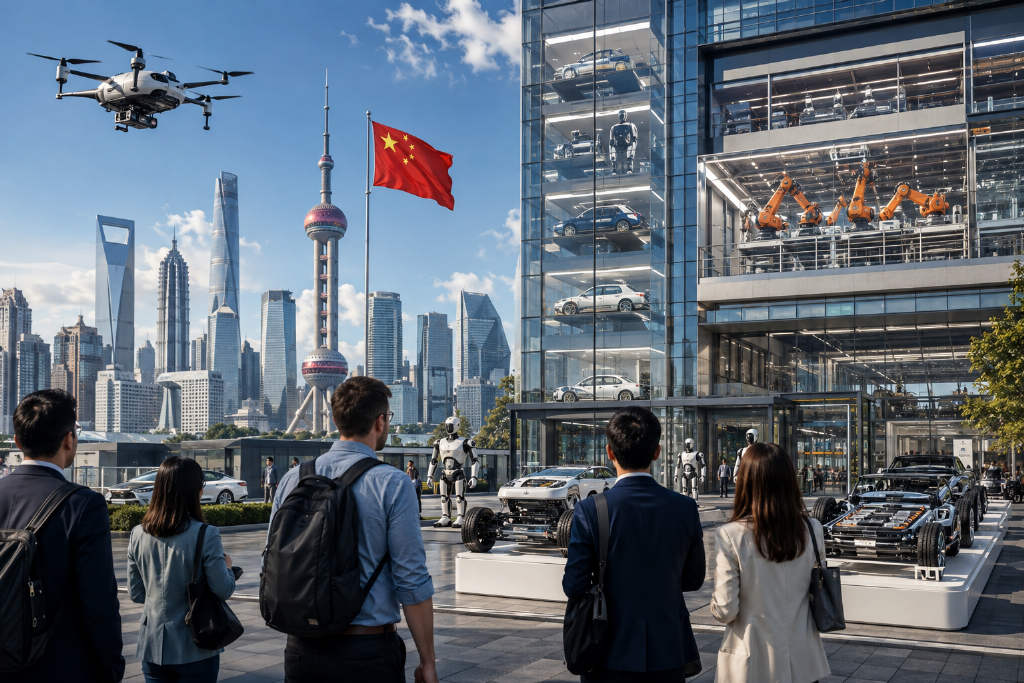
Twenty years ago, Chinese entrepreneurs visiting the United States typically treated Silicon Valley as a must-stop destination. They went to Google to study the internet, to Apple to study products, to Stanford to study innovation, and to Sand Hill Road to study venture capital.
At the time, the global division of labor in technology looked straightforward: the United States invented, China manufactured.
That direction is now starting to reverse. A Sept. 3 Reuters report, as cited in the article, said a rising number of overseas investors, startup founders, and corporate executives are making dedicated trips to Shenzhen, Hangzhou, Shanghai, Beijing, and Hefei to visit Chinese companies in artificial intelligence, robotics, electric vehicles, and advanced manufacturing. The flow is no longer limited to scattered individual visits. It is becoming a business in its own right.
Baiguan, a Shanghai research firm, charges as much as $15,000 for a five-day tech tour. Another Shanghai-based tech tour group, GloPen, said inquiries in 2026 rose 50%, with clients mainly coming from Europe and Singapore. It now organizes more than 100 one-day corporate visits each month. Even factory tours themselves have become scarce. Xiaomi’s Beijing auto plant has hosted more than 250,000 visitors since March 2024, and some tour slots obtained through a lottery system have reportedly been resold online for RMB 2,000.
These visitors are not flying into China just to walk through an ordinary factory. The question they want answered is why Chinese tech companies move so fast.
China manufacturing is being re-evaluated
For decades, the most common label attached to Made in China was cost. Cheap labor, vast factory capacity, and an export-oriented system turned the country into the world’s factory floor. The article argues that using "low-cost manufacturing" as the main framework for understanding Chinese industry is now badly out of date.
One figure illustrates the shift. In the mid-1990s, China accounted for roughly 5% of global manufacturing output. Today, that share is close to 30%. In practical terms, nearly one out of every three dollars of manufacturing output worldwide now comes from China.
The change is not only quantitative. It is structural. China once exported clothing, shoes, toys, and home appliances in large volumes. More important export products now include new energy vehicles, power batteries, solar, drones, industrial robots, and smart hardware.
The article frames this as a major upgrade: China manufacturing is moving from being a cost center to becoming innovation infrastructure.
Electric vehicles show how dense supply chains shorten development cycles
Electric vehicles are presented as the clearest example. In 2025, the world produced nearly 22 million EVs, and about 16 million of them were made in China, equal to close to three-quarters of global EV output.
China also holds more than 80% of global battery cell capacity, about 85% of cathode material capacity, and more than 90% of anode material capacity. That means a large portion of the core supply chain behind an EV company can be found inside China.
In the article’s view, the key result is not simply lower prices. It is faster iteration. A five- or six-year vehicle development cycle used to be normal. In China’s EV market, the pace of competition has become difficult for many traditional automakers to match. Consumer demand changes, companies revise products, suppliers adjust at the same time, and updated models return to market quickly.
That is why the more important question, the author argues, is not why Chinese cars are cheap, but why Chinese automakers can iterate so quickly.
Robotics in factories create a data-and-cost flywheel
The article then shifts to robotics. In 2024, 54% of all newly installed industrial robots in factories worldwide were installed in China. The country added about 295,000 industrial robots in one year. Put another way, more than one out of every two newly added industrial robots globally went into Chinese factories.
The total number of industrial robots operating in Chinese factories has already exceeded 2 million.
The article says these figures matter more than the robot stunts that circulate on short-video platforms. AI and robotics become industrial forces not on stage, but on factory floors through welding, handling, sorting, assembly, quality inspection, and logistics.
Those settings generate real operating data every day and expose engineering flaws every day. That creates a flywheel: robots enter factories, gather real data, expose engineering problems, supply chains improve, costs fall, more factories adopt the systems, and even more data comes back into the loop.
The author breaks the process into three separate questions:
- Labs answer whether something can be done.
- Industry answers whether it can be done 100,000 times a day.
- Capital ultimately asks whether it can be done 1 billion times at low enough cost.
The distance between those questions is not a small technical gap. It is an entire industrial system.
What Shenzhen offers is industrial density
The article says Shenzhen has become one of the core destinations in this new wave of overseas tech visits because what matters there is not just a single company, but the industrial density behind it.
To build a robot, a company needs chips, cameras, lidar, sensors, motors, reducers, screws, batteries, structural parts, molds, control systems, software, contract manufacturers, testing equipment, and logistics. If those suppliers are spread across five countries, a design revision can mean weeks of communication. If they are concentrated inside one dense network, an engineer can discover a problem in the morning, meet a supplier in the afternoon, produce a new sample in a matter of days, switch materials if costs are too high, revise molds if structures do not work, and launch a second-generation product soon after the first reaches customers.
What Shenzhen has built, the article argues, is not a simple supply chain. It is a large-scale "technology time compressor."
Drones are used as the sharpest example. Shenzhen has more than 1,500 drone-related companies. Companies in the city once accounted for about 74% of the global consumer drone market. DJI, also based in Shenzhen, holds an estimated 70% to 80% share of the global non-military, non-government drone market, according to industry research cited in the article.
The concentration is not explained only by the rise of DJI. It is also because the capabilities drones require — motors, batteries, cameras, image transmission, chips, structural parts, gimbals, software, and precision manufacturing — are already embedded in the local industrial network.
The article’s point is that a great company does not always create an entire supply chain. In many cases, a dense industrial network makes it easier for great companies to keep emerging.
China is described as an "industrial compression field"
The author uses the phrase "industrial compression field" to describe the capability now taking shape in China’s technology sector. It refers to compressing technology, engineers, supply chains, manufacturing, capital, markets, and application scenarios into one highly concentrated industrial network.
The article is careful not to claim superiority across every category. The United States still has many of the world’s strongest universities, a powerful base in fundamental research, leading AI chip companies, and Silicon Valley’s large venture network. What makes China distinctive, the article says, is that a large number of tech inputs are becoming physically close to one another.
That proximity creates multiplier effects. Car companies need batteries. Battery makers need materials. Materials producers need energy. Robots need motors, sensors, and batteries. Drones need chips, vision, and communications. AI needs servers, and servers need chips, power, and data centers. Different industries begin feeding one another. Technology development no longer moves only in a straight line down one supply chain. It cross-pollinates through a broader industrial web.
That is why, in the author’s telling, the most important question about China today is no longer tied to any single company. It is why so many industries can evolve so quickly at the same time in the same place.
Tesla’s Shanghai factory remains a key case study
The article also points to Tesla’s Shanghai gigafactory as a classic case for understanding China’s supply-chain strength. Many observers used to explain the plant through a simple idea: China is a large market. The author says the more important point is the industrial role it later took on.
The Shanghai factory does not only serve the domestic market. It has become a major export base in Tesla’s global system. By the second quarter of 2026, more than half of the vehicles produced at Tesla’s Shanghai factory were exported.
One of the most representative American technology car companies turned its China plant into a key production node serving Europe, Asia-Pacific, and other markets. The underlying explanation still comes back to the same words: supply chain, efficiency, scale, and industrial clustering.
The article uses this example to show why "decoupling" is more complicated than political slogans suggest. A factory can be moved. But the hundreds of suppliers around it, the tens of thousands of engineers, the logistics system, the mold-making system, the materials base, and the engineering experience accumulated over decades cannot simply be duplicated on command. The most valuable asset is not the building itself. It is the invisible industrial coordination network behind it that keeps improving efficiency.
AI’s physical phase raises the value of manufacturing
The piece then addresses a common question: if this is the AI era, should algorithms not matter most? The answer given is the opposite. The further AI develops, the more important manufacturing may become.
Over the past two decades, the internet revolution largely unfolded in the digital world. Google, Facebook, TikTok, and WeChat are fundamentally software products. Software has near-zero replication cost. Once built, an app can spread to hundreds of millions of users quickly.
But the next stage of AI is moving into what the article calls Physical AI: robots, autonomous driving, drones, AI glasses, smart vehicles, smart factories, energy storage systems, and AI terminals. Once artificial intelligence gains a body, the requirements change completely.
AI no longer needs only GPUs. It also needs motors, reducers, sensors, batteries, cameras, materials, factories, and supply chains. As of 2024, more than 4.7 million industrial robots were already operating worldwide, and more than 500,000 more were being added every year. China accounted for more than half of annual new industrial robot installations globally.
That leads to the article’s broader argument: the first half of AI may happen in servers, but the second half may play out in factories. If that is the case, the manufacturing capabilities China built over the past several decades take on a different strategic meaning.
Capital may need to reprice industrialization capability
From an investor’s perspective, the article says the change goes even deeper. The traditional question in technology investing has been: how far ahead is your technology? That will still matter. But another question may become just as important: how fast can you industrialize it?
AI lowers the cost of spreading knowledge. A model that leads by six months may be caught quickly. An algorithm that leads by a year may not create a moat that lasts a decade. Many technical breakthroughs can also be understood and copied by engineers around the world in short order.
That means the harder things to replicate may become the heavier ones: supply chains, engineering experience, manufacturing capability, industrial clusters, customer networks, application scenarios, and scale. They may look less glamorous than a new AI model, but the article argues they can form a tougher moat.
BYD is cited as an example. In August 2026, BYD’s global sales reached about 440,000 vehicles, up 17.8% year over year. Its overseas sales for the month reached about 189,000 vehicles, up more than 134%. In the first half of 2026, BYD also recorded a notable shift for the first time: overseas revenue exceeded domestic China revenue.
The author sees this as a sign that Chinese technology manufacturers are entering a new phase. The sequence has gone from China production with global brands selling, to Chinese brands producing and selling into China, and now toward Chinese brands, Chinese technology, and Chinese supply chains selling into global markets.
The article does not claim China has won every race
The piece also makes a point of drawing a boundary. Foreign visitors coming to China to study technology does not mean China has comprehensively surpassed the United States.
The United States still controls many of the most advanced core intellectual property assets, has the world’s strongest group of technology companies, elite university systems, venture-capital networks, and powerful basic research capabilities. China still has clear gaps in high-end AI chips, foundational software, some scientific instruments, original algorithms, and frontier research.
The article notes that even participants in the Reuters-referenced China tours acknowledged that non-Chinese technology companies still hold large shares of global markets, the most advanced intellectual property, and enormous profits.
So the issue is not who has already won. The issue is that the scorecard for global technology competition may be changing. Papers, patents, laboratories, and top companies still matter. But another measure may need to be added: industrialization speed. Leading technology remains important, yet more and more commercial value may depend on whether that technology can become a stable, repeatable, scalable product in a short enough period.
The next contest may center on technology time
Near the end, the article reduces the argument to a single variable: time. The first industrial revolution competed over machines. The second competed over electricity and mass production. The information revolution competed over chips and software. The internet era competed over traffic and network effects. The AI era, the author argues, may end up competing over a more abstract resource: time.
Who can train models faster, manufacture chips faster, build data centers faster, produce robots faster, lower costs faster, and put a technology in front of 100 million users faster? The competitive advantage in each case may depend on the same measure: how long it takes to move from technical emergence to large-scale commercial application.
China’s greatest advantage in the past was cost, the article says. In the future, the more important advantage may gradually become speed. That speed does not come from intensity alone. It comes from an industrial system acting together.
If a country can keep shortening the cycle from identifying a problem to building a product and then scaling it, it is effectively competing for a new factor of production: technology time. The side that compresses technology time more effectively may be the side that forms scale advantages first in the next industrial cycle.
Why the world is coming to China
Viewed through that lens, the foreign investors and entrepreneurs flying to Shenzhen, Hangzhou, and Shanghai are not really trying to study just one robot, one EV, or even one star company.
They are trying to understand why all of these things are happening so densely and at the same time in China. Why can robots be mass-produced so quickly? Why can EVs iterate so fast? Why did drones form a full supply chain? Why can a hardware founder find suppliers so quickly? Why can a new technology reach a real market and face real testing so fast?
The answer offered by the article is that China is evolving from the world’s factory into a vast industrial laboratory.
In the past, the world sent design blueprints to China and China manufactured the products. A new possibility is now taking shape: research, design, engineering, manufacturing, market feedback, and iteration are starting to form a closed loop in the same place. Once that loop is in place, manufacturing is no longer just the last step of innovation. Manufacturing itself starts taking part in innovation.
The article closes by saying that two decades ago, Chinese entrepreneurs went to Silicon Valley to learn how to create the future. Today, more and more people are coming to China to study how to turn the future into reality more quickly.
The piece was originally published on the WeChat public account "Lingxiao - Technology Investor" and written by Lingxiao.