
WuBlockchain’s WhiteLine Daily pulled together a set of developments across equity regulation, corporate fundraising and AI infrastructure demand, arguing that capital markets and technology companies are facing pressure from several directions at once.
FT report says China regulators asked for an IPO pause and a halt to major shareholder sell-downs
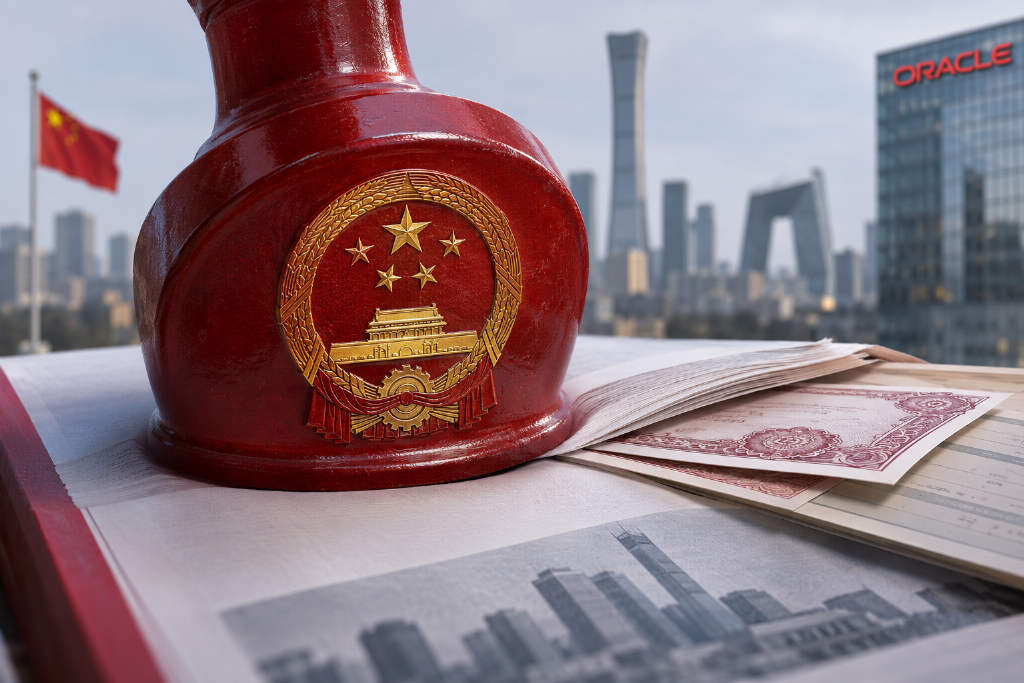
According to the Financial Times, which cited people familiar with the matter, the China Securities Regulatory Commission recently held meetings with investment banks and used informal “window guidance” to ask for a pause in initial public offerings and large stock sales by existing shareholders until the market regains stability.
The report said China’s IPO fundraising this year has topped RMB 292 billion, the highest level since 2023. It also noted that regulators had already taken steps including curbs on share sales and encouragement for stock buybacks. The reported pause has not been formally confirmed by regulators.
WuBlockchain said that if the arrangement is implemented, companies would face delays in listing-related fundraising and shareholders would see exits pushed back, while near-term funding demand tied to new listings and large sell-downs would also fall.
Oracle prices about $20 billion in stock and debt
Cloud computing and enterprise software company Oracle said it has priced roughly $20 billion in common stock and senior notes, with about $10 billion coming from equity and about $10 billion from debt.
Oracle plans to issue about 86.21 million common shares at $116 per share. The bond offering is split into five tranches with maturities ranging from 2029 to 2046 and coupons between 7% and 8.65%. The 2046 notes carry a principal amount of $1.5 billion and a coupon of 8.65%.
After underwriting discounts and offering expenses, the stock sale is expected to generate about $9.9 billion in net proceeds, while the bond sale is expected to bring in about $10 billion in net proceeds. Oracle said the funds are intended for general corporate purposes, which may include capital expenditures, debt repayment, investment acquisitions, dividends and share repurchases. The two offerings remain subject to closing, and neither depends on the completion of the other.
WuBlockchain said the financing adds both equity dilution and new interest expense, with the cost of funding Oracle’s cloud infrastructure expansion already visible in the deal terms.
Palantir’s U.S. commercial revenue tops U.S. government revenue for the first time
Data analytics and AI software company Palantir reported third-quarter results showing U.S. commercial revenue rose 148% year over year and 29% from the prior quarter to $984 million, exceeding U.S. government revenue of $953 million for the first time.
Total revenue increased 96% year over year to $2.313 billion. On a U.S. GAAP basis, operating income came in at $1.085 billion, with an operating margin of 47%.
During the quarter, the total value of signed U.S. commercial contracts reached $1.463 billion, up 11% from a year earlier. Remaining deal value in the U.S. commercial segment rose 79% to $6.517 billion.
Palantir also raised its full-year revenue guidance to $8.530 billion to $8.534 billion and said it expects full-year U.S. commercial revenue to exceed $3.559 billion, representing growth of at least 143%.
WuBlockchain said the quarter marked the first time revenue from U.S. enterprise customers surpassed revenue from U.S. government customers, increasing the contribution of the commercial business to the company’s top line. It added that future growth will depend on whether new orders and contract execution continue to support the pace of expansion.
FT says Nvidia asked cloud providers to sell at least 51% of services to non-Chinese companies
The Financial Times, again citing people familiar with the matter, reported that Nvidia has verbally told cloud computing customers through its sales and regional teams to reduce exposure to Chinese companies and ensure that at least 51% of services are sold to non-Chinese companies.
The reported requirement applies to future contracts and does not affect existing leasing agreements. The report said some Chinese AI companies have been renting overseas cloud services to use advanced chips located outside China for model training and related tasks.
One Singapore-based cloud provider told the FT that it is difficult to find enough non-Chinese customers outside the United States, and that strict enforcement could affect its business. The Information, however, reported that the guidance is not mandatory, leaving room for differing interpretations of how strongly it may be enforced.
WuBlockchain said that if the ratio described by the FT is applied, overseas cloud providers with a high share of Chinese customers would need to add more business from other clients to meet the customer-mix requirement.
Main thread of the day
WuBlockchain framed the day’s developments around a common question: how markets and companies balance funding needs against stability and execution risk. In its reading, China’s regulators are reportedly trying to reduce equity supply by pausing IPOs and large shareholder sell-downs, while Oracle is turning to both stock and debt markets to fund operations and investment, with dilution and interest costs clearly spelled out in the terms.
At the same time, Palantir’s U.S. commercial growth points to continued expansion in enterprise AI spending, while Nvidia’s reported customer-mix guidance could affect which buyers some overseas cloud providers are able to serve. Whether capital keeps flowing in, whether businesses can generate cash, and whether customer demand converts into revenue remain the key points to watch.



