


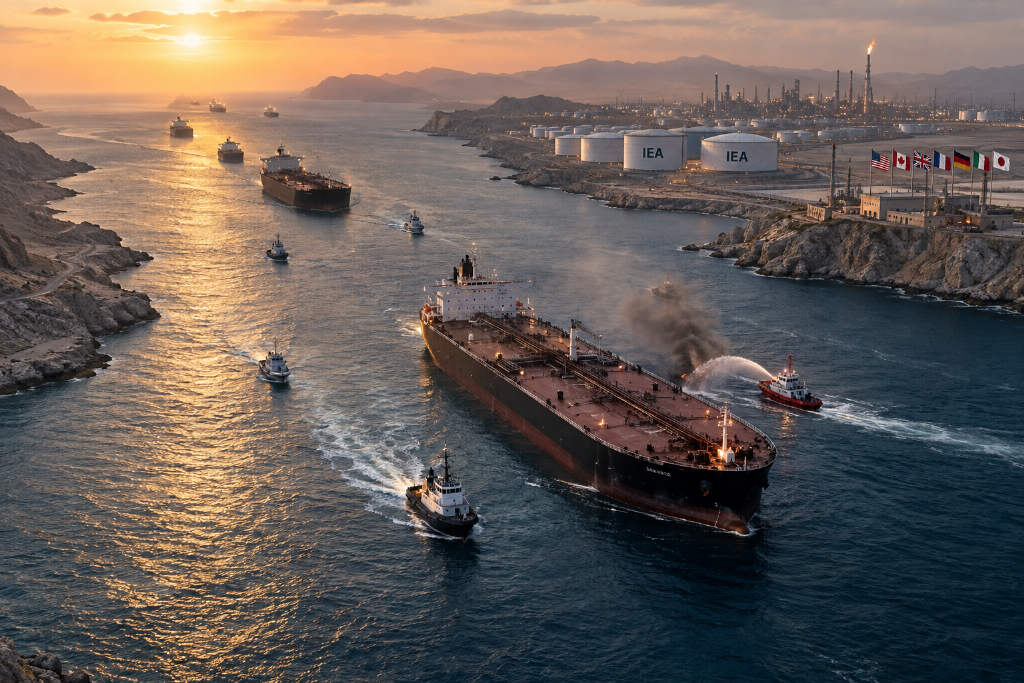
Oil prices moved lower on Monday after the Group of Seven said it would coordinate the release of 100 million barrels of crude and oil products through the International Energy Agency, but the decline was modest and the market remained focused on fresh shipping risks in the Strait of Hormuz.
Brent crude futures fell $1.93, or 1.89%, to settle at $100.32 a barrel. U.S. West Texas Intermediate crude dropped $1.68, or 1.84%, to $89.43.
A day earlier, another tanker was attacked in the Strait of Hormuz, leaving traders to weigh the effect of emergency stock releases against ongoing geopolitical threats.
G7 says diesel will be front-loaded
In a joint statement, G7 leaders said the 100 million barrels of crude and oil products would be released immediately and distributed over four months. Diesel will be prioritized, with G7 members and partners required to release a substantial volume in the first 20 days.
The statement also said officials would meet in the coming days under the IEA framework to discuss whether additional diesel releases are needed. It added that refinery maintenance schedules would be coordinated to avoid simultaneous shutdowns, and that member states would not impose export restrictions on energy products.
Before the statement was issued, Washington had already applied pressure. The Trump administration had threatened to ban U.S. diesel exports and urged Europe to tap emergency diesel inventories. After the announcement, Trump wrote on Truth Social: "Europe just agreed to release a large amount of plentiful diesel inventories, and the process will begin immediately." He also told reporters at the White House the same day that he would not impose an export ban.
The U.S. is set to hold midterm elections in November, and high fuel prices are a political issue for Republicans.
IEA says about 325 million barrels from the March pledge have already been released
IEA Executive Director Fatih Birol joined the video meeting. In a news release, the agency said about 325 million barrels from the 400 million barrels pledged in the collective action announced on March 11 had already been released, more than 80% of the total.
Birol said the impact of the Hormuz crisis on energy markets remains "severe, especially in the diesel market." According to the IEA, Middle Eastern crude exports have rebounded sharply, but flows of refined products remain heavily constrained. Ukrainian attacks on Russian refineries have also tightened diesel supply.
Shipping-tracking data showed that in four of the seven days in the final week of September, Middle Eastern crude exports were above pre-war levels. Andrew Lipow, president of Lipow Oil Associates, said: "Despite the risks tankers still face, the ultimate hope is that more oil reaches the market."
On Sunday, seven OPEC+ members, including Saudi Arabia and Russia, agreed to keep output unchanged in November. Saudi Aramco also unexpectedly cut its official selling price for crude bound for Asia in November to the lowest level in six years.
Questions remain over how much supply is actually new
The market is still unsure how much of the newly announced 100 million barrels is genuinely additional supply and how much may come from the unused balance of the 400 million-barrel commitment made in March.
Using the figures in the report, about 325 million barrels have already been released from that earlier 400 million-barrel plan, leaving roughly 75 million barrels. If that remaining amount is included in the new 100 million-barrel pledge, the truly incremental volume may be only about 25 million barrels.
Global oil consumption is about 100 million barrels a day. Spread over four months, the release would average a little more than 800,000 barrels a day.
Hamad Hussain of Capital Economics said the emergency release by G7 members would "put some downward pressure on prices, particularly global diesel prices. However, the impact will be temporary." Eleanor Budds, an S&P Global Energy CERA analyst quoted by The Wall Street Journal, also said staggered releases from European inventories could ease winter pressure, but the global market remains tight and the effect on prices may be short-lived.
Diesel and refining remain the tighter constraint
The report said the real bottleneck is refining rather than crude itself. Crude exports have returned to around pre-war levels, but diesel remains in short supply.
According to the American Automobile Association, the U.S. national average diesel price recently hit a record $6.50 a gallon, up from $5.61 a month earlier. That helps explain why the G7 chose to front-load diesel in the first 20 days and coordinate refinery maintenance at the same time.
Hormuz attack keeps geopolitical premium elevated
The UK Maritime Trade Operations office said on Sunday that a tanker in the Strait of Hormuz was hit by an unidentified projectile, damaging the engine room while leaving the crew safe. The Wall Street Journal said there had been seven vessel attacks around the strait since Sept. 28.
Tamas Varga, an analyst at PVM Oil Associates, said: "A ceasefire in the Middle East remains far off, and renewed hostilities by the Houthis, backed by Saudi Arabia and Iran according to the source text, will keep energy facilities and ships under attack, leaving the geopolitical risk premium elevated."
On Oct. 5, the U.S. Department of Energy said the U.S. Strategic Petroleum Reserve fell to 283 million barrels last week, the lowest since October 1982. Amin Nasser, chief executive of Saudi Aramco, said at the Energy Intelligence Forum in London that supply is expected to remain tight and that rebuilding global inventories after emergency drawdowns could take two years.
Online reaction focused on scale and refining spreads
Reaction on social media was more blunt. Users on Reddit's r/wallstreetbets calculated that 100 million barrels is roughly equal to one day of global consumption and described it as a bandage on a large wound. Others said the market should be watching refining spreads rather than crude prices, because diesel is the real issue.