

Crypto exchanges built their growth over the past few years on a fairly direct formula: BTC, ETH, and long-tail tokens as the asset base, spot and perpetual futures as the main products, stablecoins such as USDT as the settlement layer, and 24/7 trading paired with high volatility to attract global order flow.
Gate Research says that model starts to strain when crypto enters a period of lower volatility, thinner narratives, and weaker liquidity. In that setting, one market is no longer enough to absorb all trading demand. Rate decisions, nonfarm payrolls, geopolitical shocks, moves in gold, changes in oil supply and demand, tech earnings, and global indexes often generate more immediate opportunities outside crypto. For users already accustomed to managing capital in stablecoins, the friction point is clear: taking part in those moves usually means opening separate accounts, converting currencies, wiring funds, and settling across crypto platforms, FX brokers, securities accounts, and banks. Capital gets split up. So do trading opportunities.
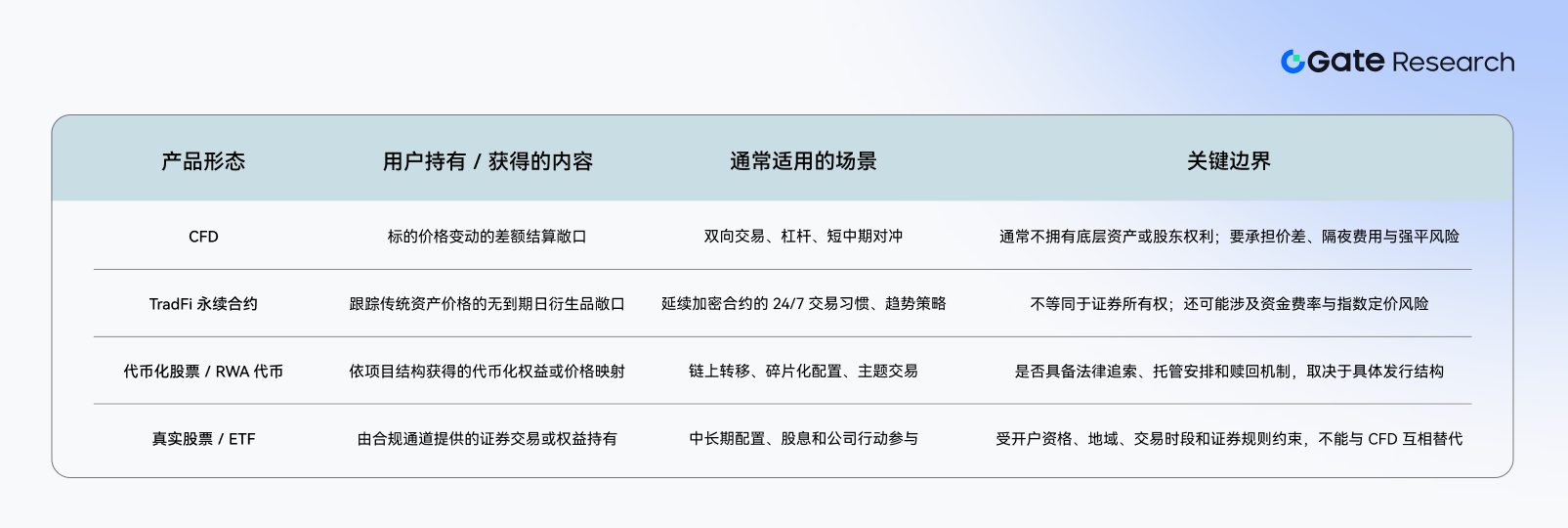
That is the gap where CFDs, or contracts for difference, enter the crypto platform stack, according to the report. A CFD does not require the user to buy a physical ounce of gold, a barrel of oil, or a share of stock. The trade is settled on the price difference between entry and exit. Users can take long or short exposure, and they can magnify that exposure with margin. For an exchange, Gate Research says, adding CFDs is not just about listing another product line. It is about connecting traditional price discovery, stablecoin-based margin, and a crypto-native trading experience inside one account system.
The report says leading crypto exchanges, with Gate as a representative case, have accelerated their push into TradFi since 2026. Gate has already placed CFDs, perpetual contracts, tokenized products, real stocks, ETFs, IPO Access, and wealth management inside a single multi-asset framework. Product structures and access rules vary from one venue to another, but the underlying direction is converging: crypto exchanges are shifting from single-market digital asset venues toward integrated trading accounts that use stablecoins as the capital language and multiple forms of risk exposure as the product supply.
CFDs are built around price exposure, not ownership
Gate Research describes the product in simple terms: a CFD settles the price difference between opening and closing a position. A gold CFD does not give the trader deliverable bullion. A U.S. stock CFD usually does not make the trader a shareholder of the underlying company. What the user gets is P&L exposure to price movement. The platform organizes that through margin, spreads, commissions, overnight financing, and risk controls.
That structure makes CFDs a natural fit for frequent price monitoring, event-driven trades, and cross-market hedging. Markets that used to sit behind different venues, settlement rules, and onboarding processes can be compressed into a more unified order interface and a shared margin language. Still, the report stresses that “more unified” is not the same thing as homogeneous. Traditional markets keep their own opening hours, holiday schedules, liquidity patterns, and corporate action rules. Crypto trades around the clock; stocks, FX, indexes, and commodities do not. When traditional venues are closed and a crypto account remains active, quoting interruptions, gaps, and repricing risk at the next session can all become larger.
The distinction between forms of TradFi exposure matters for two reasons in the report’s framework. First, the value of a CFD is low-friction access to price exposure, not a replacement for asset ownership. Second, the competition around multi-asset accounts depends on whether different products can work together under different time horizons and risk preferences. Short-term traders care about execution and risk controls. Allocation-oriented users focus more on rights attached to the asset and holding costs. Institutions need custody, limits, and verifiable clearing and settlement arrangements.
Stablecoins as the common funding language
Without stablecoins, the report argues, crypto platforms plugging into traditional assets would still run into the same old constraints: fiat deposits and withdrawals, cross-currency conversion, and regional payment rails. Stablecoins convert funds that would otherwise be spread across dollars, Hong Kong dollars, euros, yen, and on-chain assets into a relatively unified margin unit inside the platform, one that can move quickly between products.
For users, the most tangible change is fewer intermediate steps. They do not need to swap USDT into fiat held in a bank account, transfer that fiat to a separate broker, and only then open a position. Gate Research cites the European Central Bank’s observation that stablecoins are still used mainly for more volatile crypto-asset trading, with more limited use in real-economy payments. In the report’s view, that is exactly why crypto CFDs have a practical starting point: stablecoins already circulate efficiently inside crypto trading accounts, and that makes them a workable bridge to TradFi price exposure.
The report says stablecoins reshape trading accounts in three direct ways.
- Capital can be moved faster. USDT in one account can be shifted among spot, crypto perpetuals, gold, FX, and stock-related products with less waiting time and lower operational friction than traditional cross-account transfers.
- Account management becomes simpler. Users can track P&L, set risk budgets, and compare returns using dollar-pegged assets. That does not remove currency risk, though. If the underlying is a non-dollar currency, an overseas stock, or a commodity priced in another currency, FX moves can still affect the trade through the underlying asset itself.
- Margin efficiency improves, but risk also becomes more concentrated. A unified margin base reduces idle capital, yet it also means crypto volatility, TradFi gaps, stablecoin liquidity, and platform risk controls can interact within the same account. The more unified the account, the more important risk segregation and position management become.
From the platform side, the report treats stablecoins as something close to account-layer infrastructure. They connect trading, collateral, liquidation, yield products, and payment functions. If that funding layer is managed with compliance, transparency, and deep enough liquidity, a multi-asset trading service can become genuinely usable rather than a short-lived quote display.
Why crypto users are looking at gold, FX, stocks, and indexes
Gate Research breaks the demand shift into four parts.
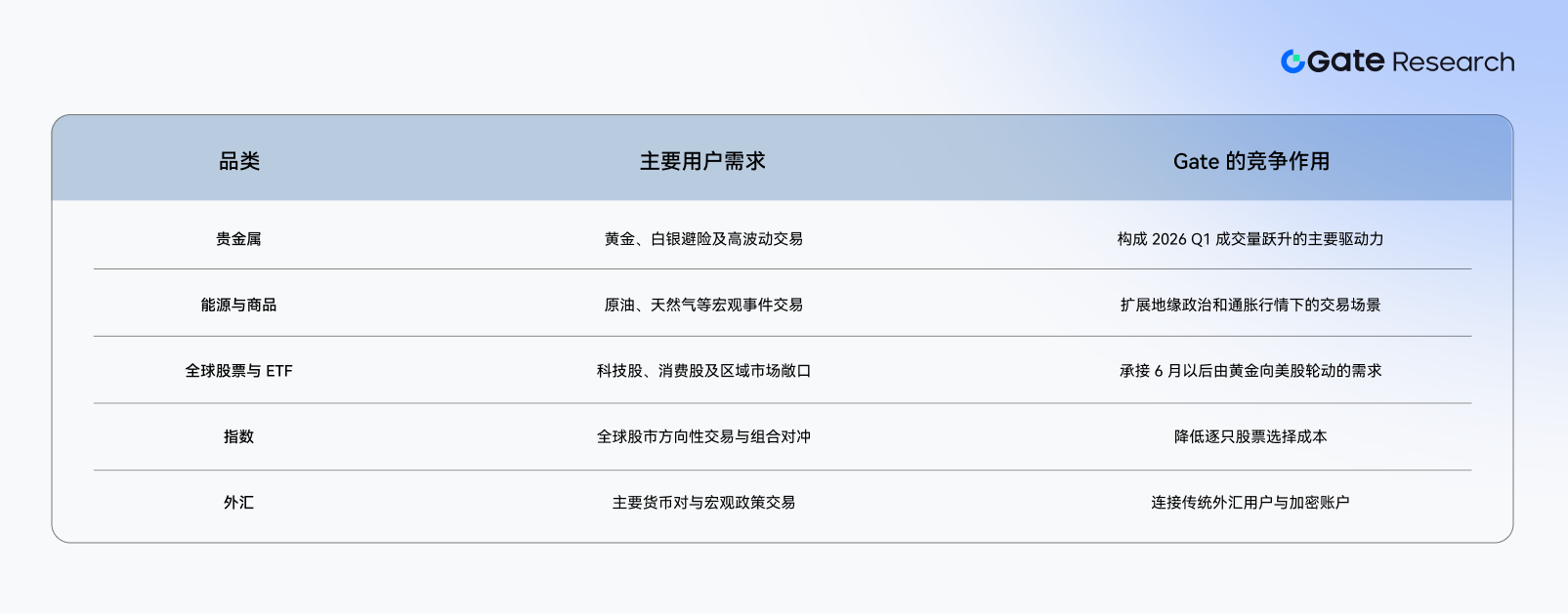
The first is a mismatch in market cycles. Crypto carries high beta, high volatility, and concentrated narratives. When majors trade sideways and altcoin momentum fades, large amounts of stablecoins can sit unused in accounts. At the same time, macro releases, central bank decisions, energy supply shifts, and earnings season keep moving FX, precious metals, equity indexes, and stocks. CFDs let users shift attention to a different price cycle without leaving the original account.
The second is the spillover of risk-management needs. The report says correlations between crypto and risk assets are not fixed, but during sharp changes in risk appetite, tech stocks, the dollar, rate expectations, gold, and oil often influence crypto sentiment together. Hedging does not erase risk, but it can turn a simple “long crypto” stance into relative-value or multi-asset positioning. A user holding high-beta crypto may watch gold as a haven trade. Someone positive on the AI supply chain but wary of token price swings may prefer to express that view through stocks, indexes, or ETF-related products.
The third is strategy migration. Crypto has already trained a large base of traders who are familiar with leverage, candlestick analysis, take-profit and stop-loss tools, grid systems, copy trading, and APIs. For that group, traditional assets are not necessarily about long-term holding. They may be approached with the same technical analysis, trend-following, event-driven, or arbitrage frameworks that traders already use in crypto. In the report’s view, adoption then depends on whether the product offers enough depth, predictable costs, stable risk controls, and tools that fit existing trading habits.
The fourth is access friction across jurisdictions. Users in different countries and regions face different requirements when opening overseas securities or FX accounts, from identity checks and fiat funding to cross-border transfer constraints, minimum balances, and product availability. Stablecoin-based crypto accounts lower some of that friction. They do not remove geographic restrictions. Whether a user can access a product still depends on local law, the platform entity involved, KYC rules, and risk classification.
From exchange product add-on to integrated account model
The report frames the supply-side change as a convergence between two skill sets that used to serve different audiences on different capital rails. Traditional CFD brokers specialize in quoting, liquidity access, margin risk controls, client suitability, and compliance operations. Crypto exchanges bring stablecoin liquidity, global users, digital asset trading habits, API ecosystems, and around-the-clock product operations.
Gate Research lays out four stages of product evolution.
- An internal crypto leverage stage, where platforms focus on spot margin, delivery futures, and perpetuals for BTC, ETH, and altcoins, with competition centered on leverage limits, order-book depth, fees, and matching performance.
- An external brokerage-tools stage, where users reach FX, gold, or indexes through terminals such as MT5 while the crypto platform mainly provides traffic, capital entry, or distribution partnerships. The main account and the TradFi product remain visibly separate.
- An embedded CFD stage, where TradFi underlyings appear directly inside the app or web interface, and users can transfer USDT into them using a unified trading interface with baseline risk controls.
- A cross-asset integrated account stage, where CFDs sit beside perpetuals, tokenized assets, stocks, ETFs, asset management, custody, APIs, and cross-venue clearing. At that point, the competitive focus shifts to how efficiently capital, strategies, and risk controls move across asset classes.
Those stages are not replacing one another in a clean line, the report says. All of them still exist in the market. Traditional brokers continue to compete on established compliance and market infrastructure. Crypto platforms use stablecoins and user acquisition channels to add traditional-asset capabilities. Tokenized products offer a separate form of on-chain composability. The notable change, in Gate Research’s view, is that leading crypto platforms are now treating CFDs as part of an integrated account strategy instead of a niche plug-in.
Using public information, the report identifies three broad routes now competing in the market.
- A TradFi route from crypto platforms. Gate is presented as an example: starting with existing users and USDT balances, it brings FX, metals, indexes, commodities, and stock-related products into the crypto trading experience. The report says Gate currently places stocks, tokenized stocks, CFDs, and perpetuals side by side as TradFi product types, all settled in USDT.
- A multi-asset route from traditional brokers. These firms often have longer operating histories in FX, commodities, and stock CFDs, with more mature quote systems, client suitability processes, terminals, and licensing structures. They may not have crypto-native users, stablecoin balances, or on-chain capital scheduling.
- A tokenization and on-chain finance route. This route emphasizes issuing, holding, and transferring rights in stocks, bonds, funds, or commodities as tokens. It suits asset holding and composability, but it imposes higher requirements on legal structuring, asset segregation, redemption mechanisms, and secondary-market liquidity. It is not the same thing as a CFD.
That leaves crypto platforms and traditional brokers in something other than a pure replacement contest. One side has account entry points, stablecoins, and crypto-native tools. The other has established TradFi compliance and trading processes. In the report’s telling, future market share may depend on who can combine those two capability sets more reliably.
What sits behind a single CFD order
A user sees a chart and an order button. The report says at least four layers of capability sit behind that simple front end.
The first is the underlying and its price source. Stocks, indexes, FX pairs, and commodities all have different benchmarks, trading hours, and liquidity structures. A platform needs to explain reference pricing, spread formation, how abnormal quotes are handled, and what rules apply when the underlying market is closed. The report argues that a quote’s proximity to a tradable market price matters more than the sheer number of assets shown on the page.
The second is the margin and risk engine. Leverage can turn a small price move into a much larger account gain or loss. Platforms need rules for initial margin, maintenance margin, risk limits, liquidation, negative balance protection, and extreme-market handling. For users, the report says, tolerable loss should be the starting point for opening a trade.
The third is cost structure. Crypto perpetuals usually make traders think about fees and funding rates. CFDs may reflect costs through spreads, commissions, overnight financing, and adjustments related to dividends, stock splits, or other corporate actions. No funding rate does not mean no holding cost. The report says real cost comparisons have to combine holding period, spread, slippage, and overnight charges.
The fourth is execution and clearing. Around key macro releases, earnings announcements, or weekend openings, prices can jump quickly. Whether an order actually fills, how far execution drifts from the intended price, whether a stop is triggered as expected, and whether the system stays stable can decide the entire user experience. For institutional and quantitative teams, API stability, latency, rate limits, account segregation, custody, and clearing arrangements often matter more than a single headline fee.
The report also ties CFDs to platform economics. Their value is not just commission revenue. Longer trading windows, more event-driven scenarios, and higher margin utilization may lift capital retention and cross-product usage. In a quiet crypto period, users can shift into gold, oil, FX, or indexes. During a risk event, they can hedge across asset classes. If longer-term allocation demand appears, the same platform can route that user toward ETFs, stocks, or wealth products. That is why the report describes CFDs as a key entry point for the integrated account strategy.
Even so, Gate Research says platform incentives and user value are not naturally aligned. Higher leverage, more frequent trading, and longer overnight holding can support platform activity while also raising user costs and loss risk. A mature CFD market, in the report’s view, should rely on transparent pricing, clearly stated charges, measured leverage, and understandable risk disclosure rather than high leverage and short-term incentives alone.
The market is moving into a new competitive phase
Gate Research says crypto CFDs are shifting from a supplementary contract category to a contest over cross-asset integrated accounts. Winners will not be determined only by leverage multiples or near-term turnover. The report points to four measurable capabilities: tradable asset coverage, open interest and margin accumulation, upgrading of the user mix, and the efficiency of cross-market infrastructure.
From crypto exchange to cross-asset brokerage platform
The report describes three stages in the competitive logic.
Stage one was leverage within crypto itself. Exchanges competed around perpetuals, leverage levels, fees, and matching performance for BTC, ETH, and other digital assets, while user assets and opportunities stayed largely inside crypto.
Stage two brought traditional price exposure into the crypto account. Gold, FX, crude oil, stocks, and indexes entered through CFDs, with stablecoins such as USDT acting as the margin and transfer medium. Gate is cited as an example of a top-tier platform that has already integrated stock, FX, gold, commodity, and index CFDs into its app and web interfaces.
Stage three is a merger of multiple asset classes, trading modes, and user tiers. The question is no longer who can list CFDs, but who can let capital move through trading, allocation, hedging, and management inside a unified account chain. The report lists four key links in that chain:
- low-friction deposits and margin transfers using stablecoins;
- coverage across holding periods through CFDs, perpetuals, and spot tokens;
- professional-user support through APIs, copy trading, quant funds, and wealth management;
- capital retention supported by reserves, custody, risk controls, and compliance capability.
That is why the report says the new competition is really about account entry points, breadth of assets, and capital efficiency. CFDs are the front-end shape. The deeper moat lies in whether a platform can connect liquidity, margin, and user demand across markets.
Gate’s reported jump from catch-up to lead in two months
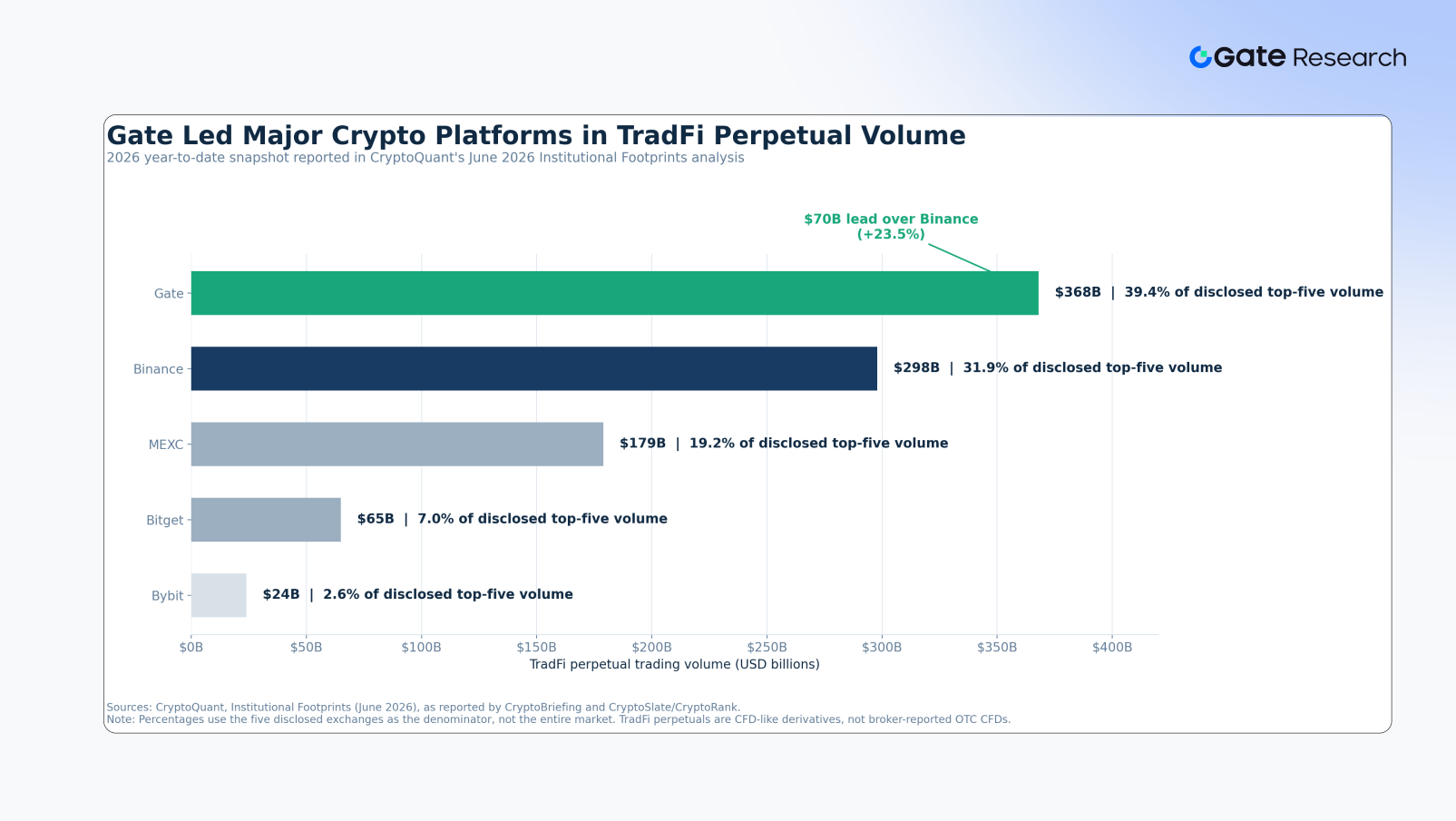
Among five disclosed platforms in the report, Gate accounted for 39.4% of combined trading volume, 7.5 percentage points ahead of Binance. In absolute terms, it led by $70 billion, a gap the report describes as 23.5%. It also says Gate’s volume was about 2.06 times MEXC’s and 4.13 times the combined volume of Bitget and Bybit.
The report adds an important qualification: the percentages use a $934 billion combined volume base from those five disclosed platforms and do not represent total exchange market share. The ranking comes from a June 2026 CryptoQuant report snapshot for the year to date, not a unified first-half ranking across all data vendors.
Even with that caveat, Gate Research says the ranking shows Gate is no longer just a broad-product challenger. In this segment of traditional-asset derivatives trading carried by crypto platforms, it has built a scale advantage. Unlike the standard crypto derivatives market, which is commonly led by Binance, the TradFi derivatives segment showed a different order in the report: Gate first, Binance second, MEXC third. The point, in the report’s framing, is that the new market has not simply copied the old crypto futures hierarchy.
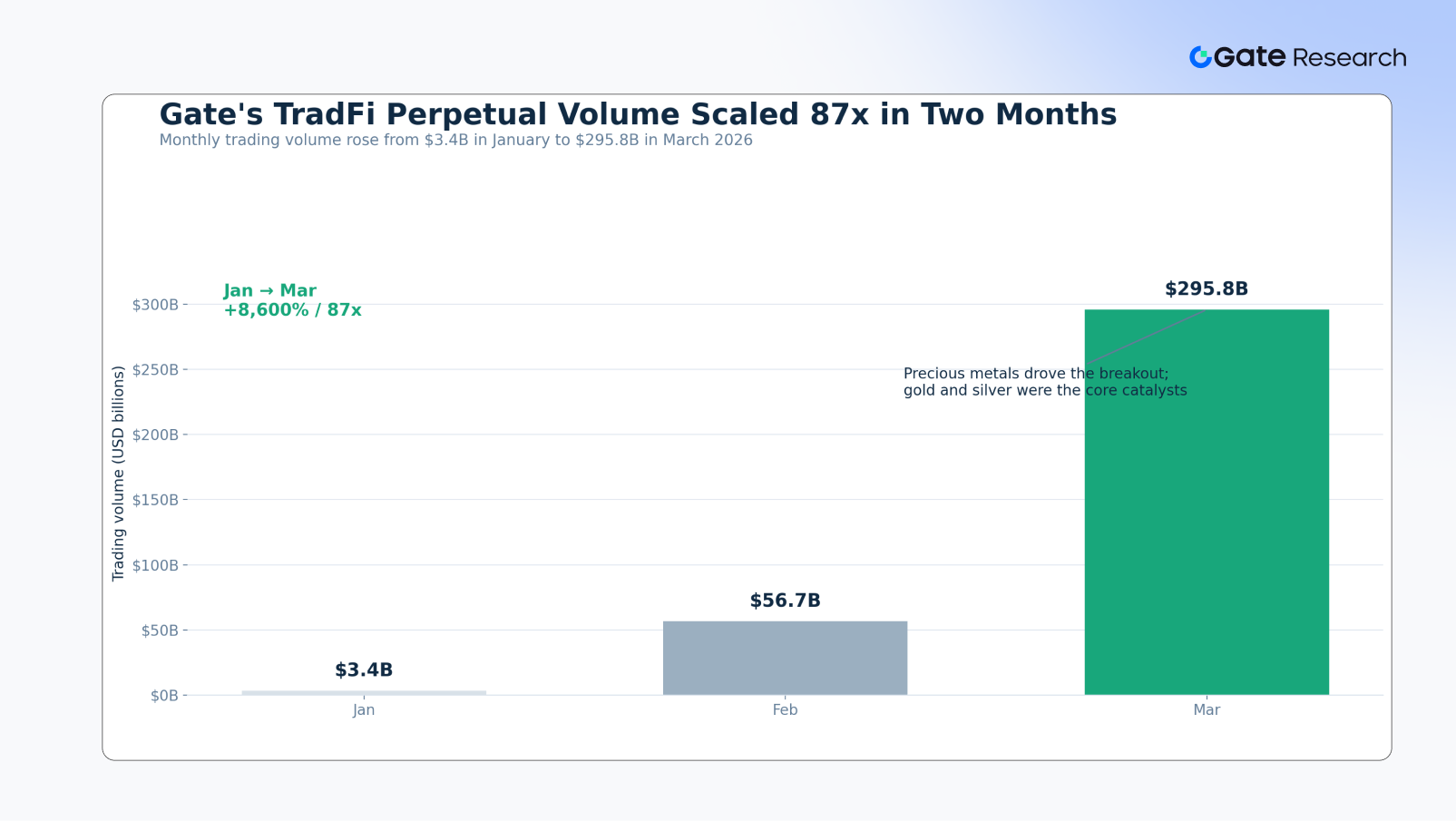
That lead was not built through gradual gains. CryptoQuant data cited in the report shows Gate’s TradFi perpetual trading volume rising from $3.4 billion in January 2026 to $56.7 billion in February and then $295.8 billion in March. From January to March, that was roughly an 87-fold increase, or 8,600% growth.
March is described as the turning point. Moves in gold and silver lifted demand among crypto users for leveraged precious-metals exposure, while crude oil contracts also started to gain volume. Gate’s TradFi product matrix, spanning precious metals, energy, stocks, indexes, and FX, let it consolidate demand that had been split among FX brokers, CFD platforms, and crypto exchanges into one account structure.
By the time of CryptoQuant’s June report, Gate’s cumulative year-to-date volume had reached $368 billion, $70 billion above Binance, according to the report. Gate Research attributes that edge to three factors: earlier entry into gold and FX CFD scenarios, multiple leverage tiers, and lower-friction links between crypto accounts and TradFi trading accounts through USDT/USDx.
Scale beyond a single precious-metals trade
The report says Gate’s position is not only about headline turnover. It also claims the platform has the broadest CFD product coverage in the industry, with tradable global stocks, indexes, FX, metals, energy, and other commodities, ranking first among global crypto trading platforms by number of assets.
In the report’s reading, that means the platform is not relying on one gold-driven market phase. Gate has already built a fuller cross-asset trading entry point: first breaking through with high-demand assets such as gold and silver, then extending into stocks, indexes, FX, and commodities, and finally using a unified account, stablecoin settlement, APIs, and wealth management to take in capital and professional users. The report says that shifts Gate’s competitive identity from “a crypto exchange that added CFD functionality” toward “using crypto infrastructure to rebuild global multi-asset brokerage services.”
The next test, however, is whether that first-place trading burst can be turned into sustained liquidity quality, open interest, institutional participation, and capital retention. If that happens, the report says, Gate’s lead would move from a market-cycle volume advantage to a platform moat that lasts across cycles.
Case study: how Gate built a broader system around CFDs
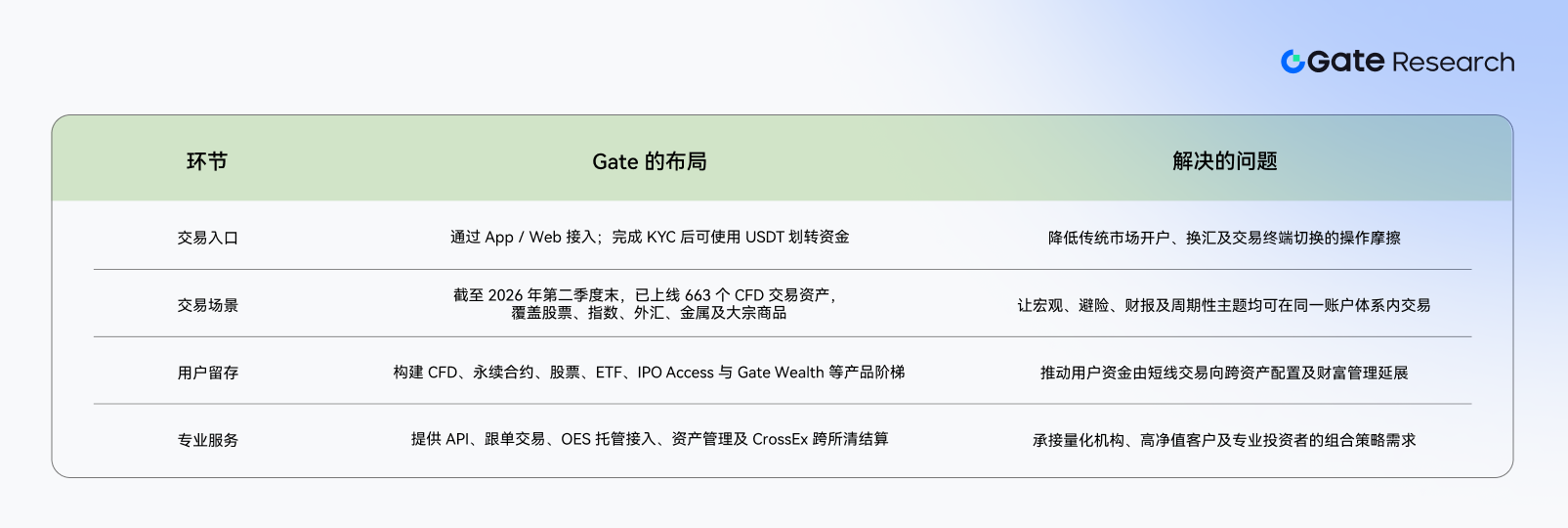
Gate Research says crypto platforms entering the CFD market often fall into one of two extremes. One treats traditional assets as an isolated zone and uses high leverage and short-term incentives to pull volume. The other tries from day one to replicate the full feature set of a mature securities broker, leaving product design, capital flow, and user experience fragmented. Gate, the report argues, has taken a third route: lower the entry barrier with tools crypto users already know, including USDT, contract trading, and app/web access, then extend the time capital stays inside the account through CFDs, spot and stocks, ETFs, strategy tools, and institutional services.
That path works because each product layer serves a different function. CFDs handle higher-frequency trading and two-way hedging. Stocks and ETFs serve longer-duration equity allocation. APIs, copy trading, and custody support more professional strategy capital. Proof of reserves and compliance work provide the trust layer needed for retention.
From a second account to another asset entry point
The report says the main barrier for crypto users approaching traditional assets is the account system itself. Moving from BTC perpetuals into gold, the Nasdaq index, or FX usually means fiat conversion, broker onboarding, fund transfers, terminal switching, and learning a new ruleset. Any friction in that chain can erase the value of a short-lived trade.
Gate put TradFi products into its app and web interface in February 2026, according to the report. After KYC and permission activation, users could transfer USDT into a TradFi account and trade CFDs tied to metals, FX, indexes, commodities, and some popular stocks. The first level of value, the report says, is not the product list alone. It is that discovery, onboarding, funding, and execution for TradFi were embedded into an existing Gate user path, rather than being pushed into a separate terminal or another broker registration.
The report makes clear that “unified” here means a shared account entry point, identity layer, and funding language. It does not mean every product shares one identical risk rule set or a completely unsegregated margin pool. Different products may still sit in separate accounts and follow different trading hours, leverage settings, fees, and access requirements. For the platform, that layered arrangement is part of risk control. For users, convenience should not be mistaken for flattened product risk.
Gate Research points to three immediate effects from this design:
- It lowers the barrier to a first TradFi trade. Crypto users can begin with familiar tools such as USDT, candlestick charts, stop-losses, and position management instead of learning fiat onboarding and overseas broker workflows from scratch.
- It extends the usable time of capital. When crypto lacks high-volatility setups, stablecoins do not have to leave the platform and wait for the next crypto cycle. They can be used in gold, FX, equity index, or stock themes.
- It shortens the path from idea to trade. After a macro event, earnings release, or geopolitical development, users can search for the relevant underlying within the same application.
That may look like user-experience optimization, the report says, but it is really a contest over account entry points. CFDs fit the first step because they deliver price exposure. Users do not need to hold the security directly in order to express a view with smaller size, two-way positioning, and leverage.
From asset count to scenario density
By the end of the second quarter of 2026, Gate had listed 663 CFD trading assets, according to the report, covering stocks and some ETFs, indexes, FX, precious metals, energy, and other commodities.
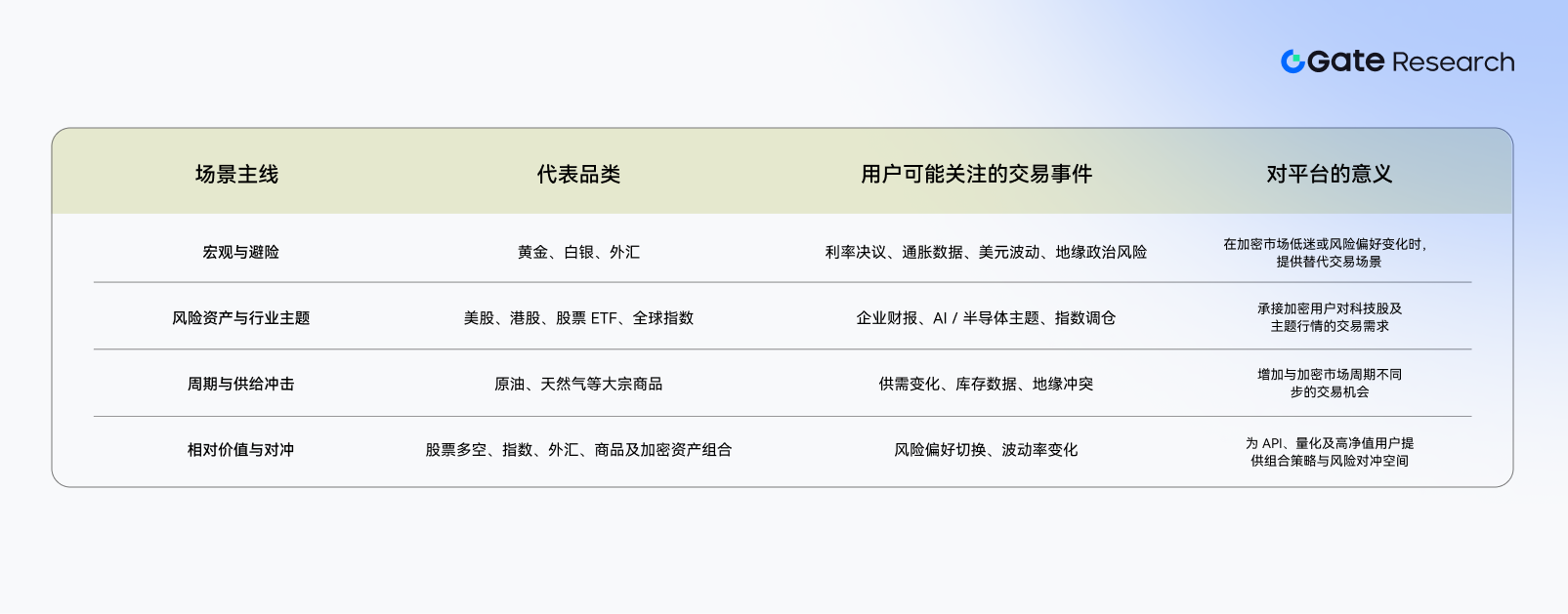
The report says the more important question is how those instruments combine into trading scenarios. In its description, Gate’s asset mix broadly maps onto four main lines. Gold serves a hedging role in haven narratives. Equity indexes and tech shares tie into changes in risk appetite and earnings season. FX products line up with macro policy and exchange-rate trading. Commodities offer exposure to geopolitical and cyclical variables. More assets do not automatically make for a better product, the report notes, but a platform only reduces dependence on a single crypto market when its lineup can cover a wider set of trading events. Ultimately, quality still comes back to liquidity, because depth, spreads, fill rates, and overnight costs differ materially across stock and ETF CFDs, FX, commodities, and indexes.
A product ladder built for frequency and retention
Gate upgraded TradFi in May into an integrated trading section covering CFD contracts, perpetual contracts, and spot tokens, according to the report. In that setup, CFDs serve as two-way leveraged tools for traditional price exposure, perpetuals continue to match crypto users’ habits around high-frequency and trend trading, and spot tokens serve longer holding periods. The importance of the change, in the report’s view, is that the platform moved away from thinking in terms of one trading terminal and toward product layering, where the same asset theme can be approached with different risk-bearing styles and holding horizons.
In June, the report says, Gate disclosed the launch of real stock trading for U.S., Hong Kong, and South Korean shares, along with IPO Access, while bringing stocks, ETFs, commodities, FX, IPO products, and Gate Wealth into one ecosystem. Users can use USDT for stock and ETF access in some markets, and the initial U.S. market lineup included more than 10,000 instruments, according to the report. It also draws a line between those real-stock services and CFDs: the former involve security ownership rights, corporate actions, and securities rules; the latter provide derivative exposure to price differences. Keeping both inside one strategy matters because one user can shift between short-term trading and longer-term allocation.
The report summarizes the ladder this way:
- short-term, event-driven, two-way trading: CFDs;
- high-frequency, trend-oriented, crypto-native strategies: perpetual contracts;
- medium- to long-term equity and thematic allocation: stocks, ETFs, and spot tokens;
- larger capital pools, strategy combinations, and long-duration service: custody, quant products, and Gate Wealth.
For the platform, the report sees three commercial benefits. It lowers the probability that users leave immediately after a trade is complete. It broadens the range of risk preferences the account can serve, rather than relying on one high-leverage user profile. It also creates a path for cross-selling: a user may begin with gold CFDs, move into indexes or ETFs, and later add stocks or wealth products, while institutions may enter through APIs or custody and later use cross-market arbitrage, risk management, or asset-management offerings.
Capital retention, reserves, and professional channels
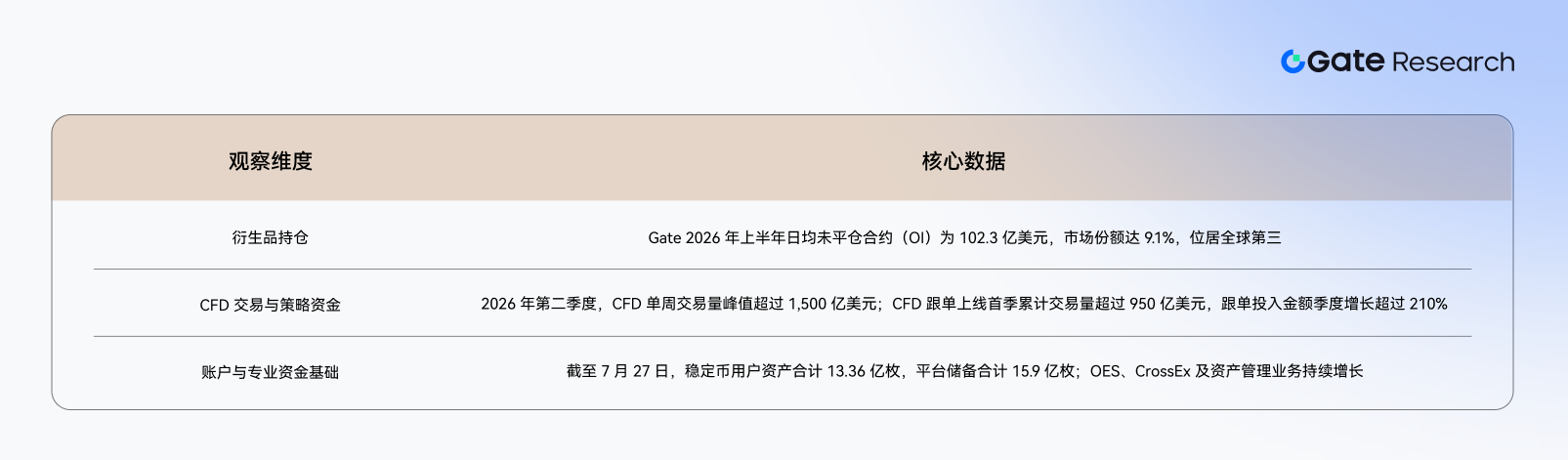
Derivatives carrying capacity remains the base layer for multi-asset expansion, the report says. CoinGlass data for the first half of 2026 put Gate’s cumulative derivatives volume at $2.53 trillion, or 7.2% of the sampled market. More notably, average daily open interest stood at $10.23 billion, a 9.1% market share, ranking third. Because the OI share was 1.9 percentage points above the trading-volume share, the report argues that Gate was carrying relatively more standing risk exposure than turnover alone would imply rather than relying only on fast-rotating flow. It adds that these OI and volume figures refer to Gate’s crypto derivatives market and should not be attributed directly to CFDs.
Within CFDs, the report says the business has moved beyond simple listing expansion and into strategy trading. By the end of Q2 2026, Gate had 663 tradable CFD assets. Weekly trading volume at peak exceeded $150 billion. The newly launched CFD copy-trading business generated more than $95 billion in cumulative copy-trading volume in its first quarter, while capital committed to copy trading rose more than 210% during the quarter. The report says those figures matter because they show CFDs forming real trading scenarios, with gold, FX, equity indexes, and stocks beginning to move into strategy replication and user capital-allocation flows.
Stablecoin balances provide the funding base for movement across markets. Citing Gate’s latest reserve report, the document says that as of July 27, 2026, the platform’s overall reserve ratio was 117%, covering nearly 500 user assets. User balances across four stablecoins — USDT, USDC, USD1, and GUSD — totaled 1.336 billion units, against platform reserves of 1.590 billion units, for a combined reserve ratio of 118.97% and an excess reserve ratio of 18.97%. The report ties those figures to CFDs by arguing that stablecoin balances are what let users shift capital among spot, crypto perpetuals, CFDs, stocks, and ETFs without requiring a fresh fiat deposit each time.
Professional capital is also beginning to get dedicated channels for custody, cross-venue execution, and asset management, according to the report. In the second quarter, Gate disclosed that derivatives volume through OES institutional services rose 11% quarter over quarter. CrossEx assets under management increased 128.1% quarter over quarter, trading volume was up 202.6% from the start of the quarter, and the number of trading users rose 76%. The asset-management platform’s average monthly AUM exceeded $3 million. Gate Wealth, meanwhile, had expanded its service scope to digital assets, stocks, ETFs, RWA, FX, and commodities. The report treats these numbers as evidence that Gate is building a multi-asset service system that reaches beyond the ordinary trading account into custody, cross-venue execution, strategy management, and high-net-worth allocation.
From that perspective, the report sees three parallel capital paths now taking shape at Gate:
- trading capital moving through crypto perpetuals and CFDs, tied to positions, margin, and trading frequency;
- account capital held in stablecoin balances, ETFs, and stocks, extending holding periods and enabling cross-market transfers;
- professional capital using APIs, copy trading, OES, CrossEx, and Gate Wealth for custody, strategy execution, and asset-management allocation.
Those numbers and pathways, the report says, strengthen the argument that Gate’s CFD business is already part of a wider account and strategy system.
User mix: APIs, copy trading, and institutional services
The value of multi-asset trading tends to be higher for professional users than for single-asset traders, the report says, because broader product coverage increases the need for automation, portfolio-level risk control, and lower-friction capital scheduling.
One part of that buildout is the API layer. Gate announced a TradFi trading API in February 2026 supporting automated trading, real-time market data, and account and position management for metals, FX, indexes, and commodities, according to the report. In March, it also raised maximum order sizes and account position limits for some CFDs: stock CFD single-order limits rose to 100 lots, while indexes, commodities, FX, and other CFDs were capped at 10 lots per order, and the combined limit for open positions and working orders in an account rose to 300. The report does not present that alone as proof of large-scale institutional trading, but says it does show product parameters being adapted to multi-strategy and more professional trading use cases.
Another part is copy trading. The report says Gate introduced a CFD copy-trading mechanism in 2026 that mirrors positions based on a ratio of total assets and calculates leader profit-sharing under a high-water-mark principle. For retail users, that lowers the threshold for taking part in cross-market strategies without building them from scratch. For strategy leaders, it creates a path to scaled revenue sharing. For the platform, it turns fragmented individual activity into a repeatable strategy supply. The report is explicit that copy trading does not reduce the underlying risks: position sizing, timing, fees, slippage, and principal size can all make actual outcomes differ from historical performance.
The institutional-service layer is broader still. Gate’s 2025 annual report, cited in this document, showed total institutional users up 69.29% year over year, institutional contract volume up 34.29%, and institutional contract volume’s share of all platform contract volume up 101.11% year over year. In June 2026, Gate’s institutional spot trading volume grew 49.39% month over month. During the same period, the platform continued to expand OES custody access, CrossEx cross-exchange trading and unified clearing, institutional OTC Loan, and Gate Wealth services. Taken together with the infrastructure buildout, the report says Gate’s priority is not just adding retail CFD users. It is also bringing institutional custody, execution, financing, clearing, settlement, and strategy management into a multi-asset service framework.
An operating loop built around entry, scenarios, retention, and specialization
The report closes the case study by describing Gate’s differentiation as a four-part loop: entry point, trading scenarios, retention, and professionalization. Compared with a pure CFD broker, Gate has a native stablecoin capital pool, a large crypto trading user base, and derivatives trading habits already in place. Compared with a crypto-only exchange, it can use TradFi underlyings to fill the capital-usage gap that appears when crypto itself is quiet. In that structure, CFDs work as an acquisition tool, a trading-frequency tool, and a front-end gateway into broader asset-allocation services.
The report’s conclusion
Gate Research says the significance of the crypto CFD market lies in whether a platform can organize stablecoins, traditional price exposure, crypto derivatives tools, and professional capital services into a cross-asset account that people can actually use. As gold, FX, indexes, commodities, and stock-related products enter crypto platforms, the center of competition shifts toward letting the same pool of capital trade, hedge, allocate, and remain on the platform more efficiently across markets.
The report presents Gate’s path in three layers. At the front end are the app and web interface, KYC, and USDT transfers that lower the barrier to TradFi products. In the middle are CFDs, TradFi perpetuals, stocks, ETFs, and IPO Access serving needs from short-term trading to longer-term allocation. At the back end are APIs, copy trading, OES, CrossEx, and Gate Wealth handling strategy-oriented, institutional, and high-net-worth capital. It also points to several usage metrics: CoinGlass data showing Gate’s average daily crypto-derivatives open interest at $10.23 billion in the first half of 2026, a 9.1% share that ranked third globally; weekly CFD volume in Q2 peaking above $150 billion; and first-quarter cumulative CFD copy-trading volume above $95 billion.
On that basis, the report says Gate has crossed a key threshold from “a crypto exchange that added CFDs” to the early shape of a multi-asset account. Whether it can become a cross-cycle integrated financial gateway from here will depend on turning short-term TradFi trading heat into lasting liquidity quality, capital retention, and professional service capacity. The report’s final point is that as the trading experience improves, CFDs will become an important interface linking crypto capital with global asset allocation.
Sources and disclaimer
The report lists Gate at https://www.gate.com/tradfi, the European Central Bank’s “The international role of the euro” at https://www.ecb.europa.eu/press/other-publications/ire/html/ecb.ire202606.bg.html, and CoinGlass at https://www.coinglass.com/learn/2026h1-market-report-zh as data sources.
It also says Gate Research is a blockchain and cryptocurrency research platform providing technical analysis, market reviews, industry research, trend forecasts, and macro policy analysis. The report includes a risk warning stating that cryptocurrency investment carries high risk and that users should conduct independent research and fully understand the nature of any asset or product before making investment decisions. It adds that Gate does not assume responsibility for losses or damages arising from such decisions.