
Storage has long been treated as a highly cyclical segment, with corporate earnings closely tied to supply-demand swings and pricing elasticity. In the AI era, that framework is being revised. Storage is moving from a supporting component inside general-purpose hardware to a critical resource within computing infrastructure. Large-model training and inference require not only stronger GPUs and interconnects, but also storage systems with higher bandwidth, larger capacity and lower latency.
AI demand changes the role of storage
The importance of HBM on the GPU side, as well as DDR5 and enterprise SSDs on the server side, is rising. For cloud providers and data-center customers, storage is no longer only a cost item. It has become a variable that affects model-training efficiency, inference throughput and overall deployment cost. The expansion of AI applications is not only increasing storage-chip shipments; it is also raising the share of high-end products in the mix.
HBM offers higher bandwidth, higher integration and higher added value than conventional DRAM. Enterprise SSDs are also benefiting from heavier data-center workloads. As product portfolios migrate toward higher-performance categories, revenue structures, margin structures and valuation frameworks for leading manufacturers are changing. This cycle differs from the older logic in which price increases were quickly followed by capacity expansion. High-end storage products such as HBM are constrained by manufacturing processes, yield, advanced packaging and customer qualification schedules, which limits the speed of supply release.
Micron as a representative AI storage case
Micron Technology, Inc. (NASDAQ: MU) was founded in 1978 and is headquartered in Boise, Idaho. It is a global supplier of semiconductor memory and storage solutions. The company designs, manufactures and sells DRAM, NAND Flash, NOR Flash, HBM, SSDs and storage products for data centers, mobile devices, automobiles, industrial applications and consumer electronics. Gate Research uses Micron as a case study not to focus the report on a single stock, but because its product range, customer structure, earnings sensitivity and market pricing provide a representative view of the AI storage track.
In the global storage-chip industry, Micron stands alongside Samsung Electronics and SK Hynix as a major DRAM supplier, and it is also an important participant in the global NAND market. As demand for large-model training and inference continues to grow, AI servers are driving rapid demand growth for HBM, high-capacity DDR5 and enterprise SSDs. Storage chips are no longer merely supporting parts inside general computing devices. They are becoming one of the bottlenecks in AI computing infrastructure. In GPU clusters in particular, HBM bandwidth, capacity and power-efficiency performance directly affect how much AI-chip performance can be released, placing Micron within the core supplier group of the AI semiconductor supply chain.
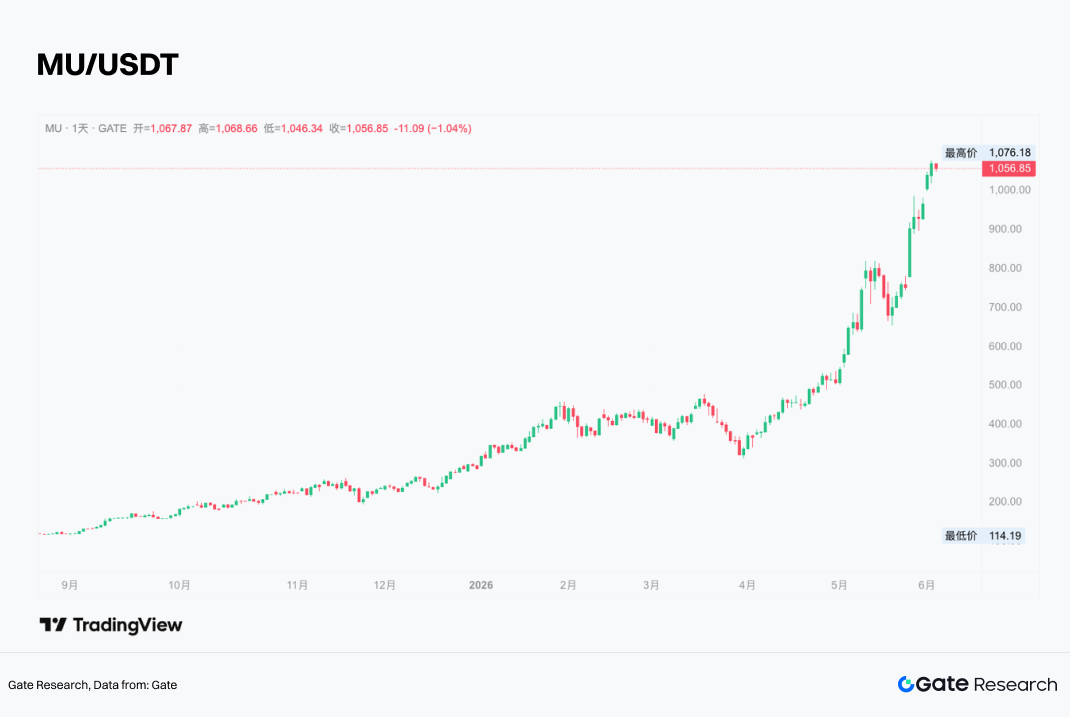
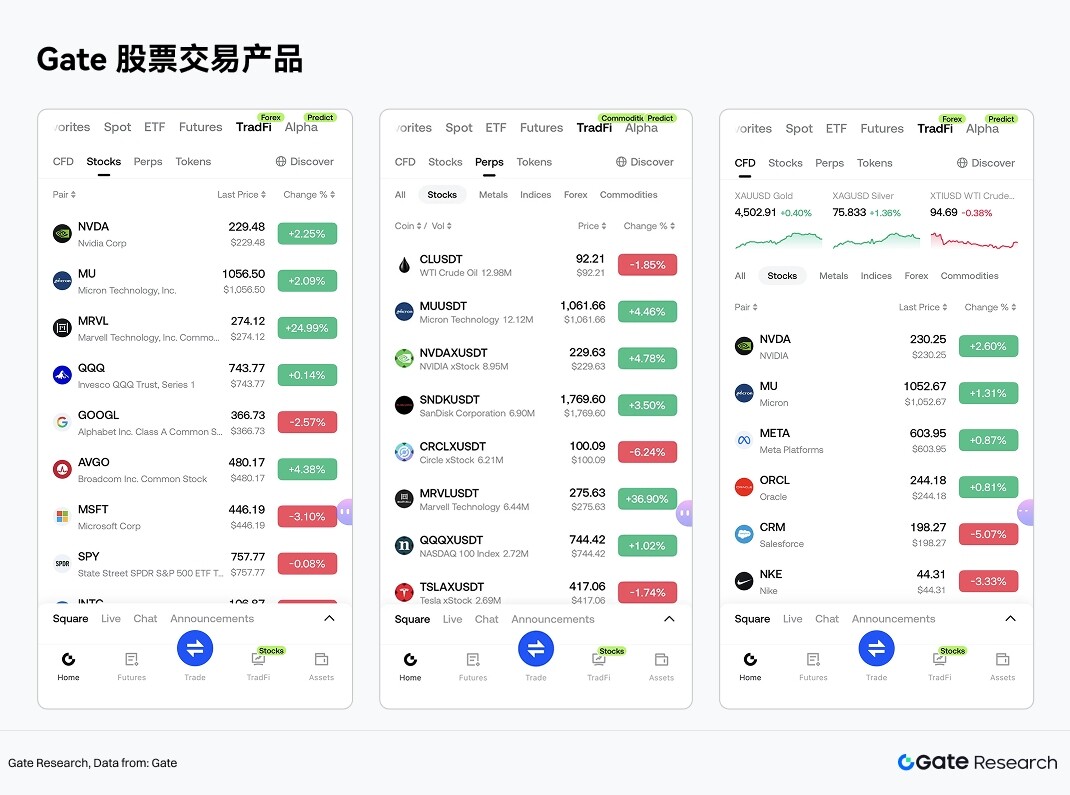
According to Gate market data, as of June 3, 2026, Micron shares were quoted at $1,056. Based on roughly 1.1 billion diluted shares outstanding, the company had a market capitalization of about $1.17 trillion. Over the past year, MU showed a volatile upward move that eventually accelerated into a breakout. The stock started near $110, rose steadily above $400 as expectations for AI storage demand strengthened, then entered another major uptrend after a phase of adjustment, supported by HBM and AI data-center demand. From May to June, it climbed sharply and touched a high of $1,076. Compared with its one-year low, the stock rose more than eightfold, and its cumulative one-year gain exceeded 800%, while the company’s market value moved above $1 trillion.
Micron currently serves four major application areas. The first is data centers and cloud computing, including AI servers, enterprise servers and networking equipment. The second is mobile devices, including smartphones and tablets. The third is storage, including enterprise and client SSDs. The fourth is embedded business, including automotive, industrial and consumer-electronics applications. As AI data-center capital expenditure expands, data-center-related storage demand has become Micron’s fastest-growing and most margin-sensitive business direction.
FY2026 Q2 results and the HBM growth line
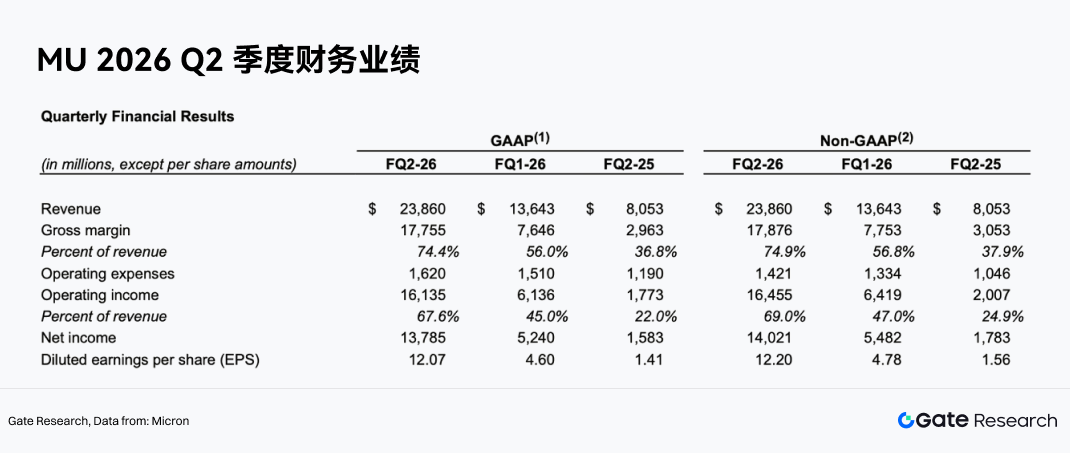
Micron’s move past a trillion-dollar market value did not come only from a rebound in the traditional storage cycle. It came from market repricing of the company’s strategic value inside the AI infrastructure supply chain. FY2026 Q2 results showed record levels in revenue, gross margin, EPS and free cash flow, confirming an earnings inflection driven by AI demand, tight industry supply and upgrades toward high-end storage products. In its FY2026 Q2 earnings announcement, Micron said the record quarter reflected the ‘strategic value of memory in the AI era.’ CEO Sanjay Mehrotra said that in the AI era, memory has become a strategic asset for customers.
Micron’s FY2026 Q2 revenue reached $23.86 billion, up sharply from $13.64 billion in the previous quarter and also well above $8.05 billion in the same period last year. Non-GAAP net income reached $14.02 billion, Non-GAAP EPS was $12.20, operating cash flow was $11.90 billion, and adjusted free cash flow was $6.90 billion. Profit quality improved at the same time. FY2026 Q2 Non-GAAP gross margin reached 74.9%, compared with 56.8% in the previous quarter and 37.9% in the same period last year. Non-GAAP operating margin rose to 69.0%, compared with 47.0% in the previous quarter and 24.9% a year earlier.
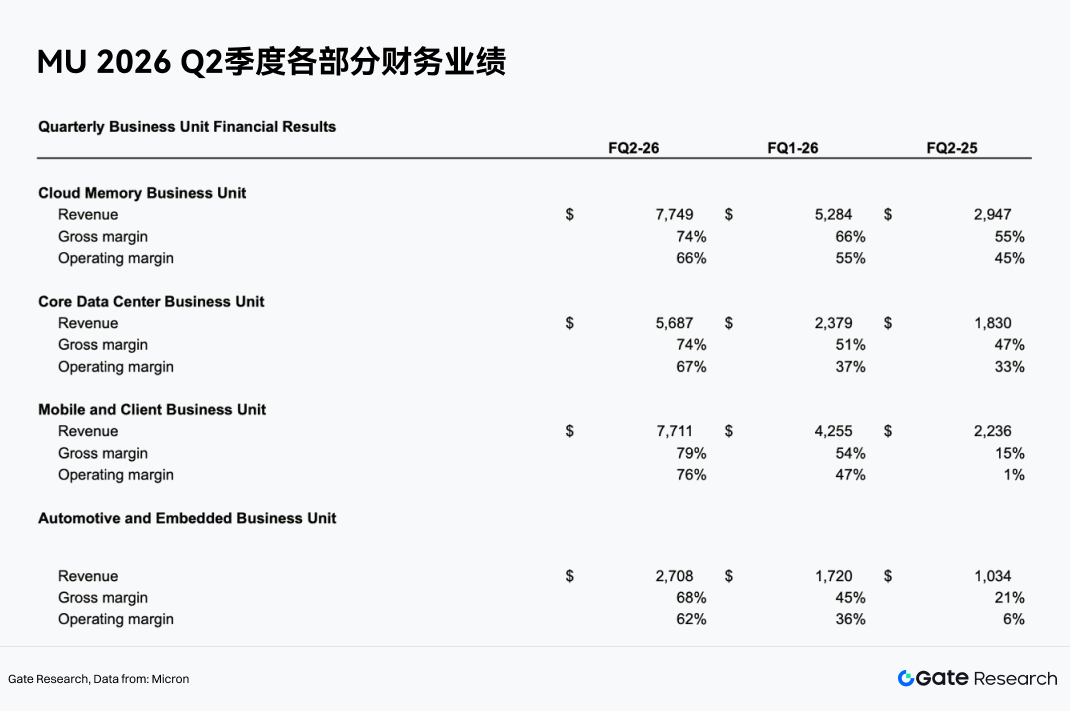
By business unit, growth was highly concentrated in AI and data-center-related areas. Cloud Memory Business Unit revenue reached $7.749 billion, with a 74% gross margin and 66% operating margin. Core Data Center Business Unit revenue reached $5.687 billion, with a 74% gross margin and 67% operating margin. Together, the two businesses generated more than $13.4 billion in revenue and became the company’s most important growth engines. This shows that Micron’s business focus is shifting from the consumer-electronics cycles of PCs and smartphones toward cloud computing, AI servers and data centers.
The product categories where Micron is benefiting most are HBM and high-end DRAM. HBM is a key storage product in AI GPUs and accelerators, with high bandwidth, high capacity and high energy efficiency. Its price per GB and gross margin are both higher than those of ordinary DRAM. UBS expects Micron’s HBM ASP to increase by about 50% year over year in 2027 and to support continued HBM revenue expansion. As AI-chip platforms iterate and demand for HBM capacity and bandwidth rises, Micron can increase the revenue contribution from HBM3E, later HBM products and advanced packaging-related capabilities.
LTAs and constrained supply reshape the cycle
Micron’s strong FY2026 Q2 performance was also driven by tight industry supply. Some institutions expect DRAM undersupply to continue until at least the second quarter of 2028, and NAND undersupply to continue until the fourth quarter of 2027. Under constrained supply, DRAM and NAND prices have continued support, helping Micron maintain high revenue and margin levels. The difference from past cycles is that high-end memory demand from AI servers is growing quickly, while HBM capacity expansion is restricted by technology, yield, advanced packaging and customer qualification cycles. Supply therefore cannot easily catch up with demand at high speed.
LTA stands for Long-Term Agreement. In the semiconductor memory industry, an LTA usually refers to a supply arrangement agreed in advance between a supplier and core customers, covering purchase volumes, delivery schedules, product specifications and, in some cases, pricing frameworks. In the past, memory procurement agreements were more often designed to lock volume rather than price. Customers committed to certain purchase volumes in advance, giving suppliers partial demand visibility, while prices still moved quickly with DRAM and NAND market supply and demand. When the industry entered a downturn, sharp price declines still directly hit revenue and profit at Micron, Samsung and SK Hynix.
LTAs are another key logic behind Micron’s valuation reset. Newer LTAs not only lock purchase volumes but also partially lock prices, with terms that can reach three to five years. For Micron, the value of LTAs lies in improving revenue visibility, reducing price volatility and strengthening earnings across cycles. For cloud providers and AI customers, LTAs help secure future storage supply and partially lock costs, reducing exposure to higher prices during tight-supply periods. Under large-scale implementation, Micron’s business model would move from that of a traditional cyclical commodity company toward a semiconductor supplier with long-term orders, steadier cash flow and stronger customer stickiness.

Micron’s FY2026 Q2 adjusted free cash flow reached $6.9 billion, and the board approved a 30% increase in the quarterly dividend. This indicates not only a major improvement in earnings, but also stronger cash-flow quality. In capital markets, stable and large free cash flow often supports higher valuation. Micron’s valuation had previously been lower mainly because the market questioned the sustainability of its earnings. Now, AI demand, LTAs and the HBM product-mix upgrade together form the basis for a shift from a traditional storage-cycle-stock valuation toward the valuation framework of a core AI semiconductor asset.
Gate Stock access and risk notes
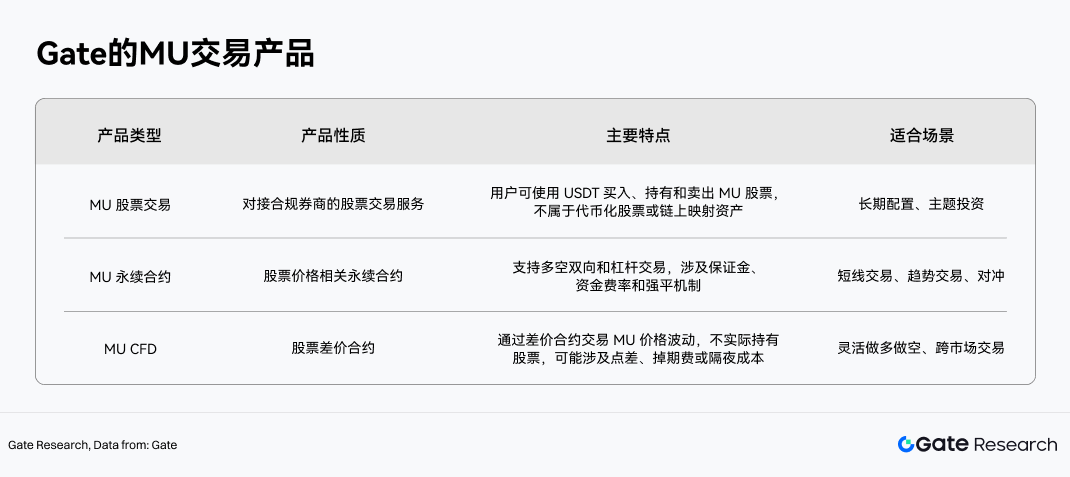
Unlike common stock tokenization or RWA mapping models, Gate Stock emphasizes market access and a compliant trading framework. By connecting with regulated brokers, Gate Stock provides users with stock and ETF trading services. It is not an on-chain mapped asset and is not a tokenized stock derivative. Users can buy, hold and sell stock assets through their Gate accounts, while positions, profit and loss, fund flows and corporate-action information can be viewed and managed in one account.
In terms of coverage, Gate Stock currently supports more than 10,000 stocks and ETF assets, covering major securities markets and liquidity networks including NYSE, Nasdaq, NYSE Arca, NYSE American and BATS. Gate Stock currently supports intraday trading and will gradually expand to 24/7 trading, providing global users with a more flexible entry point for U.S. stock allocation. Within Gate TradFi, stock-related trading tools can be divided into three categories, using MU trading products as an example. Gate stock spot trading is independent from the traditional CFD system. Stock trading does not involve funding rates found in perpetual contracts, and it differs from CFD products that may include swap fees, overnight fees or other holding costs. It is therefore more suitable for users seeking longer-term U.S. stock allocation. Perpetual contracts and CFDs are more trading-oriented tools for directional trading or risk management around Micron’s short- and medium-term price movements.

Based on a unified crypto-asset account system, Gate links digital-asset trading with stock-investment scenarios. After completing KYC and meeting regional access requirements, users can enter the stock section through the TradFi tab in the Gate App, view market quotes and participate in trading after transferring stablecoins through the trading page or asset page. This extends USDT usage from crypto-asset trading to global stock-asset allocation.
For researchers, the storage track can no longer be understood purely through a single ‘price-cycle stock’ framework. A more accurate description is a semiconductor sub-track where cyclical attributes remain, while the weight of structural upgrading continues to rise. Micron provides a clear sample for observing that transition. At the same time, LTAs still involve uncertainty around locked-price ratios, execution terms and customer commitments, and they cannot fully remove industry volatility. Micron’s share price and market value have already risen sharply, and expectations for an AI storage supercycle and valuation reset are high. If results fail to meet those expectations, share-price volatility can intensify. Gate Research is a comprehensive blockchain and cryptocurrency research platform that provides technical analysis, hot-topic insights, market reviews, industry research, trend forecasts and macroeconomic policy analysis. Cryptocurrency market investment involves high risk. Users are advised to conduct independent research and fully understand the nature of the assets and products they buy before making any investment decision. Gate does not assume responsibility for any loss or damage caused by such investment decisions.