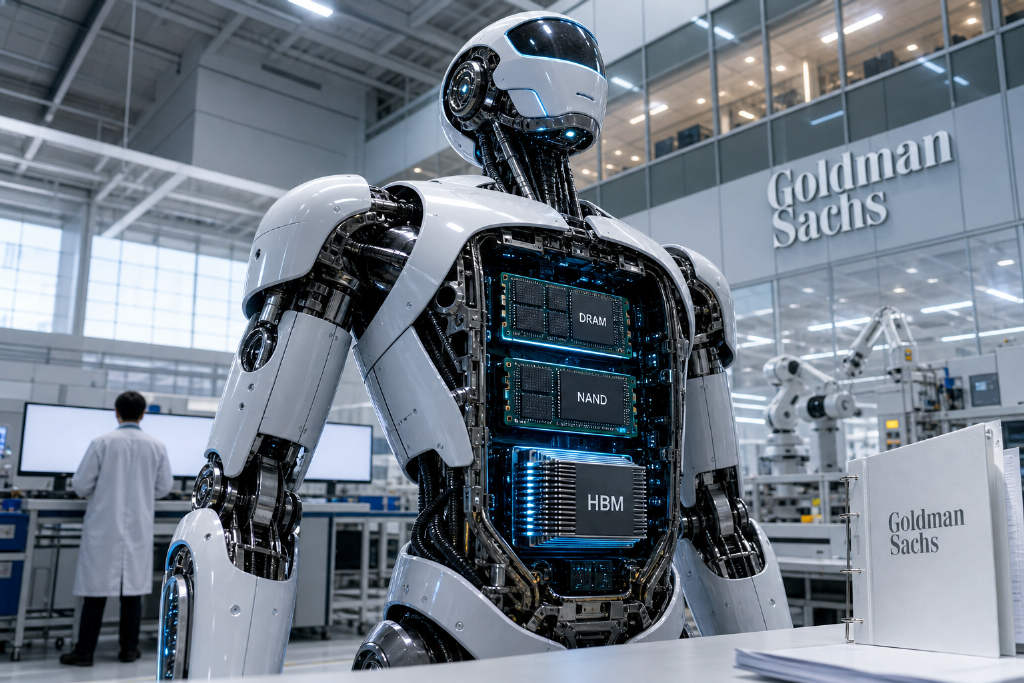
Goldman Sachs estimates that memory could account for as much as 40% of a humanoid robot’s semiconductor value, excluding GPUs and CPUs, according to a post by Paradis on X. The bank’s working assumption is that an average humanoid robot will carry about 128GB of DRAM and roughly 1TB of NAND non-volatile memory. On that basis, the serviceable market for DRAM per unit is put at $250 to $350, while NAND is estimated at $350 to $450. Combined, total memory value per robot comes to about $600 to $800, or potentially more. Goldman Sachs also said at least part of each system’s memory stack is expected to use high-bandwidth memory, or HBM, because humanoid robots face heavy edge-computing workloads. The note added that HBM supply is currently dominated by Micron, Samsung and SK Hynix, leaving limited near-term competitive pressure for Chinese memory makers including CXMT. The bank said it remains unclear whether robot makers will source HBM and conventional DRAM from different suppliers, and noted that DRAM and NAND pricing could shift even though its assumptions use prevailing market prices at the time of writing.
Odaily reported that Paradis said in a post on X that Goldman Sachs expects memory to make up as much as 40% of a humanoid robot’s semiconductor value, excluding GPUs and CPUs.
Goldman Sachs said memory configurations may vary, but its base assumption is that a single humanoid robot will carry about 128GB of DRAM and around 1TB of NAND non-volatile memory on average. Based on that assumption, the serviceable market for DRAM per unit is estimated at $250 to $350, while NAND is estimated at $350 to $450. That puts total memory value per robot at $600 to $800, or higher.
The bank also said at least part of the memory in each system is expected to use high-bandwidth memory, or HBM, given the heavier edge-computing workload associated with humanoid robots. HBM is mainly supplied by Micron, Samsung and SK Hynix, and Goldman Sachs said Chinese memory makers, including CXMT, may face limited competition in the near term.
It also said it remains to be seen whether humanoid robot manufacturers will buy HBM and conventional DRAM from different suppliers.
Goldman Sachs added that DRAM and NAND prices may change, but its assumptions use prevailing market prices at the time of writing because many long-term agreements have been signed at those price levels.
This article was originally published by Bit.Fan. For more cryptocurrency news and market insights, visit www.bit.fan. Disclaimer:
The market information, project data, and third-party content displayed on this platform are for industry information sharing only and do not constitute any form of investment advice or return commitment.
Cryptocurrency trading carries high risks. Users should fully assess their risk tolerance and make independent decisions. All profits, losses, and legal responsibilities are borne by the users themselves.