

Goldman Sachs has reiterated its buy ratings on Samsung Electronics and SK Hynix after their shares fell 23% and 35% over the past month, arguing that the market is underestimating how durable earnings may prove in this memory cycle.
In Goldman’s view, three factors support that call: HBM pricing could move higher again in 2027, long-term supply agreements are expanding and locking in capacity, and supplier inventories remain low enough to reduce the risk of a sudden swing into oversupply. The report says those changes could lower earnings volatility and improve visibility on future revenue and profit for both companies.
That argument has not won over the market. Investors are still worried about softer memory pricing expectations, limited transparency around long-term contract terms, rising module-maker inventories, more supply from China, and the risk that capacity expansion eventually recreates a glut. SK Hynix’s weaker-than-expected second-quarter operating profit has also added to doubts about earnings sustainability.
Goldman expects HBM pricing to regain a premium in 2027
HBM is a critical memory component for AI accelerators, and Goldman says its pricing will have a direct effect on profit leverage for Samsung and SK Hynix over the next two years.
The bank expects the two companies’ blended HBM average selling prices to approach $2.9/Gb in 2027, implying year-over-year increases of 87% for Samsung and 100% for SK Hynix. Around 60% of the increase in key products, measured on a like-for-like basis, would come from higher pricing. The rest would come from product mix, including a larger contribution from newer generations and higher-layer HBM.
Goldman ties that 2027 reset to supply and demand. AI server demand may continue to outpace HBM supply, while the latest HBM generations are becoming harder to manufacture. More advanced processes are being used for core die and base die, higher-layer stacks increase process complexity and hurt yields, and newer HBM products consume more wafer capacity. All of that limits effective supply.
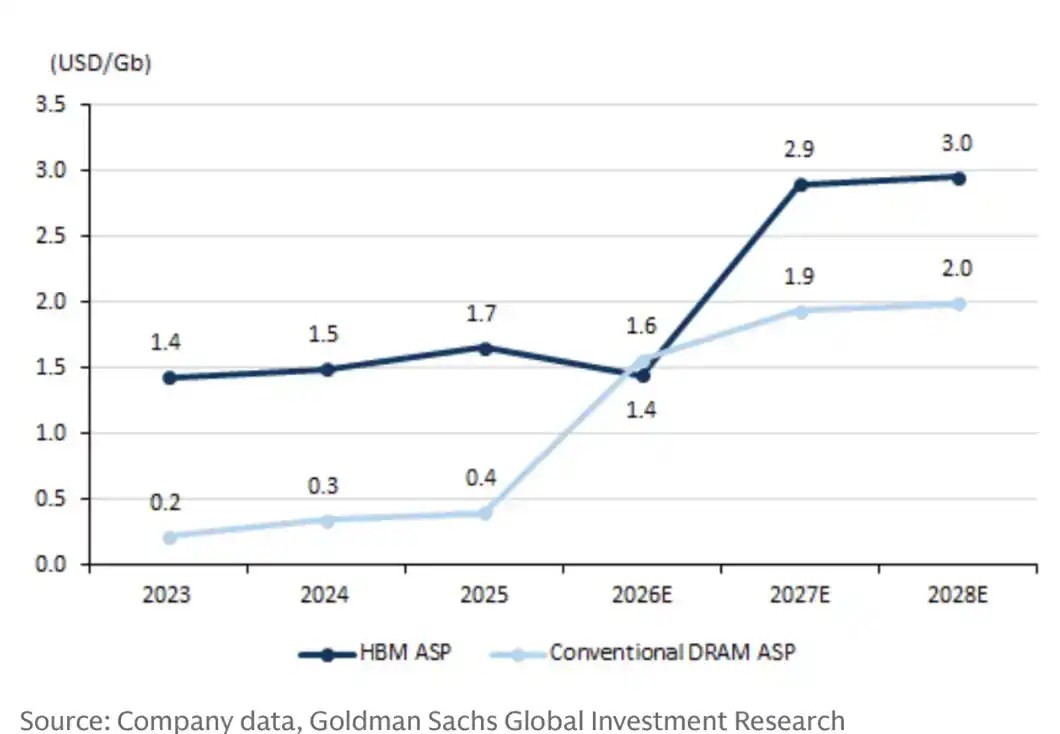
The report also says the pricing relationship between HBM and conventional DRAM has shifted. HBM is typically negotiated on an annual basis, which keeps prices relatively fixed during the year. Conventional DRAM is repriced monthly or quarterly and reflects market moves faster. By the second quarter of 2026, conventional DRAM pricing had already moved above HBM pricing. Goldman expects conventional DRAM average selling prices to rise to about $2/Gb by the end of 2026, up sharply from roughly $0.5 to $0.6/Gb at the end of 2025.
If HBM is to preserve the margins and premium expected of a high-end product, Goldman argues that a repricing in 2027 becomes necessary. Citing Visible Alpha, the report says market consensus for SK Hynix’s 2027 HBM average selling price is around $2.3/Gb, about 24% below Goldman’s $2.9/Gb estimate.
HBM is also expected to account for a larger share of revenue. Goldman forecasts HBM as a percentage of DRAM revenue rising from 8% and 14% for Samsung and SK Hynix in 2026 to 16% and 22% in 2027, then to 18% and 25% in 2028. If pricing and shipments come through as projected, AI-related memory would become a larger and more visible part of both companies’ profit mix.
Long-term agreements are extending to 3 to 5 years
Annual HBM pricing explains where 2027 upside could come from. Multi-year LTAs are Goldman’s answer to a different question: why this memory cycle may be steadier than prior ones.
In a traditional cycle, customers place concentrated orders during shortages and cut purchases quickly when demand softens. Suppliers expand on the back of strong expectations, then absorb the downside when prices fall and inventories build. Goldman says the new wave of long-term agreements is changing that setup through longer contract periods, higher coverage ratios, price protection, and prepayments that shift part of the risk to customers earlier.
According to the report, LTAs now typically run for three to five years, with most structured on a five-year base and some on three years. Samsung uses a rolling contract structure that extends the term by one additional year through annual negotiations, which means effective cooperation can last longer than five years.
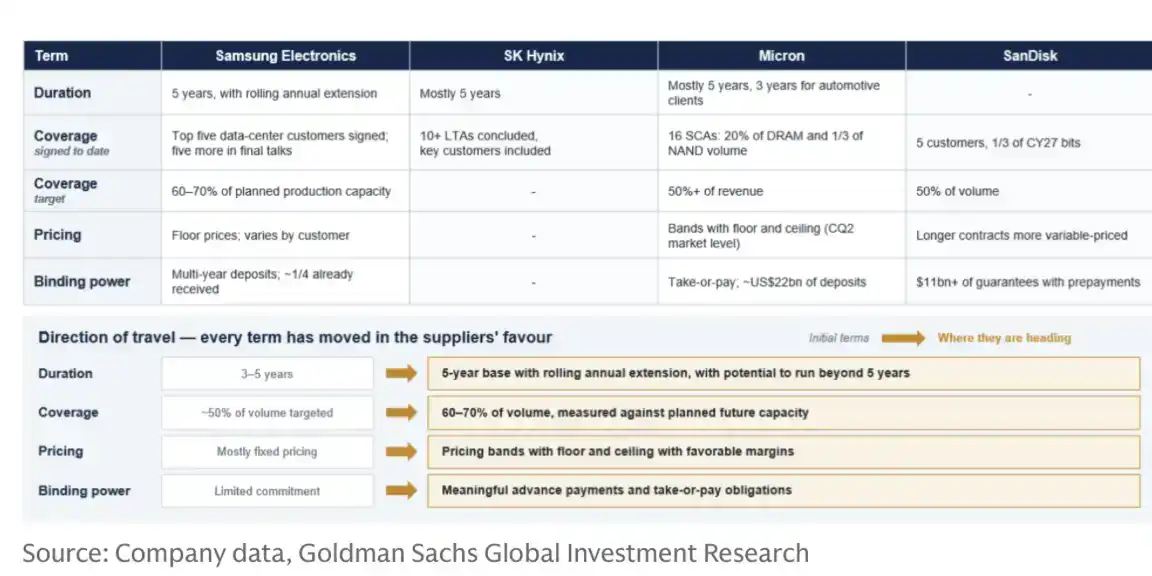
Coverage is broadening as well. Goldman says Samsung has already signed contracts with the world’s top five data center customers and is in final negotiations with another five major AI-demand-related customers. Once those talks are completed, multi-year agreements are expected to cover 60% to 70% of its planned capacity.
SK Hynix has said it completed LTA negotiations with about 10 customers, including key accounts. Micron has disclosed 16 strategic customer agreements covering about 20% of DRAM shipments and about one-third of NAND shipments over the contract period, and it expects such agreements to eventually cover more than 50% of its revenue.
The terms themselves are getting tighter. The pricing structures under discussion include fixed prices, price bands with upper and lower bounds, and floor prices. Price bands can reduce severe swings, while floor prices limit downside risk for suppliers and still leave room to benefit when market prices rise.
Some contracts also include take-or-pay provisions, prepayments, and penalties for non-performance. Micron expects to receive $22 billion in cash deposits and related financial commitments. Sandisk has disclosed more than $11 billion in financial guarantees and prepayments. Samsung has also said it has already received roughly one-quarter of total contract prepayments.
For memory makers, securing stronger customer commitments before adding capacity could reduce exposure to future demand shifts. Capital spending can still create supply pressure, but if a large share of future output is already covered by contract, the buffer against falling prices becomes thicker.
Low inventories are still holding down fears of a reversal
Goldman does not dismiss recent concern over rising inventories at module makers. Weak demand in smartphones and PCs has pushed some of them to build stock.
Even so, the bank says that change matters more for market sentiment than for sector fundamentals. Module makers represent only a single-digit share of the overall memory market, while inventories at major suppliers and major customers remain at healthy levels.
As of the end of the second quarter of 2026, Goldman estimates DRAM and NAND inventories at suppliers at two to four weeks, below the normal four to five weeks and far below the more than 10 weeks often seen before a memory downturn. With capacity additions and supply growth over the next 12 to 18 months still likely to lag demand growth, low inventory levels may persist.
Customer inventories are also seen as close to normal. The report says procurement has been strong over the past few quarters, but most server memory supply has gone into immediate production rather than stockpiling. Low inventories, together with higher LTA coverage, make a sudden near-term reversal in memory pricing less likely in Goldman’s view.
Enterprise SSD demand is supporting NAND
Goldman does not argue that the whole memory market is free of risk. NAND and conventional DRAM still face pressure from soft demand in consumer electronics such as smartphones and PCs.
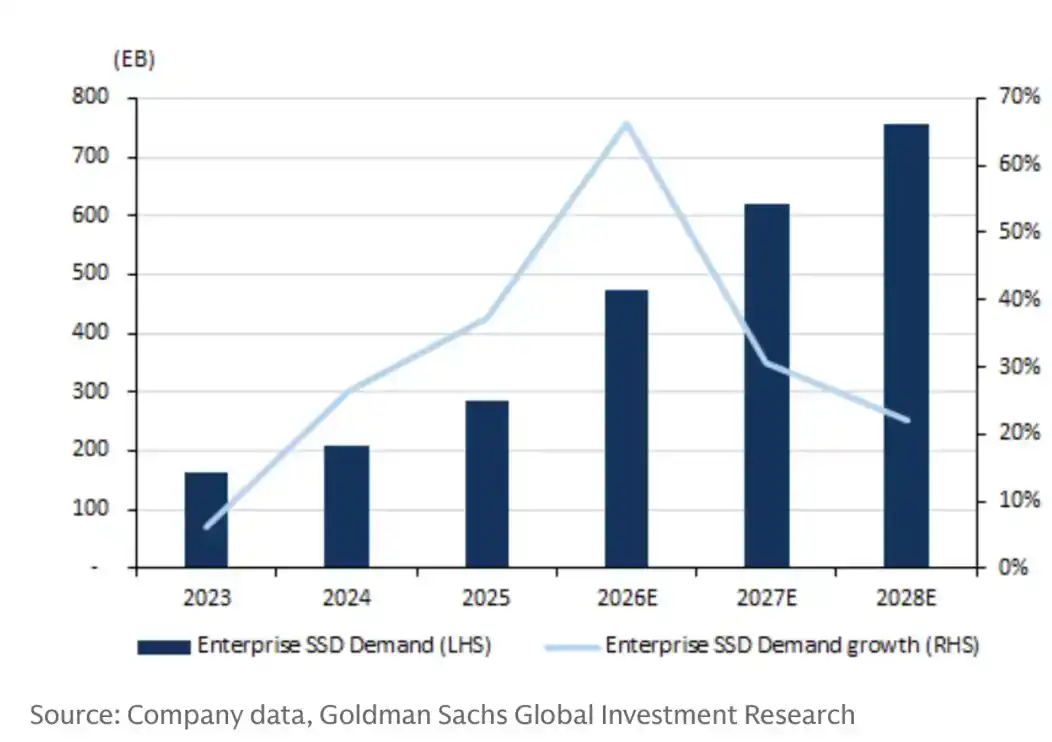
What is changing, the report says, is the source of incremental NAND demand. Goldman expects enterprise SSD demand to reach 474EB in 2026, 619EB in 2027, and 755EB in 2028, representing year-over-year growth of 66%, 31%, and 22%. Even if consumer demand stays weak, server demand could offset part of that pressure.
Supply growth appears relatively controlled. Major manufacturers are directing more capital spending toward DRAM, while NAND investment is focused more on technology migration than on a large increase in wafer capacity. Goldman therefore expects medium-term NAND supply growth to remain below demand growth.
Recent weakness in NAND spot pricing has also been concentrated in specific products such as TLC 512Gb, while products such as TLC 1Tb have been more stable. Goldman notes that TLC 512Gb prices rose nearly 600% over the past year, and the recent pullback came after a period of strong outperformance versus other products. On that basis, it does not treat the move as evidence that the entire NAND market has shifted into oversupply.
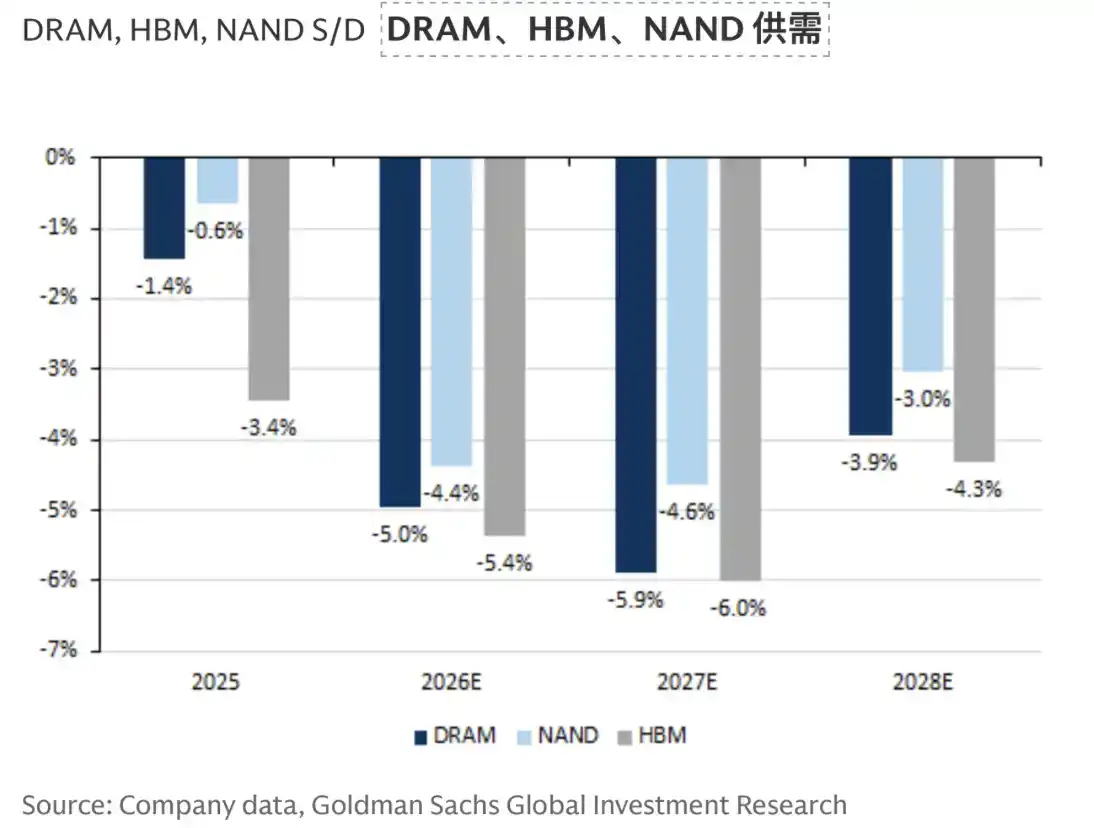
Its supply-demand model also points to tightness. Goldman forecasts supply gaps in 2027 of about 5.9% for DRAM, 4.6% for NAND, and 6.0% for HBM, with HBM the tightest of the three. A supply gap does not guarantee continuously rising prices, but the bank says the figures show that NAND has not moved straight into oversupply simply because consumer demand is soft.
CXMT is a longer-term supply variable, not a near-term disruption
The market is also watching how ChangXin Memory Technologies, or CXMT, could affect global DRAM supply and demand as it expands. Goldman expects CXMT to gain share mainly through domestic Chinese demand, while overseas sales remain constrained by both commercial conditions and geopolitical factors. Given the technology gap, Goldman says CXMT is unlikely to materially change the tight global memory balance in the short to medium term.
Citing TrendForce, the report says about 70% of CXMT’s mobile DRAM shipments this year are still LPDDR4(X). Samsung and SK Hynix, by contrast, are already centered on LPDDR5(X), which is expected to account for 75% to 85% of their mobile DRAM shipments.
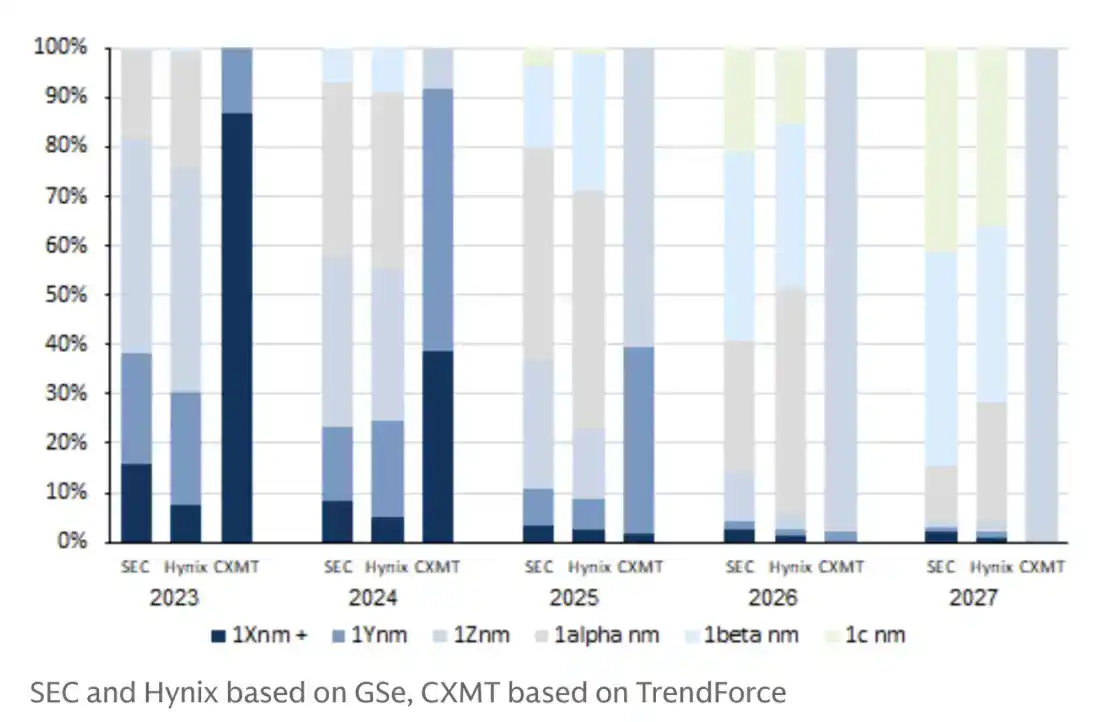
There is also a process-node gap. Goldman says CXMT’s main process is roughly at the 1z node, while the global leaders are moving from 1a and 1b toward 1c, leaving a gap of about two to three generations. Historically, each migration has taken years, and capacity expansion by itself does not erase that gap.
Equipment constraints could slow that progress further. More advanced DRAM manufacturing requires wafer fabrication tools such as EUV, and Chinese manufacturers still face limits on obtaining that equipment. The report also says domestic lithography tools would need a long development cycle to reach EUV-level performance.
HBM is harder still to catch up in. Beyond conventional DRAM process technology, it requires advanced packaging, transmission speed, power efficiency, yields, and base-die foundry capability. Goldman says CXMT would need parallel upgrades across China’s advanced-process and packaging supply chains to become competitive in HBM.
What could challenge the bullish call
Goldman’s rating is constructive, but the report is explicit about the risks. If AI server demand comes in below expectations, the scope for HBM price increases would narrow. If the final terms of LTAs provide weaker price protection, lower prepayments, or lighter purchase obligations than currently assumed, earnings visibility would also weaken. And if supply in mature process nodes keeps expanding, prices for conventional DRAM and consumer-oriented products could still remain under pressure.
After the recent share-price correction, Samsung Electronics and SK Hynix are trading at levels that reflect continued skepticism over whether this memory cycle can avoid the sharp swings seen in the past. Goldman’s bullish case rests on three things happening at once: HBM repricing, long-term capacity lock-ins, and low inventories. The next test is whether AI server orders keep growing, whether LTA terms are fully implemented, and whether new capacity stays disciplined before demand expands further.