
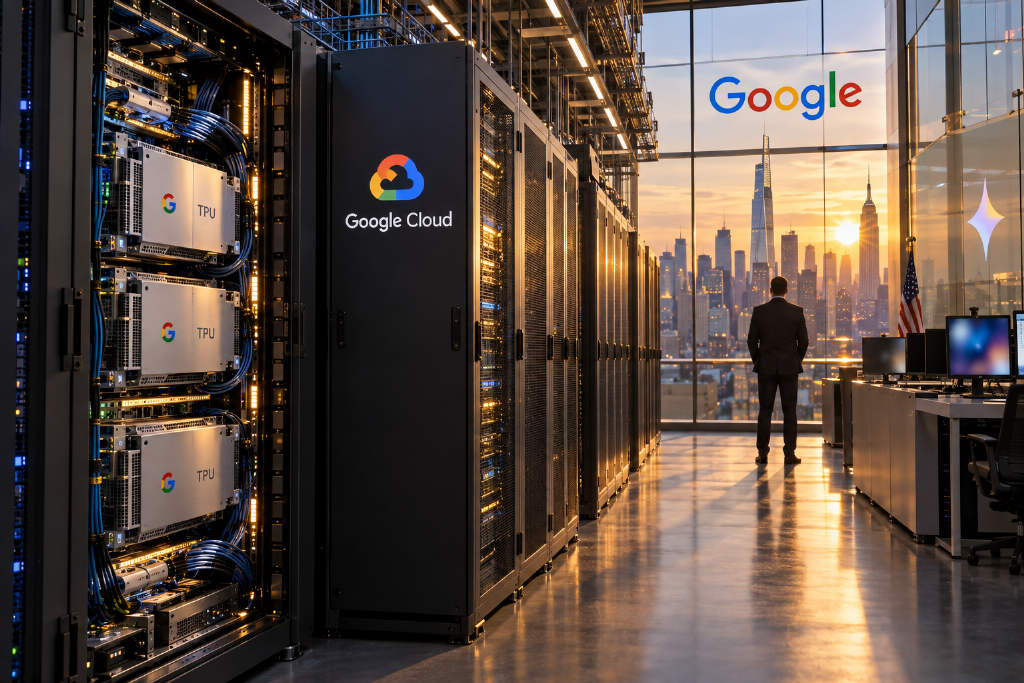
Google Cloud Chief Executive Officer Thomas Kurian said the company’s AI infrastructure spending is not a speculative expansion made in the absence of business demand. The overall payback period for AI servers is less than two years, he said, and that timeline is cut in half when Google uses its own chips.
Speaking at the 2026 Goldman Sachs Communacopia + Technology Conference, Kurian said Google Cloud is using a full technology stack — in-house chips, Gemini models, data platforms, security products and enterprise applications — to win new customers and large enterprise contracts at a faster pace.
TPU-based systems may pay back in less than a year
Kurian said Google Cloud’s AI accelerator business offers three main chip categories: Nvidia GPUs, Google’s in-house Tensor Processing Units, or TPUs, and Arm processors used to run model-generated code.
According to Kurian, Google Cloud can deliver about 2.7x price-performance in AI training, about 80% higher inference performance, and about 30% better CPU price-performance. He also said Google Cloud’s TPU business is already more than twice the size of the AI accelerator business of the next-largest hyperscale cloud provider.
On the question investors have been asking most often — whether AI capital spending can generate adequate returns — Kurian said again that the overall payback period for Google Cloud AI servers is less than two years, and only half that when the systems use Google’s own chips. That implies a payback period of less than one year for Google’s TPU-based AI servers.
He added that most infrastructure contract value comes from five-year agreements with long-term commitments, which helps improve revenue visibility and reduces the recovery risk tied to large compute investments.
Google Cloud is offering several TPU business models
Google Cloud said it offers several commercial models for TPUs, including subscription services on its own cloud, direct hardware sales to enterprises, and external compute supply through a neocloud built in partnership with Blackstone.
If an enterprise buys TPU systems directly and deploys them in its own data center, Google Cloud does not need to take on the associated spending for facilities, power and space. Kurian said that structure can also improve free cash flow and capital efficiency.
Customer acquisition has more than doubled from a year earlier
Kurian said Google Cloud’s annualized revenue is now approaching $100 billion. New customer acquisition has risen by more than 2x from the same period last year, while large transactions above $100 million have also grown by more than 2x on both a quarter-over-quarter and year-over-year basis.
Actual usage often runs above the original commitment, he said. As an example, when a customer commits to spend $100, the final amount is typically more than 50% higher, meaning actual spending exceeds $150.
Google Cloud now has more than 17 product lines with annual revenue above $1 billion, spanning chips, cloud compute, Gemini models, data management, network security and enterprise applications. Kurian said this vertically integrated model means Google is not limited to selling models through APIs; it can also earn revenue from AI agents, chips, data platforms and security demand, reducing reliance on any single product or business model.
Gemini Enterprise is used by 90% of the Fortune 100
Beyond hardware, Google Cloud is positioning Gemini Enterprise as an enterprise AI agent platform. Kurian said traditional chatbots mainly answer questions, while AI agents can take a goal, break the task down, plan execution steps, call different tools, connect with internal enterprise systems, complete the work and deliver the result.
Gemini Enterprise has now been adopted by 90% of the Fortune 100, according to Kurian, and about 80% of Google Cloud customers are using AI products. Customers that use AI also use 1.8x as many Google Cloud products as non-AI customers on average. On a five-year basis, the lifetime value of Gemini customers is about 50% higher.
Kurian cited several use cases: Citigroup is using Gemini Enterprise to build wealth management advisors, PepsiCo is using it for supply and demand planning, Macy’s is using it for retail commerce, and German insurer Signal Iduna is using it to analyze claims and underwriting data.
The competition is shifting toward payback speed
Data released by Google Cloud suggests competition among cloud giants is moving away from a simple contest over who can spend the most capital and toward who can recover that investment faster. Kurian said Google’s advantage is that it controls chips, data centers, Gemini models, data platforms and enterprise applications at the same time, allowing the company to tune the full stack for different workloads and lower the cost of each training and inference run.
With in-house TPU payback running at less than one year, Google can reduce its dependence on outside chip suppliers while serving Gemini and third-party customers at lower cost. Combined with five-year compute contracts signed by enterprises, Google Cloud is trying to show that rising AI capital spending is supported by long-term demand and measurable returns on investment, rather than a bet on growth that has yet to materialize.