
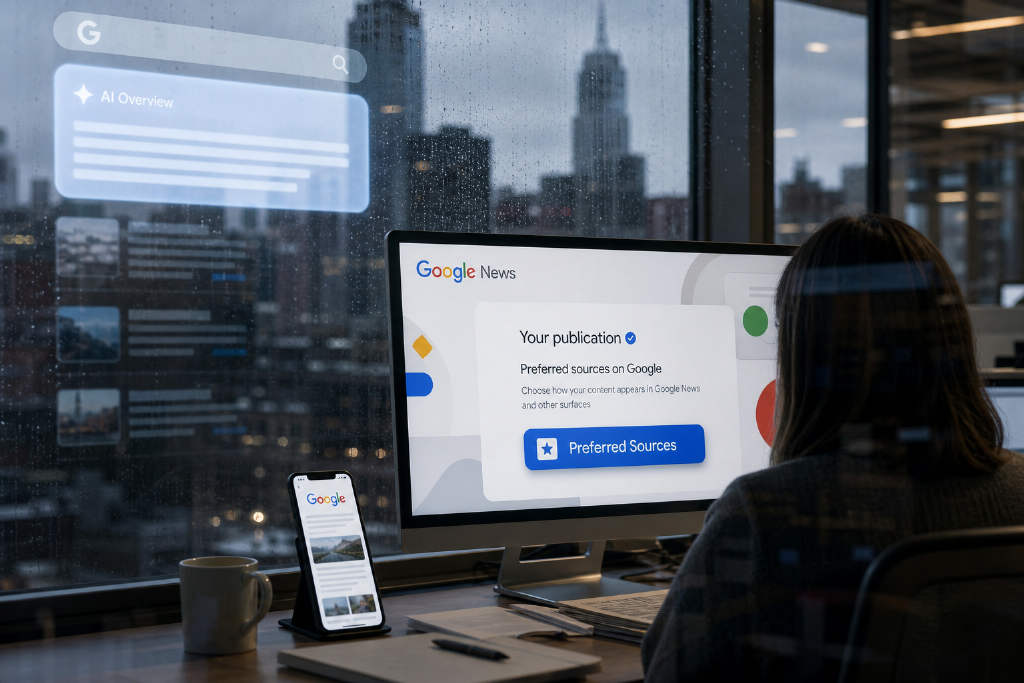
Google said on Aug. 20 that it is launching a new embedded "Preferred Sources" button for publisher websites, giving readers a way to mark outlets they want to see more often across Google Search, Discover and Google News. In the same blog post, the company said the number of readers using Preferred Sources climbed from 345,000 to 600,000 in three months.
The button can be placed directly on article pages. Once clicked, it adds that site to a reader's preferred source list. Google said selected outlets may then appear more often in Top Stories, AI Overviews and AI Mode.
A direct on-site tool for publishers
According to the report, readers who click the button on a publisher page can add the outlet without being redirected away from the article, and they return to the same reading position after the action. The process does not require a separate trip to a Google page.
Publishers that want to use the feature can pull the code from the "Preferred Sources" page in Google Search Central's developer documentation. The article says no separate application or approval process is required. Readers can also manage their lists manually from Google's Preferred Sources settings page by searching for a media brand name or URL and adding sites one by one.
Preferred Sources first appeared only in the Top Stories section, then expanded in May this year to AI Mode and AI Overviews. The new embedded button moves that choice from Google's own interface to publishers' sites, allowing creators to prompt readers directly instead of waiting for them to find the setting on their own.
Google said early research showed users were twice as likely to click when their preferred sources appeared in results than when no preference had been marked.
Discover and Google News updates come with the rollout
The announcement also included two related product changes.
- In the Google app's Discover feed, users will be able to fine-tune recommendations with natural-language instructions through the three-dot menu next to an article, telling Google what they want more or less of.
- On Android, Google News daily audio briefings will let readers choose topics, show the source of each story and include links to full articles, while adding more publishers participating in the Google News AI pilot program.
Publishers still face a much larger traffic problem
The report argues that the promise of "double" click-through rates says little without a clear baseline. At the same time, outside studies point to a much bigger hit from AI-generated search summaries.
Ahrefs said in a February 2026 study that AI Overviews reduced click-through rates for top-ranking pages by 58%, nearly double the 34.5% decline reported in a similar study from April 2025. Set beside Google's own "2x" figure, the contrast is sharp: one number is being used to encourage publisher adoption, while the other reflects how much traffic publishers may already be losing.
Pew Research Center found that when AI summaries appeared on a page, only 8% of users clicked traditional search results, compared with 15% when no AI summary was shown. Digital Content Next, an industry group representing digital content creators, said most members saw traffic declines ranging from 1% to 25%, while some reported drops of more than 75%.
In that framing, the button can only recover a small fraction of what has been lost. The broader change is that AI summaries are reshaping how search traffic gets distributed.
Control over distribution rules remains with Google
The article says the more basic issue is not whether readers get one more preference tool, but that Google still sets the rules of the system. For years, publishers allowed Google to index their websites in exchange for referral traffic. With the rise of AI Overviews, that balance has weakened.
In September 2025, Penske Media, owner of Rolling Stone and Variety, filed an antitrust lawsuit against Google, accusing the company of abusing its dominance in search and breaking the old exchange model. The complaint, as cited in the article, argues that publishers are effectively being forced to supply material to AI summaries without receiving equivalent traffic in return.
From that perspective, the Preferred Sources button gives readers more say over which outlets they want to see, but it does not give publishers authority over how recommendation rules are set. Decisions over which outlets are recommended, cited in AI summaries or placed first in results still sit with Google.
The report concludes that the button adds a layer of reader preference on top of Google's existing control, while publishers are left to embed it and wait for the outcome.