
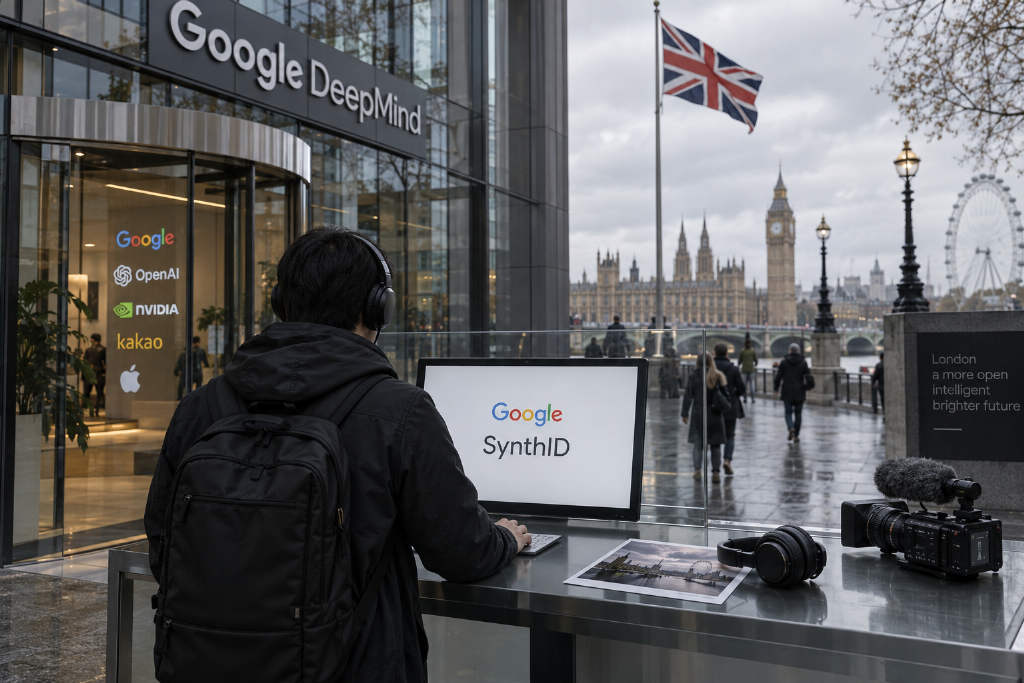
Google DeepMind said on Oct. 7 that SynthID Detector, a tool for checking AI-generated media, is now open to all users. People can upload images, videos, or audio files to see whether the content was generated by Google or by partner companies’ AI tools, including OpenAI, NVIDIA, and South Korea’s Kakao. Apple is expected to join soon.
SynthID has been applied to more than 180 billion images and videos
In an official blog post, Pushmeet Kohli, vice president of science and strategic initiatives at Google DeepMind, said SynthID is a technology Google launched in 2023. It embeds invisible digital watermarks into AI-generated images, video, and audio.
Google said more than 180 billion images and videos have already been marked with SynthID watermarks. It also said the total amount of watermarked audio now equals 240,000 years in duration. Verification features built into Google Search, the Gemini app, and Chrome process more than 1 million queries each day.
Standalone website is live, with English-only interface for now
The newly opened version is a standalone website and currently supports only an English-language interface. According to MacRumors, users need to sign in before they can use it.
Supported file types include JPG, PNG, WEBP, and HEIC for images; MP4, MOV, and WEBM for video; and WAV, MP3, and FLAC for audio. For images, the detector checks whether a watermark is present. For video and audio, it highlights the segments that contain the watermark.
It is not a general AI detector
Google states on the detection site that SynthID Detector is not a general-purpose AI detector. It can only identify content generated by participating companies’ AI tools when that content carries a SynthID watermark. If the content was created by other models or has been heavily modified, the result may appear as not detected.
MacRumors also said the tool cannot distinguish between content generated entirely by AI and content that was only edited with AI.
OpenAI also moved on text watermarking earlier this week
On text watermarking, OpenAI said earlier this week that it had added watermarks to ChatGPT text outputs in the European Union. The company said it is using its own textGrain technology to meet labeling requirements under the EU AI Act.