
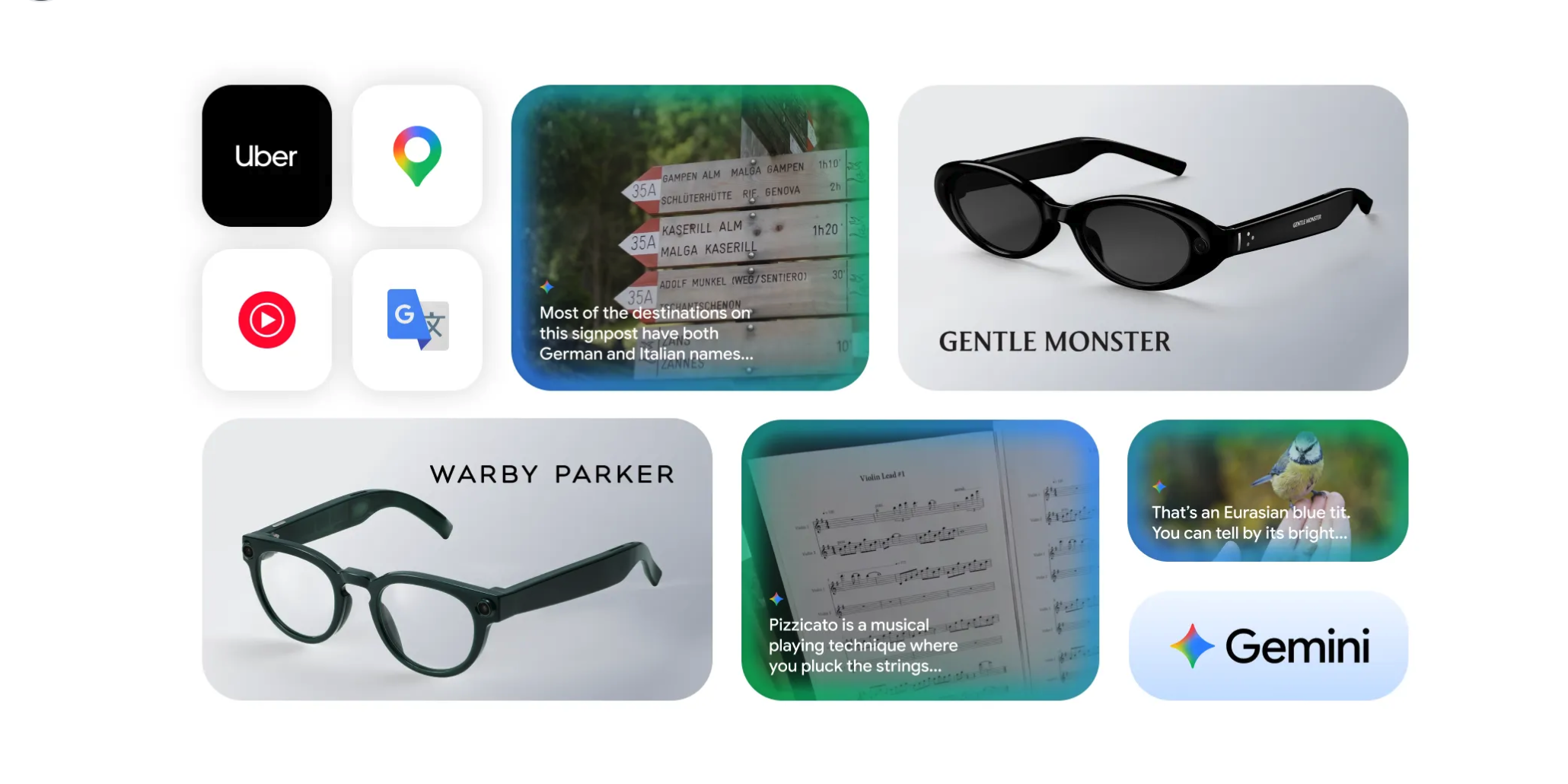
Google used its I/O 2026 developer conference to announce a return to smart glasses, starting with Audio Glasses scheduled for this fall and followed later by Display Glasses. The new push brings together several partners: Samsung is co-designing the hardware, Qualcomm is supplying the chips, Warby Parker and Gentle Monster are handling design collaboration, and the devices run on Android XR with Gemini integration while supporting both Android and iOS.
Audio first, display later
The first product in the lineup does not include a screen. Audio Glasses rely on voice controls and taps on the side of the frame, with users able to activate the device through “Hey Google.” Google said the glasses support real-time language translation, navigation prompts, notification summaries, and spoken requests tied to the surrounding environment. During the onstage demo, a Googler used the glasses to place an online coffee order without taking out a phone. Display Glasses are planned as the next step, though Google has not given a launch date.
Why Google is starting with a lower-spec model
The decision reflects lessons from the original Google Glass. When that product launched in 2013, it centered on visual display and augmented reality, but ran into weak social acceptance, battery limits, and unclear everyday use cases. This time, Google is taking a narrower approach that looks much closer to Meta’s recent playbook: make the glasses easier to wear in public first, then expand what they can do.
That strategy already has market evidence behind it. According to the source material, Meta’s return through Ray-Ban smart glasses in 2023 has led to sales of more than 2 million units, giving it over 70% of the smart glasses market. Counterpoint Research also reported that AI glasses sales rose 200% year over year in the first half of 2025, with Meta holding 73% of the category.
An Android ecosystem play, not a standalone gadget
Google’s partner list points to a broader platform strategy. Samsung brings hardware integration, supply chain depth, and distribution through the Galaxy ecosystem. Qualcomm remains a key chip supplier for AR and XR devices. Combined with Android XR and Gemini, the new glasses appear positioned as an extension of the Android device stack rather than a separate hardware experiment. That could lower switching friction for buyers and help Google build early volume through its existing mobile user base.
Meta leads for now, and Apple is preparing its entry
Google is returning to a market that is no longer empty. Meta remains the strongest incumbent. The source says the $800 display-equipped Ray-Ban Meta model has seen such strong demand that expansion in the UK, France, Italy, and Canada has been paused, while Meta is discussing plans with EssilorLuxottica to double capacity to 20 million units by the end of 2025.
Apple is also on the horizon. It has signaled that its smart glasses will be revealed in 2026 and released in 2027. With multiple major companies committing to production and chip vendors supporting the category, smart glasses are moving beyond a concept pitch. The open question now is which company can turn occasional trial use into a daily habit.