
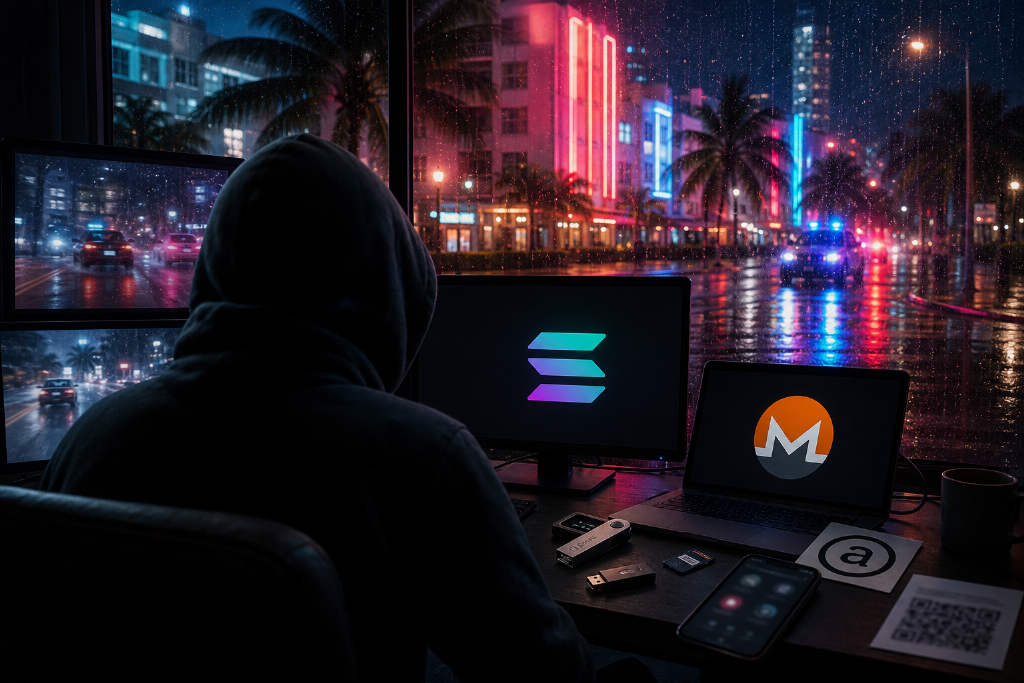
TechFlowPost reported that the hacker identified as CyberLeek, who has been releasing gameplay material tied to Grand Theft Auto 6, used a crypto-heavy operating model that extended beyond the leaks themselves.

The article says CyberLeek combined token issuance, decentralized hosting and privacy-coin payments into one system covering distribution, audience capture, takedown resistance and anonymous communications. It also says the case has drawn attention from both gaming and crypto audiences as leaked GTA 6 footage continued to circulate.
Token launch came before the leak campaign
According to the report, CyberLeek first issued a Solana-based meme coin under the same name, $CYBERLEEK. Only after the token had been live for several days did he begin releasing the footage in stages.
The article says each leaked video carried a watermark promoting the token. It also describes a token-holder voting system: people holding $CYBERLEEK could vote on what should be leaked next, with examples including daytime driving scenes or nighttime aircraft footage.
Leak website front end was reportedly placed on Arweave
TechFlowPost says CyberLeek bypassed conventional Web2 hosting and deployed the front end of the leak site on Arweave, a decentralized storage network.

In the article’s account, that gave the site a censorship-resistant base because the data would remain permanently on-chain. The report also says the hacker had publicly stated earlier that backup copies of the leaked game material had been uploaded to servers around the world, and that those files required daily manual maintenance to remain in a stored-but-not-published state.
The article adds that if his personal safety were threatened, including a scenario in which he was detained, the loss of manual maintenance would trigger an automated publication process. In that case, the report says, a full “study version” of GTA 6 could spread across the internet ahead of release. The author notes that several sources have since been taken down, making the Arweave-hosted site difficult to locate now.
Monero amounts and Session IDs were used for contact matching
The report says anyone wanting to buy ad placement in a future leak video, or commission a custom clip carrying a brand, would need to pay 400 XMR, described in the piece as roughly $165,000, as an initial fee.
When a visitor entered the “contact” page on the Arweave-hosted site, the system was said to generate two items automatically:
- a new Session account
- an XMR amount precise to many decimal places
TechFlowPost gives one example amount: 400.818811529987 XMR. According to the article, the decimal portion functioned as the system’s key signal. The buyer had to send that exact amount from a separate personal wallet.

The report says that on Monero, where transaction details are hidden by default, CyberLeek could scan for the exact decimal pattern and match the payment to the corresponding Session account. It adds that exchange withdrawals could fail for this purpose because rounding or withdrawal fees might alter the final amount. The article gives a simple example: if the on-chain amount differed by as little as 0.01, the signal would be broken.
In that setup, the payment itself acted as authentication, without a message, registration or visible identity trail. The article also points to Monero’s privacy properties, saying the amount is hidden by default and both sender and recipient are obscured within ring signatures, making outside attribution harder.
Take-Two has begun legal action, the report says
The article says game publisher Take-Two has already started looking for the people involved and has been sending out subpoenas. It does not claim a final outcome, but says the standoff between the hacker and the legal system may only become clearer over time.
TechFlowPost also says some overseas community members have framed the episode as a form of rebellion, citing the long wait for official gameplay footage, high preorder pricing and a digital-only sales approach that, in the article’s description, leaves buyers without the option of reselling a disc copy. The piece closes by saying the conduct remains illegal, while noting that the use of permanent storage, a privacy coin and meme-token voting gave the operation a distinct crypto-punk flavor.
