

HYPE has surged in recent days, smashing through the $75 mark to set a new all-time high. The rally unfolded against the backdrop of a high-profile $100,000 wager between BitMEX co-founder Arthur Hayes and former Multicoin Capital co-founder Kyle Samani. In late May, Hayes boldly declared, “HYPE should at least outperform SOL before this bull cycle ends,” and has repeatedly predicted a $150 target. The feud ignited when Samani first attacked Hyperliquid in the community; the ensuing back-and-forth culminated in a bet that HYPE would outperform all top-10 cryptocurrencies by market cap for the remainder of the year.
HYPE Spot ETF Records 14 Days of Consecutive Inflows, Divergence Deepens
On May 12, 21Shares listed the first Hyperliquid ETF (THYP) on Nasdaq; three days later, Bitwise launched BHYP on the NYSE. Since their debut, the two ETFs have posted net inflows for 14 consecutive trading days, accumulating over $136 million—roughly 0.9% of HYPE’s total market capitalization. Bitwise’s BHYP alone accounted for $82.96 million in inflows, becoming the world’s largest HYPE ETF product.
Ranked among the 12 U.S. spot crypto ETFs by cumulative net inflows, HYPE now firmly occupies the fifth spot, trailing only BTC, ETH, XRP, and SOL ETFs, and leaving earlier entrants such as DOGE and ADA in the dust. The divergence among asset classes is striking: BTC spot ETFs have suffered 12 straight days of outflows since May 15, bleeding $2.43 billion in May—snapping the previous record of eight consecutive outflow days set earlier this year. ETH spot ETFs have leaked for 16 days since May 11, with monthly outflows totaling $540 million. Even VanEck’s newly launched BNB ETF (VBNB), which debuted on May 28, experienced four days of zero net inflows right out of the gate.
Looking at launch-week performances, HYPE’s absorption power dwarfs that of its predecessors. Per SoSoValue data, BTC spot ETFs pulled in $1.46 billion in their first two weeks, absorbing only about 0.2% of BTC’s then-market cap; ETH spot ETFs actually recorded net outflows of roughly $400 million; and SOL spot ETFs netted around $380 million, or 0.47% of SOL’s market cap. In contrast, HYPE ETFs soaked up nearly 1% of the market cap in the same period, underscoring the fervor of traditional capital.
AF Buybacks and ETF Injections Form a Dual Support Floor
Beyond ETFs, Hyperliquid’s native protocol employs a powerful value-capture mechanism: the Assistance Fund (AF). Since early 2025, 99% of all trading fees from perpetuals and spot markets are automatically funnelled into the AF address and used to continuously buy back HYPE from the market. To date, AF repurchases exceed $1.1 billion, with daily protocol revenue oscillating between $1 million and $3 million, making it the most unshakable source of buy-side demand.

Although the cumulative ETF inflows still lag behind the AF’s total, their growth pace is staggering. In just half a month, ETFs reached one-tenth of the AF’s accumulated repurchase volume, highlighted by a single-day peak of $31.62 million on May 29. Together, AF and ETFs form a complementary duo that underpins HYPE’s price.
This dual support also helps cushion the regular team token unlocks. Since 2026, team tokens unlock in a lump sum on the 6th of each month; on June 6, roughly $38.7 million worth of tokens will enter circulation. Because ETF investors generally do not delve into tokenomics or DeFi mechanics, they tend to show lower sensitivity to unlock events. As long as the project’s fundamentals hold steady, the selling pressure from unlocks may remain contained.

Meanwhile, Grayscale is entering the arena. On June 2, the firm filed an amended S-1 for the Grayscale Hyperliquid Staking ETF (HYPG), seeding it with approximately 2 million HYPE and planning to launch trading on June 4. This will open yet another compliant pathway for institutional funds to gain HYPE exposure, reinforcing the buying structure.
Institutions Go Heavy: a16z and Galaxy Digital Build Massive Positions
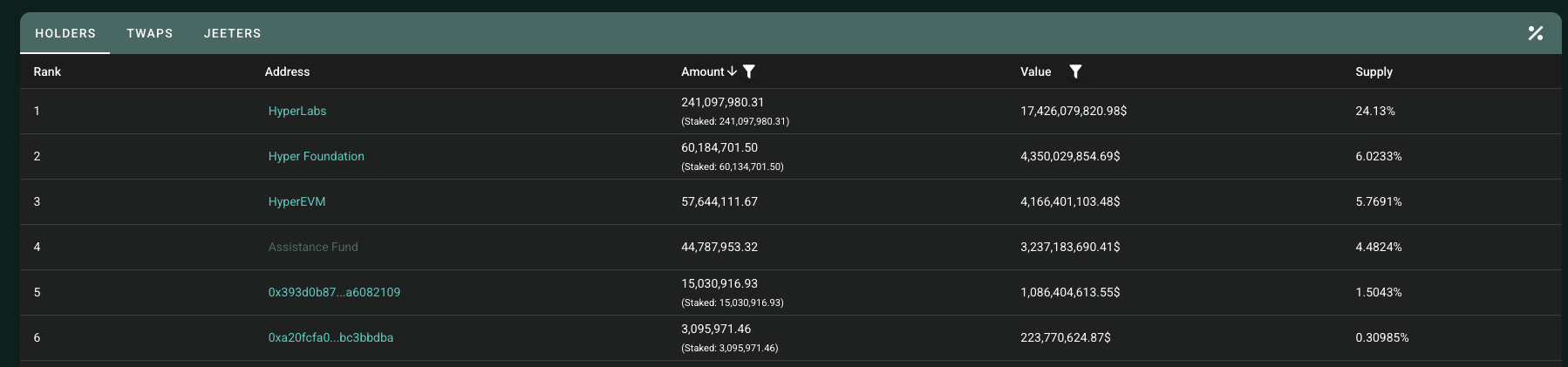
On-chain surveillance shows that top venture capital firm a16z has been quietly accumulating since August 2025. As of monitoring dates, a16z-linked addresses hold 3.095 million HYPE, worth more than $223 million, making it the largest external holder outside of Hyperliquid’s own ecosystem projects and the sixth-largest address on the HYPE blockchain.
Recent buying has accelerated: on May 28, an a16z-linked address starting with 0x4c6 withdrew roughly 254,000 HYPE from various exchanges and market makers at an average of about $59.2; just two days later, another associated address 0xb5E bought 226,121 HYPE, and since April 14 this address has acquired 3.9 million HYPE at an average cost around $49.4. Galaxy Digital has joined the buying spree as well. On June 3, it withdrew 179,000 HYPE ($12.62 million) from Coinbase, following a separate wallet purchase of 158,100 HYPE ($8.8 million) on May 21.
Institutions are not only voting with their wallets but also reframing the narrative. Bitwise CIO Matt Hougan wrote that HYPE, with real value capture, buybacks, and institutional demand, represents a “second-generation” cryptocurrency. Grayscale’s report positions Hyperliquid not as a mere Perp DEX but as a potential challenger to traditional derivatives and exchange infrastructure—a “financial services giant.”

PURR Eyes Russell 3000 Inclusion, Unlocking Passive Flows
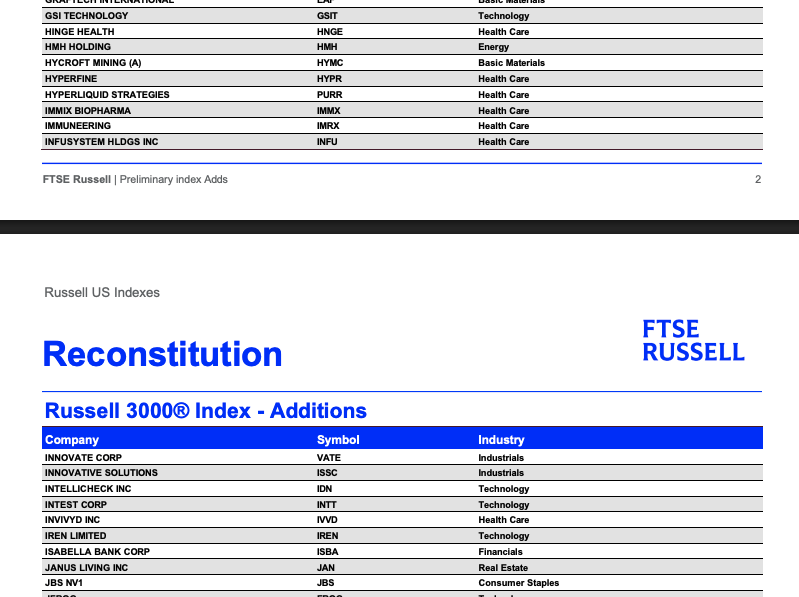
Amid a cooling DAT theme and Strategy’s recent crypto selling, publicly traded PURR—which holds HYPE exposure—continues to thrive. On May 22, FTSE Russell released preliminary additions for its June 2026 Russell 3000 index rebalancing, with PURR appearing on the addition list, effective June 26. The Russell 3000 is one of the broadest U.S. stock indices, encompassing approximately the 3,000 largest U.S. companies. FTSE Russell reports that around $10.6 trillion in assets are benchmarked to Russell U.S. indices, including index funds, pension funds, and ETFs that passively track the components.
If PURR is formally added, it will receive passive allocations that boost the stock’s visibility and liquidity. More importantly, PURR may in the future emulate Strategy’s “issuing to buy crypto” model, repeatedly raising capital to accumulate more HYPE, thereby establishing a fresh buy-side line of defense beyond ETFs and AF repurchases.

In summary, the consecutive large ETF inflows, the AF’s steady repurchases, the heavy accumulation by institutions like a16z and Galaxy Digital, the anticipation of Grayscale’s Staking ETF, and the PURR index catalyst are collectively raising the floor for HYPE. While short-term fluctuations around highs and unlock events may cause turbulence, the structural inflow of traditional capital and on-chain buybacks suggest that $75 might merely be a waypoint in this round of value discovery.