
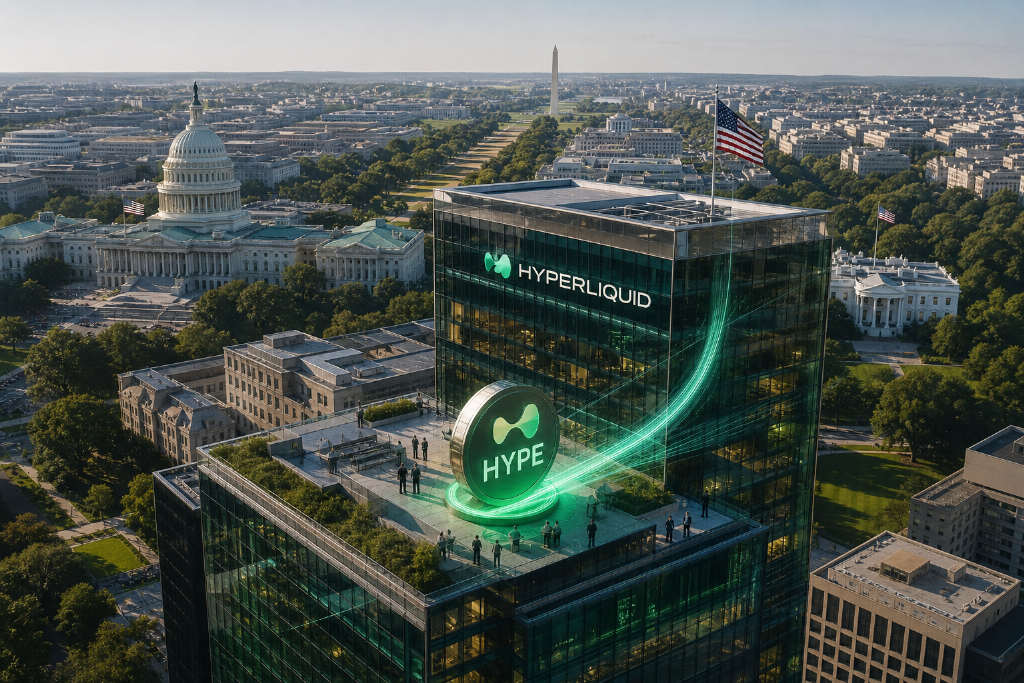
HYPE turned into one of the strongest movers in the crypto market over the past day.

At the time of writing, HYPE was trading at $73.9, up 26.86% over 24 hours and sitting less than $3 below a recent high around $76.5. The move also broke a nearly two-month stretch of choppy declines.
Odaily said the rally was supported not only by factors it had cited in earlier coverage, including Wall Street participation and growth in the Hyperliquid ecosystem, but also by a more immediate catalyst from Washington. At a White House meeting the night before, Donald Trump said the chair of the U.S. Commodity Futures Trading Commission, or CFTC, is working to bring Hyperliquid into the U.S. in a fully compliant and legal way. Read together with a previous proposal from the Hyperliquid Policy Center and trade.xyz urging the U.S. Securities and Exchange Commission, or SEC, to allow pre-IPO perpetual contracts, the report said Hyperliquid’s compliance push into the U.S. may be moving faster than the market had expected.
In Odaily’s framing, the contest over a compliant on-chain perpetual decentralized exchange in the U.S. and the right to shape premarket price discovery for U.S. equities is no longer theoretical. Hyperliquid, it argued, is already a central player.
Trump’s remarks put Hyperliquid’s U.S. entry back in focus
For Hyperliquid and HYPE, the most direct tailwind in this round came from Trump’s public comments.
Odaily wrote that as the midterm elections draw closer, Trump has stepped up political messaging again, with crypto serving as one of the clearest examples he can use to support his “Make America Great Again” narrative. The article said he has treated improvements in crypto regulation as part of a wider effort to encourage innovation and compete for leadership in finance, crypto and technology.
Hyperliquid, in Odaily’s view, stands out because it is one of the on-chain trading venues followed closely by both traditional finance and crypto markets. The platform’s industry standing and liquidity scale make it a practical case study. The report also stressed that Hyperliquid has not simply waited for regulators to move first. It has already begun lobbying and has been actively pushing for a compliant route into the U.S. market.
Hyperliquid Policy Center and trade.xyz submitted an SEC letter on IPOP
On Aug. 18, the Hyperliquid Policy Center and trade.xyz jointly released a comment letter submitted to the SEC. The proposal called for pre-IPO perpetual contracts, referred to as IPOP, to be included in a broader IPO modernization framework. That would allow investors to trade exposure to a company’s share price through perpetual contracts before the company formally lists, while creating public and continuous price formation.
The article said IPOP does not represent company shares and does not grant voting rights or other shareholder rights. It provides only price exposure, and its pre-IPO function would end once the company officially lists.
trade.xyz said it has already completed five IPOP markets on Hyperliquid, including markets tied to Cerebras, SpaceX, SK hynix and CXMT. According to Odaily, prices formed in some of those pre-listing markets were relatively close to the opening prices once the stocks began trading, which could give issuers and underwriters an added public signal for price discovery.
The two parties also proposed that the SEC and CFTC clarify the regulatory classification of equity-linked perpetual products and establish rules covering disclosure, listing eligibility, market manipulation prevention, leverage and position limits. Their stated end goal is to allow U.S. investors, including retail participants, to take part in pre-IPO perpetual markets.
Odaily linked that filing to a series of earlier developments:
- In March this year, S&P Dow Jones Indices officially authorized trade.xyz to use the S&P 500 Index to launch on-chain perpetual contracts for eligible non-U.S. investors.
- On May 26 this year, SEC chair Paul Atkins launched proposal CLL-16 to invite market discussion on reforming IPOs, direct listings and other listing methods.
- On July 14, the Hyperliquid Policy Center, trade.xyz and Sullivan & Cromwell formally met with the SEC crypto task force to present the Hyperliquid protocol, its technology and the HIP-3 market.
The article argued that Hyperliquid’s prior ecosystem performance and its existing operational process give weight to its lobbying effort and to the claim that it can support a workable price discovery mechanism in the premarket equity space.
Odaily also placed that effort inside a broader industry shift. It noted that both the Robinhood CEO and the Uniswap founder have spoken about tokenization reshaping global finance. From that perspective, using on-chain trading venues to rework traditional financial assets is already happening, while the remaining question is whether regulators decide to step in, draw clear lines and manage the rules around it.
CFTC chair Michael Selig is seen as a key figure in the process
Beyond Hyperliquid’s own lobbying, Odaily pointed to another important factor: CFTC chair Michael Selig, whom Trump mentioned in the White House meeting.
On Aug. 14, Selig announced in advance that the first meeting of the CFTC’s Innovation Advisory Council would be held in Washington on Aug. 20. The agenda would focus on crypto-asset regulation, artificial intelligence and prediction markets, and the meeting would be livestreamed on the CFTC’s website.
At the White House crypto meeting in the morning, Selig again referred to the inaugural council meeting set for the following day and said more detail would be shared then on the regulatory path ahead. He said that path would give innovators greater certainty and support market confidence over the coming decades.
Selig added: “Innovation depends on regulatory clarity. Clear rules build confidence, confidence attracts investment, investment creates jobs, strengthens our markets, and keeps the world’s top talent building here in the United States.”
Odaily said the development of derivatives products by platforms such as Kalshi and Coinbase also moved ahead under approvals from the CFTC and Selig. The article described Selig and SEC chair Paul Atkins as two of the Trump administration’s most active pro-crypto regulatory figures, especially in derivatives oversight.
Community discussion has focused on Selig’s past links to Hyperliquid’s circle
The report also recounted claims about Selig’s earlier connections to figures around Hyperliquid.
According to Hyperliquid community member Dongdongfosi, when Hyperliquid Labs submitted two comment letters to the CFTC on perpetual contract regulation in May last year, former CFTC chair Giancarlo helped draft them as legal counsel. Dongdongfosi said Giancarlo had once been Selig’s mentor at the CFTC, and the two later worked together for three years at law firm Willkie. Hyperliquid Labs filed those comment letters two months after Selig had left the firm. The article added that before Selig became CFTC chair, Giancarlo had publicly backed his “student” on multiple occasions.
Based on that history, Odaily wrote that Hyperliquid had managed to connect with the current CFTC chair through the involvement of a former CFTC chair acting as legal counsel, which could help it pursue a compliant route into the U.S.
Galaxy head of research Alex Thorn has also been watching the issue. Odaily said Thorn posted that he was very interested in the question of how Hyperliquid could become compliant. In the replies, some people speculated that a HIP-3 whitelist approach might be used, or that the platform could follow a model similar to Kalshi or Coinbase by opening derivatives trading only after KYC. The article said the exact route remains open for discussion.
Three possible paths for Hyperliquid to enter the U.S. market compliantly
After reviewing the news catalysts, Odaily laid out three possible ways Hyperliquid could try to enter the U.S. market on a compliant basis.
Path one: partner at the clearing layer and supply the backend technology
Odaily said this looks like the most realistic option from both an execution and market-efficiency standpoint.
Under this structure, Hyperliquid could work with a licensed U.S. DCM, FCM or clearing institution. The partner would plug into Hyperliquid’s execution or clearing layer, while taking responsibility for KYC, customer protection and reporting. Hyperliquid would handle the on-chain processing tied to settlement. Odaily said this is also the path that Hyperliquid Policy Center CEO Jake Chervinsky has publicly shown more support for, rather than building an entirely new U.S. exchange from scratch.
Path two: have regulated trading venues list Hyperliquid-related assets
The second route focuses more on product implementation and asset access.
In simple terms, Hyperliquid-related assets and data could be integrated into already approved venues such as Coinbase, Kraken and Kalshi. That would package on-chain assets into instruments that sit on a regulated trading platform, effectively adding a compliant frontend layer. In that setup, the Builder mechanisms behind HIP-3 and HIP-4 could be adapted into a compliance-oriented partnership model.
Path three: acquire or rebuild a compliant platform for the U.S. market
The third path deals more directly with revenue sharing and brand control, but Odaily said it is also the most difficult and the least efficient.
The article compared it to Polymarket’s acquisition of QCX. If Hyperliquid took this path, it would need to build U.S. infrastructure with KYC from the ground up, or establish a full DCM. It could also end up sacrificing core features such as permissionless access and self-custody.
The regulatory limits and the likely timeline
Odaily also stressed that the CFTC cannot simply bypass core U.S. investor-protection principles for Hyperliquid alone. Those principles include customer protection, anti-theft safeguards and anti-money-laundering requirements. What the agency can do, the article said, is lower the compliance burden for on-chain models by interpreting the core principles of the Commodity Exchange Act, issuing no-action relief or writing rules that better fit this structure.
Based on the information currently available, Odaily estimated that Hyperliquid would still need at least several months of preparation to enter the U.S. compliantly, and the process could stretch to a year or longer.
Even so, the article’s conclusion was clear: from the perspective of financial innovation and crypto regulation, the push to bring Hyperliquid into the U.S. in a compliant form has already entered a substantive stage. In Odaily’s view, that gives HYPE more room on the upside and could set the token up to challenge its all-time high again.