

“HYPE should at least surpass SOL before the end of this bull market,” BitMEX co-founder Arthur Hayes publicly declared in late May, having previously forecasted HYPE would hit $150. His spat with Multicoin Capital’s former co-founder Kyle Samani culminated in a $100,000 bet that HYPE would outperform all top-10 coins for the rest of the year. This week HYPE continued to rally, hitting an all-time high of $75, prompting both fear of heights and short-selling attempts. This article analyzes the fundamental shifts in HYPE from the perspective of spot ETF inflows and multiple buying forces.
Spot ETFs See 14 Straight Days of Inflows, Outpacing Even Early BTC and ETH ETFs
Two HYPE spot ETFs are currently trading: 21Shares launched THYP on Nasdaq on May 12, and Bitwise debuted BHYP on the NYSE on May 15. By June 2, the pair had logged 14 consecutive days of net inflows, accumulating over $136 million and absorbing roughly 0.9% of HYPE’s total market cap. Bitwise’s BHYP alone drew $82.96 million, making it the largest HYPE ETF.
Among the 12 U.S. crypto spot ETFs, HYPE funds now rank as the fifth-largest by cumulative net inflows, trailing only BTC, ETH, XRP, and SOL products—surpassing many older ETFs. Meanwhile, BTC spot ETFs have suffered 12 straight days of outflows since May 15, bleeding over $2.43 billion in May; ETH spot ETFs experienced 16 consecutive days of outflows since May 11, losing over $540 million; and VanEck’s BNB ETF, launched on May 28, has seen zero inflows for four days.
Measured against market cap, HYPE ETFs absorbed about 1% of its supply in the first two weeks—exceeding comparable launches: BTC’s spot ETF drew $1.46 billion in its first two weeks, only 0.2% of its market cap at the time; ETH’s ETF saw a net outflow of roughly $400 million; and SOL’s ETF pulled in $380 million, representing 0.47% of its market cap. This highlights stronger institutional appetite for HYPE from day one.

Assistance Fund and ETFs Form Double Buying Buffer
Beyond ETFs, Hyperliquid’s own protocol revenue acts as a major bid. Since early 2025, the Assistance Fund (AF) mechanism automatically channels 99% of perp and spot trading fees into systematic HYPE buybacks. The protocol generates $1–3 million in daily revenue, and the AF has cumulatively repurchased over $1.1 billion worth of HYPE.
Although total ETF inflows are still smaller than AF repurchases, their pace is striking: in just half a month, ETF inflows reached one-tenth of total AF buybacks, with a single-day high of $31.62 million on May 29. This dual buying pressure also helps offset the potential selling from team token unlocks. Since January 2026, team unlocks occur once monthly on the 6th; on June 6, $38.7 million worth of HYPE will be unlocked. The market generally views that ETF investors, being less focused on tokenomics events, are unlikely to react strongly to such unlocks.

a16z and Galaxy Digital Aggressively Build Positions
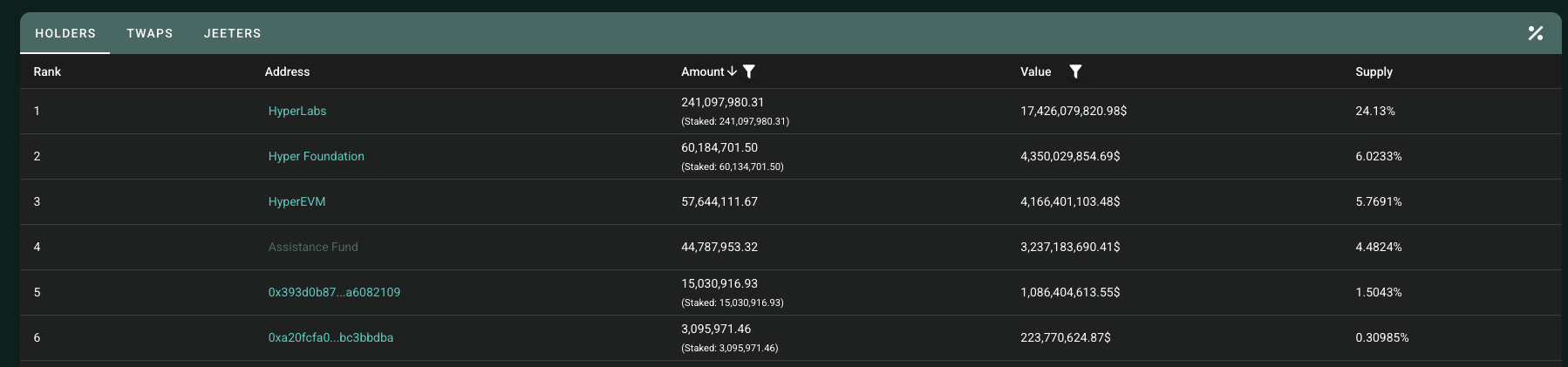
Institutional FOMO is as intense as retail’s. a16z began accumulating HYPE in August 2025. On-chain analyst Ai Yi identified a16z as likely the sixth-largest HYPE holder overall and the largest external entity, with a wallet holding 3.095 million HYPE worth over $223 million. But that’s just the tip of the iceberg: on May 28, an address linked to a16z (0x4c6) withdrew 253,947.43 HYPE from exchanges at an average price of $59.2. On May 30, another associated address (0xb5E) bought an additional 226,121 HYPE; since April 14, that same address has accumulated 3.9 million HYPE at an average of $49.4. These on-chain records show a systematic accumulation across multiple channels.

Galaxy Digital is also stacking HYPE. On June 3, it withdrew 179,000 HYPE worth $12.62 million from Coinbase; earlier on May 21, another affiliated wallet bought 158,100 HYPE worth about $8.8 million. Though the firm has not disclosed its total holdings, consistent off-exchange withdrawals signal strong accumulation intent. Bitwise CIO Matt Hougan called HYPE a “second-generation” crypto asset with real value capture and buyback-driven support.
Grayscale Joins In, Hyperliquid Rebranded as Financial Infrastructure
On June 2, Grayscale filed an amended S-1 for the Grayscale Hyperliquid Staking ETF (HYPG), seeding it with approximately 2 million HYPE; the ETF began trading on June 4. Grayscale’s report suggests Hyperliquid could eventually challenge traditional derivatives markets and evolve into a financial services giant. Institutions like Bitwise now view Hyperliquid not just as a perp DEX but a blockchain financial infrastructure platform, strengthening its fundamental narrative.

DAT Firm PURR Could Enter Russell 3000, Adding New Allocation Catalyst
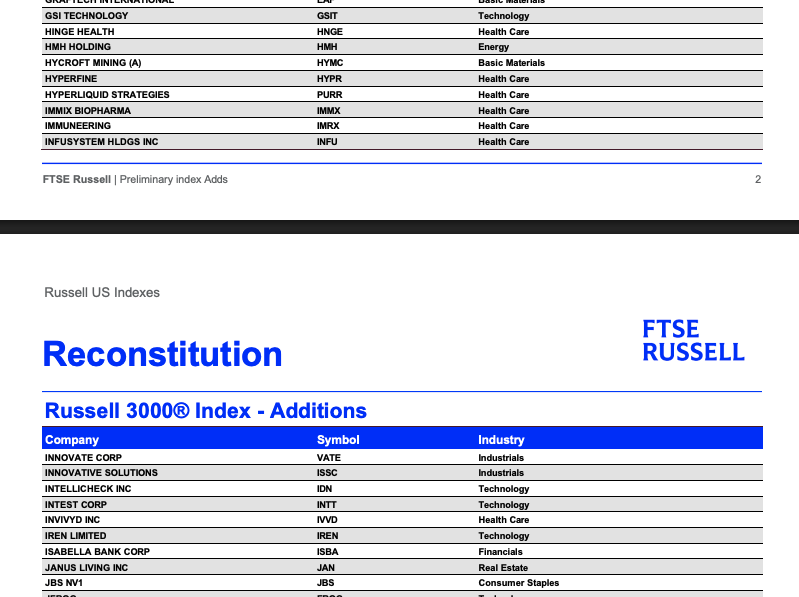
While the DAT narrative cools, HYPE-focused public company PURR continues to sit on $1.25 billion in unrealized gains. On May 22, FTSE Russell published preliminary additions to the Russell 3000 Index for its June 2026 reconstitution; PURR appeared on the list, with the changes set to take effect on June 26.
The Russell 3000 covers roughly the 3,000 largest U.S. stocks, with about $10.6 trillion in assets benchmarked to it according to FTSE Russell. If PURR is included, it would receive passive allocations from index funds and pension funds, boost its visibility, and potentially emulate Strategy’s “issue debt to buy crypto” playbook—providing yet another solid bid for HYPE.

As BTC and ETH ETF outflows persist, institutional allocation is rapidly pivoting toward emerging assets. With sustained spot ETF inflows, the endogenous buyback power of the AF mechanism, and heavy accumulation by top-tier firms, HYPE’s foundation is solidifying—$75 may just be the starting point. A confluence of catalysts is ushering in an unprecedented capital inflow cycle for the HYPE ecosystem.