

“HYPE should at least surpass SOL before this bull run ends.” When BitMEX co-founder Arthur Hayes publicly voiced this expectation in late May, he had just concluded a heated spat with Multicoin Capital's former co-founder Kyle Samani over Hyperliquid. The two eventually settled with a $100,000 bet that HYPE would outperform all top-ten tokens for the rest of the year. Now HYPE has surged to a new all-time high of $75, leaving investors wary of chasing but also reluctant to short. This article examines the underlying buying structure from ETF flows and institutional positioning.
Spot ETFs Log 14 Straight Days of Inflows, Outpacing Even BTC and ETH Launches
On May 12, 21Shares listed the first Hyperliquid ETF (THYP) on Nasdaq; on May 15, Bitwise followed with BHYP on the NYSE. By June 2, the two ETFs had recorded 14 consecutive days of net inflows, totaling over $136 million and absorbing roughly 0.9% of HYPE's market cap. Bitwise's BHYP alone drew $82.96 million, making it the largest HYPE ETF.
Measured by cumulative net inflows, HYPE spot ETFs now rank fifth among the 12 US crypto spot ETFs, behind only BTC, ETH, XRP, and SOL products—far ahead of many earlier-launched funds. Compared to the initial weeks of other major ETFs, the contrast is striking: BTC spot ETFs drew $1.46 billion in their first two weeks but absorbed only about 0.2% of its market cap at the time; ETH spot ETFs saw a net outflow of approximately $400 million; SOL spot ETFs recorded $380 million in inflows, capturing about 0.47%. HYPE spot ETFs, in just two weeks, have soaked up nearly 1% of market cap—the strongest absorption ratio among all major crypto ETF debuts.
Meanwhile, traditional crypto ETFs are bleeding funds. BTC spot ETFs have seen 12 consecutive days of outflows since May 15, with May net outflows exceeding $2.43 billion. ETH spot ETFs have recorded 16 straight days of outflows since May 11, totaling over $540 million. The BNB ETF launched by VanEck on May 28 has had zero net inflows for four straight days. Institutional appetite for BTC and ETH exposure is cooling, while capital is rotating swiftly into HYPE.

Dual Buying Pressure: Protocol Buybacks and ETF Flows
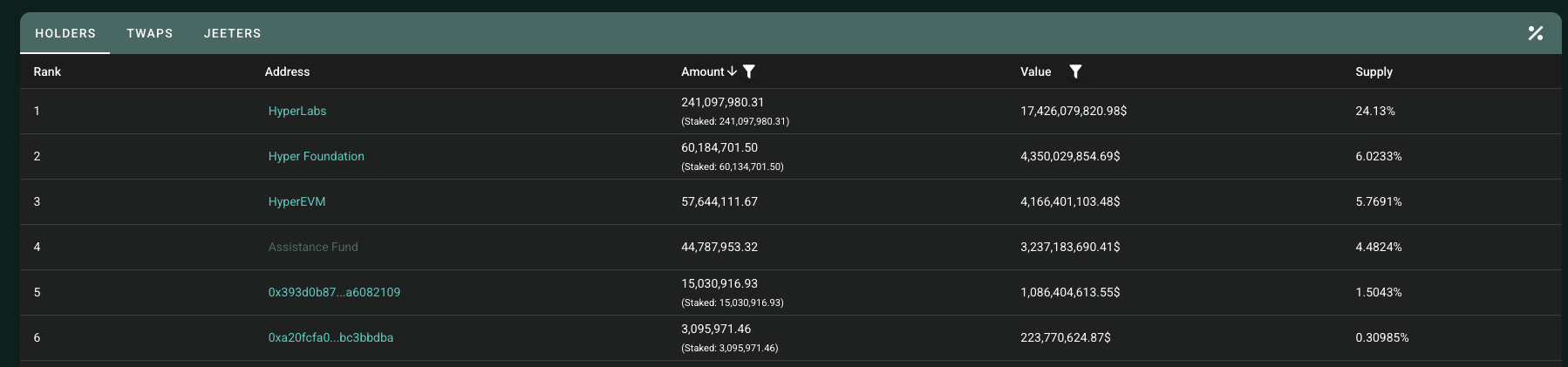
Beyond ETFs, Hyperliquid's protocol revenue continuously repurchases HYPE through its Assistance Fund (AF) mechanism. Since early 2025, 99% of all protocol trading fees (perps, spot, etc.) flow into the AF address to buy back HYPE. With daily protocol revenue ranging from $1 million to $3 million, cumulative buybacks have exceeded $1.1 billion. Although ETF inflows haven't yet matched the AF's lifetime total, their growth is rapid: in just half a month, ETF net inflows reached one-tenth of the AF's overall buyback amount, with a single-day peak of $31.62 million on May 29.
This dual buying pressure effectively offsets the selling pressure from team token unlocks. Since January 2026, official rules mandate monthly vesting on the 6th. The June 6 unlock will release $38.7 million worth of HYPE, but given the steady ETF and AF demand, the impact is expected to be absorbed smoothly. ETF investors are typically less sensitive to tokenomics or unlock schedules; as long as fundamentals remain intact, unlocks do not deter buying.

Grayscale Staking ETF Arrives; Institutional FOMO Escalates
More ETFs are coming. On June 2, Grayscale filed an S-1 amendment for its Hyperliquid Staking ETF (HYPG), seeding it with about 2 million HYPE, and trading will start on June 4. This will bring deeper liquidity, stronger institutional participation, and a continuous stream of incremental buying.

Institutional FOMO on HYPE is as intense as retail's. Bitwise CIO Matt Hougan called HYPE a “second-generation” cryptocurrency because it features real value capture, buybacks, and institutional demand. Grayscale's report even envisions Hyperliquid as a potential challenger to traditional derivatives and exchange systems, growing into a financial services giant.
a16z and Galaxy Digital Disclose Whale Buying
On-chain data reveals that a16z has been in accumulation mode. On May 28, an address linked to a16z (0x4c6…) withdrew about 253,947 HYPE from multiple exchanges and market makers at an average price of $59.2. Another a16z-associated address (0xb5E…) had, since April 14, accumulated 3.9 million HYPE at an average of $49.4. Combined with earlier holdings, one a16z address now holds 3.095 million HYPE (worth over $223 million), ranking as the sixth-largest HYPE holder on-chain and the largest non-ecosystem entity.

Galaxy Digital is also building its position. On June 3, it withdrew 179,000 HYPE (approximately $12.62 million) from Coinbase, and on May 21, another associated wallet purchased 158,100 HYPE worth about $8.8 million. These institutions no longer view HYPE as an ordinary altcoin but as a core asset positioned as blockchain financial infrastructure.
DAT Narrative Heats Up: PURR on Track for Russell 3000 Inclusion
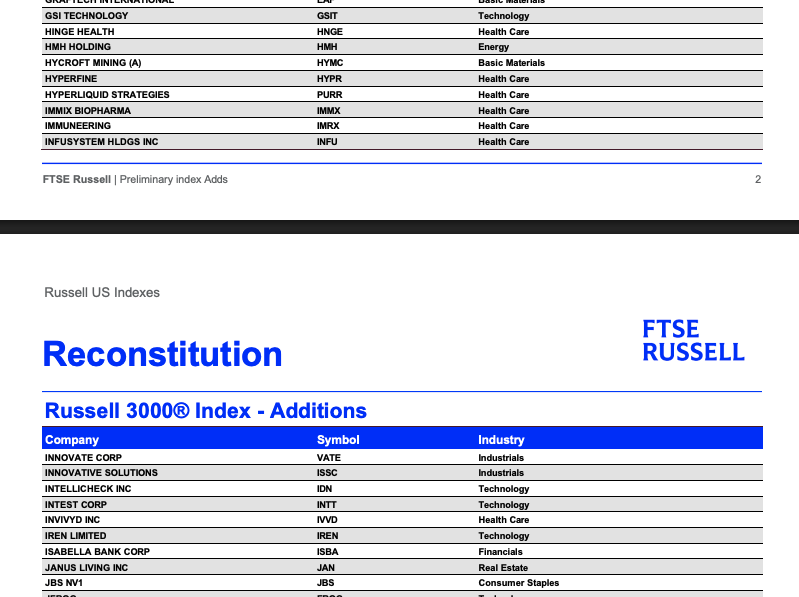
On May 22, FTSE Russell released the preliminary list for the 2026 June Russell 3000 reconstitution, naming DAT company PURR among the additions, with an effective date of June 26. The Russell 3000 covers the roughly 3,000 largest US-listed companies, with approximately $10.6 trillion in assets benchmarked against it. Inclusion would bring massive passive fund flows and greater visibility.

Market participants anticipate that PURR may emulate Strategy's “issue debt, buy crypto” playbook to further accumulate HYPE, creating yet another solid pillar of buying demand. As HYPE's price climbs, DAT companies betting on it continue to realize gains, and the path for traditional capital to gain HYPE exposure through ETFs and equities becomes increasingly clear. (See also: DAT Failed? Public Companies Betting on HYPE Sit on $1.25B Gain)