

BitMEX co-founder Arthur Hayes publicly declared in late May that "HYPE should at least surpass SOL before this bull cycle ends," having previously stated multiple times that HYPE would reach $150. The controversy began when former Multicoin Capital co-founder Kyle Samani first fired shots at Hyperliquid in the community, after which the two escalated into a $100,000 wager — HYPE would outperform every top-10 market cap token for the remainder of the year. HYPE's recent price action appears to be validating Hayes' thesis, as the token surged to a new all-time high of $75.
With the rally stretching higher, some investors are experiencing "fear of heights" and even attempting to short the token. This article breaks down the shifting fundamentals of HYPE from a buy-and-sell pressure perspective.
ETF Inflows Surge, Traditional Capital FOMO Exceeds BTC's Debut
Two HYPE spot ETFs are currently on the market: 21Shares launched THYP on Nasdaq on May 12, and Bitwise launched BHYP on the NYSE on May 15. By June 2, the two ETFs had recorded 14 consecutive days of net inflows, accumulating over $136 million and absorbing approximately 0.9% of HYPE's total market cap. Bitwise's BHYP alone accounted for $82.96 million in net inflows, making it the world's largest HYPE ETF.
Among the 12 US crypto spot ETFs, HYPE's products now rank as the fifth-largest by cumulative net inflows — behind only BTC, ETH, XRP, and SOL spot ETFs — far outpacing other crypto ETFs that launched earlier. The contrast is stark: BTC spot ETFs have seen 12 consecutive days of net outflows since May 15, totaling over $2.43 billion in May; ETH spot ETFs have bled for 16 straight days since May 11, with May outflows exceeding $540 million; and VanEck's BNB ETF, launched May 28, has gone four days without a single day of net inflows.
On a market-cap-ratio basis, the HYPE ETF absorbed nearly 1% of HYPE's market cap within two weeks. By comparison, BTC spot ETFs pulled in $1.46 billion in their first two weeks but only absorbed about 0.2% of the then-market cap; ETH spot ETFs recorded roughly $400 million in net outflows; and SOL spot ETFs took in about $380 million, absorbing only 0.47% of SOL's market cap at the time. Institutional appetite for HYPE is plainly evident in the data.

Protocol Buyback and ETFs Form a Dual Support Structure
Hyperliquid's Assistance Fund (AF) mechanism, introduced in early 2025, allocates 99% of protocol trading fees — spanning perpetuals and spot — to automatically repurchase HYPE. With daily protocol revenue ranging from $1 million to $3 million, the AF has cumulatively repurchased over $1.1 billion worth of HYPE since its inception. While the ETF's cumulative net inflows trail the AF's total, the pace is remarkable: in just half a month, ETF inflows have already reached one-tenth of AF's cumulative buyback volume, with a single-day peak of $31.62 million on May 29.
The arrival of ETFs creates a dual-support structure for HYPE, helping offset the selling pressure from team token unlocks. Since January 2026, team token unlocks occur on a fixed schedule — the 6th of each month, in a single batch. The June 6 unlock will release approximately $38.7 million worth of tokens. However, ETF investors tend to be less sensitive to tokenomics; as long as the project's fundamentals remain intact, unlocking events may not suppress buying momentum.

On June 2, Grayscale filed an S-1 amendment for its Hyperliquid Staking ETF, seeding it with approximately 2 million HYPE tokens under the ticker HYPG, with trading set to begin on June 4. HYPE is poised for deeper liquidity and stronger institutional participation.
a16z and Galaxy Digital Keep Buying Big
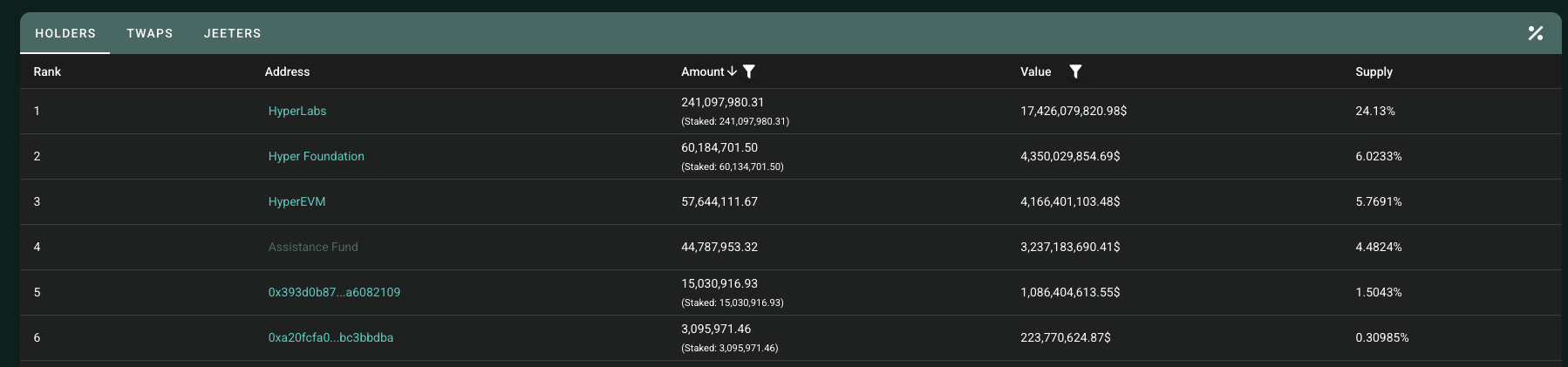
a16z began its large-scale HYPE accumulation in August 2025. According to crypto analyst Ai Yi (@ai_9684xtpa), a16z may now be the sixth-largest on-chain HYPE holder — and the largest external entity. While the top five HYPE addresses all belong to Hyperliquid's own ecosystem projects (the fifth being the Kinetiq staking protocol), the sixth address is controlled by a16z, holding 3.095 million HYPE valued at over $223 million. On-chain data shows a16z has continued buying through multiple affiliated addresses.

On May 28, an a16z-linked address starting with 0x4c6 withdrew 253,947 HYPE from multiple exchanges and market makers at an average price of about $59.20. On May 30, another linked address starting with 0xb5E purchased an additional 226,121 HYPE; since April 14, this address has accumulated 3.9 million HYPE at an average price of roughly $49.40. Galaxy Digital is also active: on June 3, it withdrew 179,000 HYPE worth approximately $12.62 million from Coinbase, following a May 21 purchase of 158,100 HYPE worth approximately $8.8 million through another affiliated wallet.
Positioning Upgrade: From Perp DEX to Financial Infrastructure
Institutional perception of HYPE has undergone a fundamental shift. Bitwise Chief Investment Officer Matt Hougan wrote that HYPE is a "second-generation" cryptocurrency, possessing real value capture, buybacks, and institutional demand. Grayscale's report goes further, stating that Hyperliquid may eventually challenge traditional derivatives trading and exchange systems, growing into a "financial services giant."

This upgraded positioning means institutions no longer view HYPE as just another altcoin — they regard it as the core asset of a blockchain-based financial infrastructure platform. They are backing their bullish rhetoric with real capital, driving the price higher.
Russell 3000 Inclusion Speculation, DAT Companies Stay Profitable
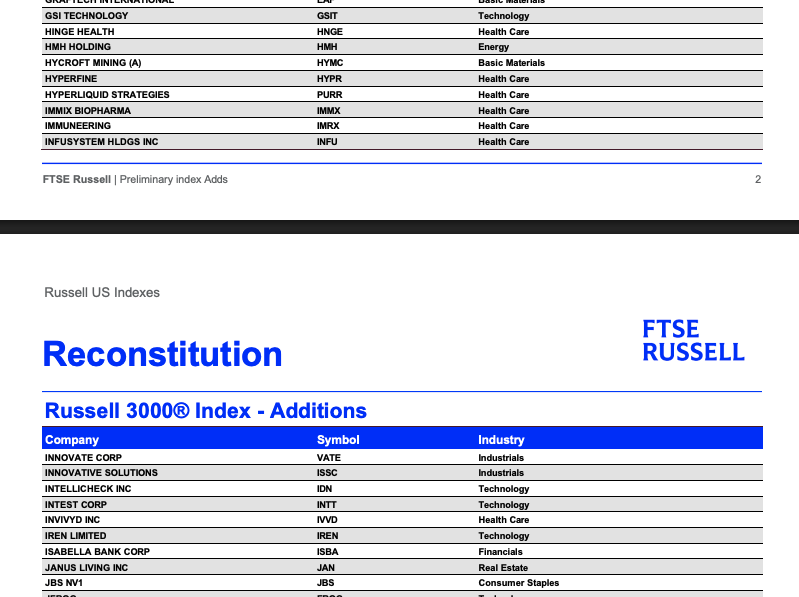
On May 22, FTSE Russell released the preliminary list for its June 2026 Russell 3000 index reconstitution, with PURR appearing on the additions list, effective June 26. The Russell 3000 is one of the broadest US equity indices, covering roughly the 3,000 largest publicly traded companies in America. FTSE Russell disclosed that approximately $10.6 trillion in assets are benchmarked to Russell US indexes.

If PURR is admitted to the Russell 3000, it would gain passive fund allocation and significantly enhanced visibility. Amid cooling DAT sentiment in US equities and sector leader Strategy beginning to sell coins, DAT companies betting on HYPE continue to rack up unrealized gains. PURR may eventually emulate Strategy's "borrow-to-buy" model, becoming yet another solid pillar of buying support for HYPE. The buying structure for HYPE is expanding from a single protocol buyback mechanism into a multi-layered framework encompassing ETF inflows, institutional accumulation, and potential index fund allocation.