
By Zhou, ChainCatcher
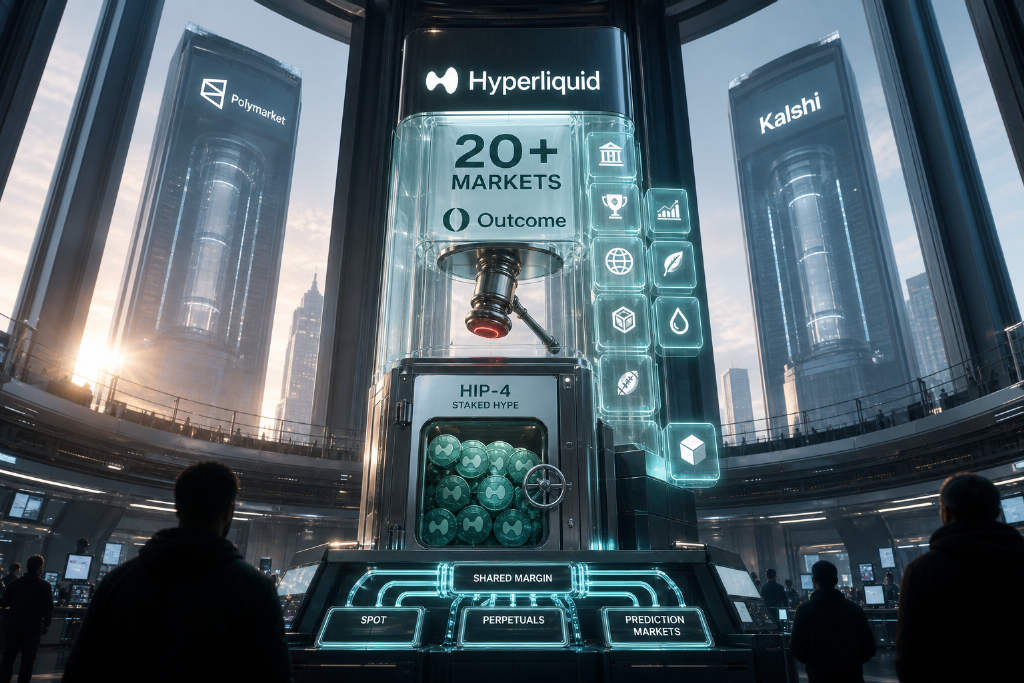
Hyperliquid opened permissionless deployment for HIP-4 on Aug. 29. Outcome, the first third-party builder to complete a mainnet launch, listed more than 20 prediction markets at once and passed $1 million in trading volume within two days. Several KOLs who tested the product said Outcome’s fees were lower than Polymarket’s by more than an order of magnitude.
At the same time, the gap between the established prediction-market players has widened. Artemis data cited in the report put Kalshi’s weekly volume at about $9 billion and Polymarket’s at about $2 billion, meaning Kalshi was handling more than four times as much. Together, the two platforms accounted for more than 90% of market share, and both had reached valuations in the tens of billions of dollars.
HIP-4 took more than half a year to go from an actual proposal to permissionless mainnet deployment. Many in the market have treated it as a credible contender to Polymarket and Kalshi because it ports a permissionless model, already tested in perpetuals, directly into prediction markets and lowers the barrier to entry. The open question is whether that can actually take share from incumbents or whether the narrative is moving faster than adoption.
Permissionless mainnet deployment goes live, with Outcome first out of the gate
According to the article, contributors including Kalshi crypto lead John Wang submitted a community proposal titled Event Perpetuals on Sept. 16, 2025. That proposal had already argued that the HIP-3 oracle was not suitable for binary events.
On Feb. 2, 2026, Hyperliquid published its formal plan, narrowing the design into Outcome Trading while keeping the HIP-4 name.
The version activated on mainnet on May 2 was that later design. At the time, markets were still deployed by validators. The first product was a daily-settled Bitcoin binary contract, and by late May the offering had expanded to off-chain events such as Federal Reserve decisions and CPI releases.
In mid-July, the community started pushing for permissionless deployment. The testnet was completed, the official fee schedule was published on Aug. 14, and the permissionless mainnet version went live at the end of August. The deployment threshold was also reduced from 1 million HYPE in the proposal stage to 500,000 HYPE, which the report said was worth more than $40 million at current prices.
Official documents say deployers must stake 500,000 HYPE and keep it locked for six months. If a market is poorly defined, settled incorrectly, or left unsettled for a week, validators can vote to confiscate that stake. The initial quota is 100 outcomes per deployer, with a daily maximum of 500 deployments. Capacity is recycled after settlement.
On fees, opening positions and minting are free. Charges apply on closing and settlement, with the multiplier set by the deployer. Revenue is split evenly between the protocol and the deployer.
The way deployment rights are acquired is also different from HIP-3. Under HIP-3, the first three assets in a perpetual sector could be deployed directly, but each additional asset required participation in a Dutch auction. The price decayed over time, and whoever was willing to pay more HYPE secured the slot. Those auction parameters were carried over from HIP-1 spot asset auctions. HIP-4 drops that bidding layer. A builder that meets the 500,000-HYPE staking requirement gets deployment eligibility directly without having to outbid anyone else.
Why HIP-4 uses a separate structure instead of the HIP-3 oracle model
HIP-4 does not directly reuse the HIP-3 perpetual oracle. Researcher Petro D. said a perpetual oracle can move the mark price by only about 1% per jump, which works for continuously priced assets such as crude oil or Tesla but not for event contracts.
For an event contract, once the outcome is known, the price needs to move from 0.5 to 1. Using the old logic would require about 50 jumps and nearly 50 minutes, leaving a long window for risk-free arbitrage.
HIP-4 therefore uses a separately designed contract. Before expiry, pricing follows linear interpolation. At expiry, an authorized oracle provides the binary result directly and settlement happens on-chain right away. USDC is the settlement currency. There is no leverage, no forced liquidation, and no funding rate, so the maximum loss is limited to principal.
These contracts can share the same margin account with perpetuals and spot positions. That is something Polymarket and Kalshi cannot offer, because funds there are locked in Polygon wallets or exchange custody accounts and cannot be hedged directly against on-chain positions.
Outcome takes the lead, Skew follows, and more builders may join
Outcome was the first third-party builder to complete deployment. In its official announcement, the team said it had started building on Hyperliquid before HIP-4 appeared and had already staked 500,000 HYPE before the HIP-4 requirements were published.
On launch day, Outcome listed more than 20 markets and opened more than $1 million in trading incentives. The lineup was not limited to crypto. Contracts tied to the S&P 500, the Nasdaq, gold, silver, SK Hynix, and WTI crude oil, all written on top of HIP-3 perpetuals, were already live. Sports markets were also in preparation, and domain names related to the Premier League, La Liga, and the UEFA Champions League had already been registered.
Market chatter cited in the piece said the second project able to display an independent prefix on the Hyperliquid front end was Skew. On Aug. 30, the official interface showed a Bitcoin hourly up-or-down market with the skew: prefix, and third-party dashboards had already indexed its on-chain address. Skew is working with 500,000 HYPE from Nasdaq-listed Hyperion DeFi. It had initially planned a HIP-3 deployment before switching to HIP-4 markets.
In addition, on-chain monitoring showed that staking addresses tied to trade.xyz, a leading HIP-3 project, and the Unit team behind it were still moving funds in increments of 500,000. The community broadly expected the 500,000 HYPE scheduled to unlock around Sept. 5 to be used for a HIP-4 deployment.
Some community users argue that more builders entering the market means more HYPE being staked and more fees flowing into buybacks, creating support for the token’s value. The report, however, said that flywheel narrative is less certain than it sounds.
Protocol revenue has fallen even as volume rose
DefiLlama on-chain data cited in the article showed Hyperliquid’s gross protocol revenue falling from about $357 million in the third quarter of 2025 to about $202 million in the second quarter of 2026, a drop of more than 40%. Over the same period, trading volume hit a record high. One key reason was that a growing share of fees was going to builders.
That suggests a larger builder ecosystem does not automatically translate into stronger protocol-level revenue.
Fees are lower, but not in every category
One of the main arguments in HIP-4’s favor is cost. The market discussion has focused on the idea that HIP-4 is much cheaper than prediction-market platforms such as Polymarket and Kalshi.
Researcher @0xinvariant estimated that for a trade of 100 contracts at $0.5 each, with $50 in principal, Outcome’s round-trip cost was about 7 to 14 basis points. On Polymarket, comparable costs were about 700 basis points in crypto markets, about 500 in sports, and about 400 in political and macro markets.
That edge does not apply across the board. Polymarket’s geopolitical and election markets often carry no fees, which can make Outcome more expensive in those cases. Polymarket also rebates 15% to 25% of taker fees to passive market makers, while Outcome has no similar arrangement. The fee advantage is concentrated mainly in higher-frequency, shorter-duration categories such as crypto and finance.
Hyperliquid remains much smaller than Kalshi and Polymarket
A Galaxy Research report said Hyperliquid’s user base is very different from Polymarket’s or Kalshi’s. The latter two spent years building products that could attract users outside crypto, while Hyperliquid serves active crypto-native traders through its terminal-style front end. That leaves it with a narrower top-of-funnel audience.
The same report said that on May 2, the first day HIP-4 went live on mainnet, prediction-market volume accounted for only 0.7% of total industry volume. By day 25, daily volume in the Bitcoin segment represented about 20% of the combined Bitcoin-category volume across Hyperliquid and Polymarket.
At the same time, April market share stood at 47% for Kalshi and 38.9% for Polymarket, with Hyperliquid still a marginal player. More than four months later, Artemis data showed HIP-4 generated just $4.2 million in weekly volume in late August, less than 0.04% of total industry volume that week.
Artemis also showed that prediction-market volume jumped during the World Cup, rising from roughly $5 billion to $7 billion per week before the tournament to a peak near $17 billion around mid-July. It then cooled, with weekly volume stabilizing around $10 billion to $12 billion in August.
Kalshi remained the largest platform by size. Polymarket increased its share noticeably during the World Cup and did not fully give it back after the event, leaving its steady-state share above pre-tournament levels. Opinion, which had previously held a meaningful slice of sports markets, was diluted instead.
The competition is running both ways
A report from May showed that about 3.3% of Polymarket wallets were also active on Hyperliquid, and those wallets contributed about 12% of Polymarket’s trading volume. Put differently, about one in every eight Hyperliquid users also used Polymarket. Permissionless deployment had not opened at that time, so the competition here was aimed more at existing users than at a large pool of new ones.
Hyperliquid is also not the only platform expanding beyond its original lane. Polymarket launched its own perpetual contracts product on April 21, offering up to 10x leverage on instruments including Bitcoin, Nvidia, and gold. Kalshi followed on May 29 with CFTC-regulated crypto perpetual contracts that settle funding every eight hours, becoming the first institution in the United States to receive regulatory approval to offer perpetuals, according to the article.
Polymarket has its own weakness: retention
Polymarket also has visible weak spots. Data cited in the report showed about 75% of users churn within 90 days, and only 8% to 11% remain active after one year. During the November 2024 election period, monthly active users briefly reached 321,500, then fell to 245,000 three weeks later. That pattern, strong activity around major events followed by a rapid drop, remains a structural issue for native prediction-market platforms.
Prediction-market participant @timemoonc said Polymarket first started charging taker fees on crypto markets in January this year, raised them again in February and March, and then expanded fees platform-wide in the V2 release at the end of March. He speculated that Polymarket may be worried about falling behind in on-chain competition and is trying to keep more profit while it still has pricing power before HIP-4 is fully rolled out.
A unified margin account is the clearest edge, but the market still has to test the rest
In the short term, Hyperliquid’s share is still nowhere near Kalshi’s or Polymarket’s, so talk of disruption looks premature.
Even so, the structure matters. A unified margin account allows traders to hold perpetuals, spot positions, and prediction-market exposure with the same pool of capital. The article argues that standalone prediction-market platforms cannot match that without rebuilding their product stack more broadly.
ChainCatcher had previously written in an earlier piece titled "Can Hyperliquid win in prediction markets?" that prediction markets are still, at their core, a content and operations business. HIP-4 still has to prove itself in topic supply, credibility, and user-profile fit. Those are not areas where Hyperliquid has traditionally been strongest, and they are unlikely to be solved overnight.
For now, permissionless deployment has mainly opened up the supply side. Whether liquidity can keep up, whether settlement can handle disputed markets, and whether the fee advantage can hold are still questions the market has to answer.