
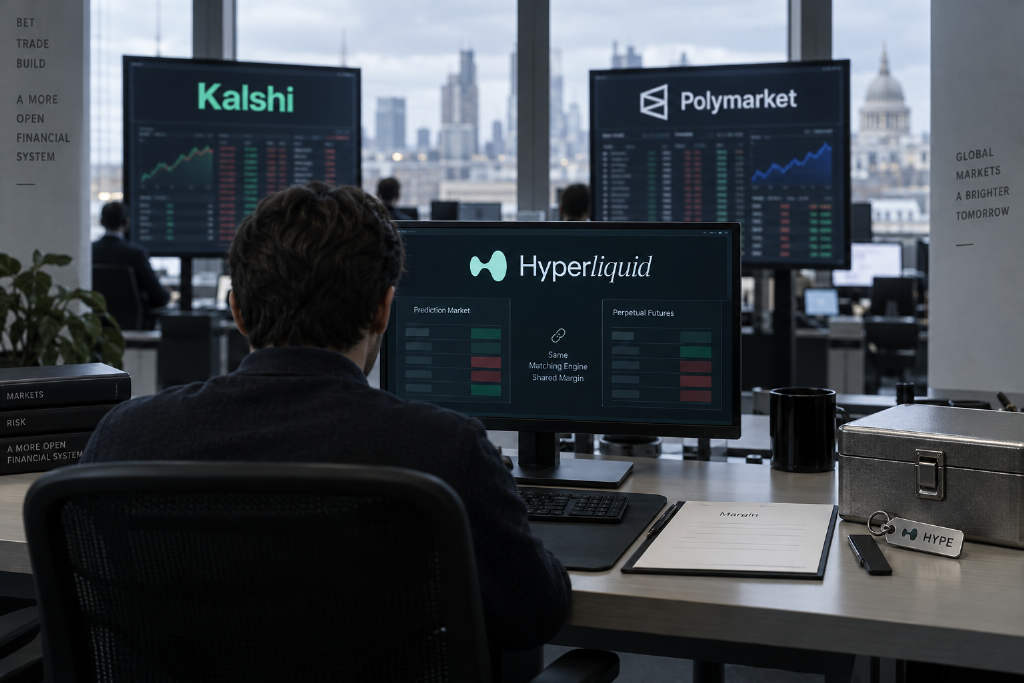
A PANews analysis by Mario Chow @IOSG says Hyperliquid’s HIP-4 prediction market looks less like Polymarket and more like an options ticket sitting next to a perpetual position. Yes shares and leveraged positions live in the same account, use the same margin, and trade on the same matching engine, so a bet and the position it is meant to hedge stay on the same screen.
The article says the data is current through Oct. 5, 2026. Prices, staking, order books, and trading data came from the Hyperliquid API. Single-market volume came from node trade archives published by Liquidiction. Kalshi and Polymarket volume figures came from The Block.
How HIP-4 differs from Kalshi and Polymarket
The piece points to three features that set HIP-4 apart.
- Anyone can launch a market by staking 500,000 HYPE.
- Settlement conditions are fixed in a template before the first trade.
- Entry is free, while exit costs roughly 0.1%, the reverse of how Kalshi and Polymarket charge users.
For its first four months, HIP-4 was run only by Hyperliquid itself. When it launched on May 2, 2026, all 691 markets were protocol-operated. External venues were not allowed in until Aug. 29. Since then, three operators have posted the required stake, and there is still no fourth one.
Whether users can even see the product depends on where they are. HIP-4 has a dedicated page at app.hyperliquid.xyz/outcomes, and the frontend decides by region whether to place it alongside perpetuals and spot in the trading menu. The article says a Korean connection showed the category in the market list, while the network used in the author’s test did not show it in the list or menu, even though the page itself still opened and trading still worked. Hyperliquid restricts frontend access in several countries, so the entry point visible in one region may be hidden in another.
From May through Oct. 5, HIP-4 generated $317 million in cumulative volume. The article says Kalshi can do that in under four hours. In September, for every $1,000 traded on Kalshi and Polymarket, HIP-4 traded about 70 cents.
Strong design, weak scale
The report says design is HIP-4’s best feature and scale is its problem.
More than a quarter of all historical volume came from the now-finished soccer World Cup. The daily Bitcoin market that carried the first four months fell 93% from its May peak. New venues pulled September volume back to $51 million, matching July, but the venue contributing the most was effectively paying traders about 0.6 cents for every $1 traded. October started more slowly, with daily average volume around $1.25 million. Total fees across the whole market were about $1,300 a day, less than half of the passive interest one venue could earn by simply leaving its stake untouched.
Fee structure: charged on exit, no maker rebate
Using actual charged trades and backing out the rate from the base fee tier, the article says HIP-4’s fee schedule works out to exactly double spot fees. Spot at the base tier charges 0.070% for takers and 0.040% for makers. In HIP-4, one side doubles and the other goes to zero, leaving the round-trip cost equal to spot, except that the whole charge is collected on exit.
Common discounts stack by simple multiplication. A 4% referral discount cuts 0.140% to 0.1344%, and adding a 10% staking discount brings it to 0.12096%. The article says every checked trade matched that math exactly. Makers do not receive rebates, which it describes as the one place where market makers are worse off than in other parts of the exchange.
No venue has raised its fee multiplier above the default so far, meaning venue revenue is carved out of the protocol fee rather than added on top. The only possible charge on entry comes from frontend apps. Under spot rules, the builder fee cap is 1%, and one app charged 0.81% on entry, about six times the protocol’s exit fee.
Settlement: automatic for crypto price markets, signed by the market creator for the rest
The article spends extra time on settlement because that is where venue risk sits. Polymarket relies on UMA tokenholder voting, and the piece points to a $375 million Microstrategy market earlier this year that became highly contentious. Kalshi, as a regulated exchange, makes the call itself with regulators above it.
HIP-4 splits the process in two. Crypto price markets settle automatically by reading the exchange mark price at the agreed minute. All other markets are resolved by the market creator signing the result. There is no dispute window, and no one else can sign on that person’s behalf.
Of the 228 markets open today, 223 fall into the second category. The constraints are money and time rather than code. As long as a venue still has unresolved markets, its stake stays locked. It cannot be withdrawn for six months. Operators can only use wording pre-approved by validators. The article says those templates are intentionally long and exacting. In the “company listing” template, for example, the conditions defining what counts as a listing run for a full page. Writing the rules before trading starts is better than arguing later, the piece says, but handing the pen to a named party with no appeals path is still weaker than a formal process, assuming that process works.
World Cup volume spike, then a long slide in the daily Bitcoin market
June was the high point because of the World Cup. Soccer markets alone traded $89.5 million, or 28% of HIP-4’s cumulative volume. Once the tournament ended, volume dropped by more than 80% over two months. September recovered to $51 million, and all of that rebound came from external venues. The first five days of October produced $5 million.
Underneath those event-driven bursts, the protocol had been running the same market every day since May: whether Bitcoin would be above a certain price at 6 a.m. the next morning. The article calls this the most Hyperliquid-native product in the lineup, and says it took four straight months of decline before it found a floor.
In the week of May 11, that market traded $16.6 million. By the week of Sept. 28, it was down to $1.2 million, with the prior two weeks at roughly the same level. Ask the same question every day and fewer people listen each time. The article says whatever HIP-4 becomes later, it will not look like this.
Five weeks after opening deployment: Outcome dominates and incentives prop up volume
The article treats the period after Aug. 29 as the open-deployment phase. Outcome was the first to go live that day. Skew registered markets the next day and has seen almost no trading since. Events, operated by Trade.xyz, registered on Sept. 5 and opened to the public on Sept. 10.
Looking at the most recent day across all of HIP-4, Outcome accounted for 68% of volume, Trade.xyz for 21%, protocol-run markets for 10%, and Skew for the rest. Looking only at external venues since Aug. 29, Outcome held 92%, while Trade.xyz rose from zero to nearly one-quarter on the latest day. The article says Trade.xyz has taken a more opinionated approach to listings, including binary contracts on its own stock and commodity perpetual prices, NFL markets, and the only exchange-listed questions on whether Anthropic and OpenAI will go public before a deadline.
Still, the report says those volume figures need a discount. Outcome runs a $1 million rewards program that pays makers and traders by market and by day, but only for orders carrying its own app code. As of Oct. 5, it had paid $273,409 to 2,487 wallets, or about $7,400 a day. That equals roughly 0.6% of Outcome’s total volume and about four times a round-trip trading cost. One-quarter of the budget is already gone, and the daily payout pace has not slowed.
External venues traded $1 million to $2 million a day through September, with weekends the busiest. In October, that slipped back to around $1 million a day while rewards kept flowing.
Duplicate listings are appearing, and order books do not merge
Open listing has already produced the first duplicate markets. Outcome and Trade.xyz both listed a market on the Federal Reserve’s October rate decision. Over the past seven days, Outcome’s version traded $354,000 while Trade.xyz’s traded just $90. Both also listed a set of questions on Anthropic’s first-day market capitalization after a listing, and neither side saw much activity.
The article says that if anyone can list a question, two venues can list the same one, and their order books will not merge. Flow goes to the venue paying the subsidy.
Trading is also tilting toward sports. Over the past 30 days, soccer, American football, and esports made up 45% of volume. Crypto price questions were 42%, stocks and commodities 7%, and the Fed 6%. Open interest leaned even harder toward sports: two-thirds of at-risk capital sat there, mostly in long-dated season markets such as the Premier League, Champions League, and NFL winners. Crypto prices accounted for only 17%.
The menu of templates is growing faster than the number of venues. Validators have approved 28 templates, up from 18 in mid-September. New additions include point spreads and totals, the Ballon d’Or, head-to-head contests between two AI models on a leaderboard, and first-day market capitalization for a company listing. The next network upgrade will double each venue’s cap, taking simultaneous live markets to 200 and daily new listings to 1,000. Testnet has 95 registered deployers. Mainnet still has three.
Order flow: about 70% appears to come through Outcome’s frontend
The article also looks at where orders come from. If a frontend app wants to place orders for a user, the user must authorize a separate signing key, and that key is named after the app. A wallet that registered through outcome.xyz therefore keeps a public label such as Outcome-9d3c74de. Hyperliquid’s own mobile login leaves a similar mark, shown as Mobile QR. Desktop trading signs each step with the user’s own key and leaves no label.
The author examined only Outcome because it represents about 90% of external-venue volume. The result: roughly 70% of volume came from wallets that had registered on outcome.xyz, about one-fifth came from wallets with no label at all, and one-tenth came from scripts and third-party tools that named their own keys.
The larger the wallet, the larger Outcome’s share. Among the biggest 20 wallets, Outcome represented three-quarters of traded value. In the rest, it was about half. The article says that is exactly what the rewards program should produce: it pays only for orders routed through Outcome’s code, and the market makers collecting those rewards are the largest wallets.
The method has limits. A label only proves that a wallet once registered through an app, not that any given trade was routed by it. The unlabeled fifth cannot be treated as official exchange-page users either, because most of them quote both sides across many order books using scripts signed with their own keys. The sample covered 121 wallets drawn from recent trades in the 60 most active order books and weighted by 48-hour trading value, so it naturally leans toward market makers.
Fees do not fully solve the attribution problem. Less than 1% of the sample paid builder fees, just $9 over two days. Outcome’s own code charges nothing, so free-routing apps and no app look the same in the data.
Against Kalshi and Polymarket: roughly a 1,400x gap, still widening
The article says the gap is about 1,400x and still widening in dollar terms even though HIP-4 is growing.
Kalshi traded $59.3 billion in September, up $20.6 billion from August. Polymarket plus its U.S. business traded $13 billion, with the larger share now in the U.S. app. HIP-4 traded $51 million.
According to the piece, the incumbents do not win on market design. They win on the two things that actually drive volume. First, they have the events people care about, in the thousands, and can list them within hours of a news break. Second, they have distribution: apps, brand, sports audiences, and in Kalshi’s case a compliant wrapper that U.S. brokerages can plug into directly. HIP-4 has 28 templates, three venues, and a user base that was already trading perpetuals.
At the same time, the older platforms are moving toward Hyperliquid. The article says Polymarket launched perpetual contracts for users outside the U.S. in early September, with 67 markets covering crypto, stocks, indexes, and commodities at up to 20x leverage. Putting bets and leveraged positions under one roof used to be HIP-4’s unique feature. Now it is a feature race, and Polymarket entered with the events already in hand.
The economics: total market fees are less than half of one venue’s passive staking return
At the pace of the past 30 days, the article estimates that all HIP-4 traders together would pay about $480,000 in annual fees. Venues can take at most half of that, and three of them have to split it.
By contrast, the required stake for one venue, left untouched for a year, would earn $1 million. The largest venue is paying rewards at a $2.7 million annualized rate to buy that volume.
On those numbers, the article says none of the venues is operating a business that already works. They are buying an option. That option has value: Hyperliquid has said deployers may later be able to raise fees themselves, volume could grow enough to support the cost base, and private-market comps in the sector are valued at $22 billion and $21 billion, while Kalshi is discussing $40 billion. But it is still an option, and the carrying cost is a $47 million stake. If volume never arrives, it expires worthless.
Conclusion: the design is ahead of the market
The article’s closing view is simple: the building blocks are good, but the market is not here yet.
On the dimensions engineers tend to care about, Hyperliquid built the better product: one account, one margin pool, bets and hedges on the same screen, settlement rules written into templates before the first trade, and a shared order book for Yes and No so liquidity is not split in two. Over the past five months, the article says there has been no sign that design is the bottleneck.
The strongest case for HIP-4 is that users never have to leave Hyperliquid. Margin, hedging, and betting all sit in one account. For a desk already trading perpetuals there, adding a prediction position is one click, not a platform switch, a new balance, or a transfer back and forth. Whatever happens in the competition with Kalshi, the article says that convenience has value and helps explain why HIP-4 could persist at some scale even if it never becomes a major standalone business.
Still, it is less unique than it was in August. Polymarket now sells leverage next to betting as well, and it started from the side that already had users.
The market is also not deep enough. Across the 25 most active order books, the median bid-ask spread was 0.29 cents, and about $4,700 sat within one cent of the best ask. A $1,000 market buy order cleared only a few basis points above the best ask. A $10,000 buy order cost 2% to 3% more, and in four or five of those 25 books the visible liquidity could not fill it at all. Retail-size trading works. Large size does not. Market makers constantly refresh quotes, so patient limit orders can do better than those snapshots suggest, but thin books are exactly what a five-month-old market looks like.
There is also not much to trade. Prediction-market volume is built from topics, and topics come either from editorial teams listing hundreds of events each week or from sports calendars. HIP-4 has 28 approved phrasings. Three venues each had to post a $47 million stake to use them, and two of those venues are already listing the same questions. Kalshi can open a market off a single news item in one afternoon.
The user base is mismatched in a very specific way. Each address trades eight times a day. That is a trading desk, not a mass-market betting audience. If the goal is to give crypto traders a capped-upside instrument, the article says that is fine and exactly what the design does best. If the goal is to chase the audience Kalshi and Polymarket are fighting over, it is not enough. Two-thirds of at-risk capital sitting in long-dated soccer season markets suggests venues are still pushing in that direction.
The most likely path, the article says, is the boring one. HIP-4 remains a feature inside Hyperliquid, earns a small amount, and matters because perpetual traders do not need to open accounts elsewhere. That is worth building, but not worth valuing as a standalone prediction-market business.