
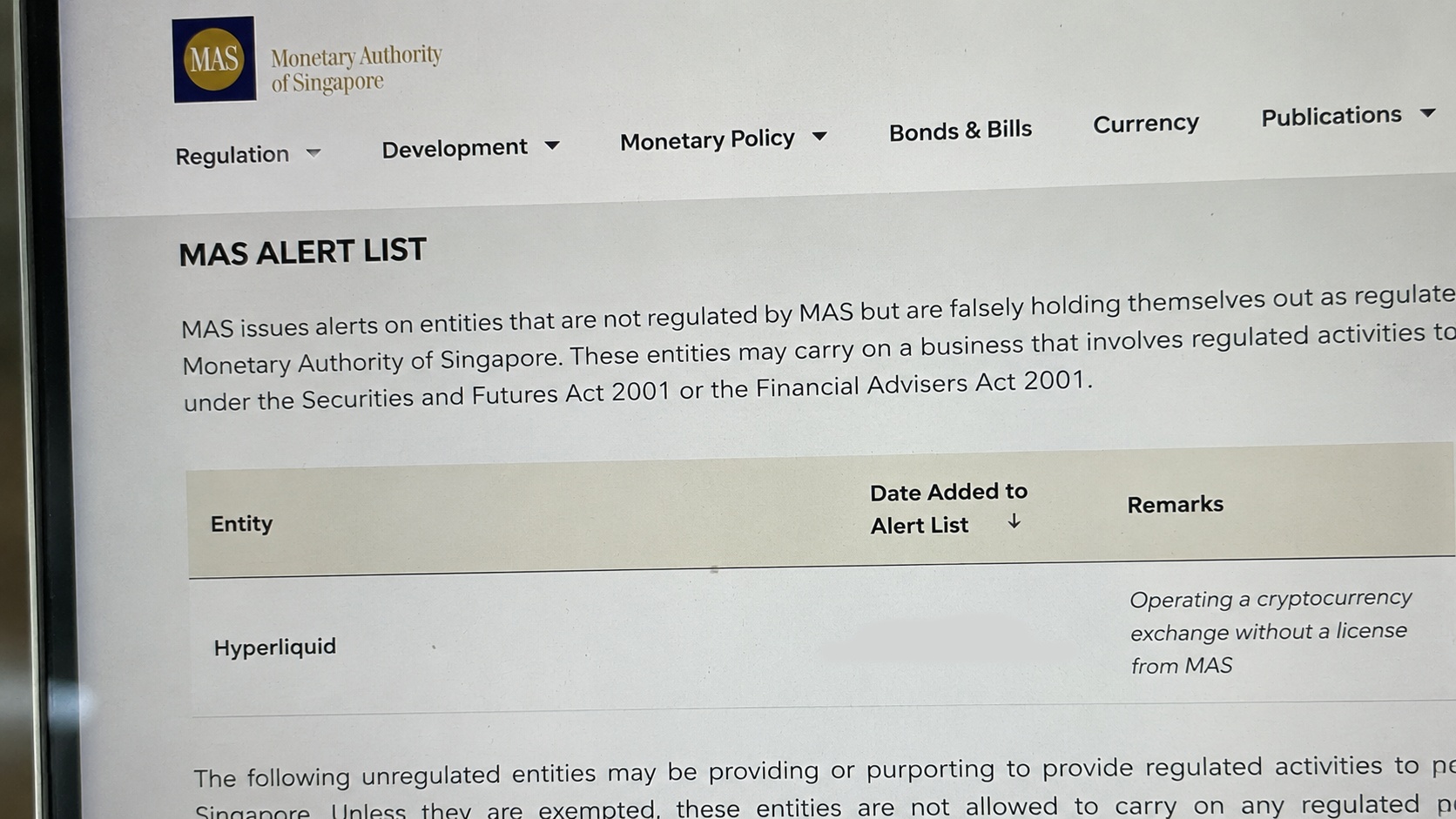
Singapore's Monetary Authority of Singapore (MAS) has added Hyperliquid to its Investor Alert List (IAL). Hyperliquid responded in a post on X, saying the listing does not amount to a ban, an enforcement action, or a finding of non-compliance. The protocol said it has never claimed to hold a MAS license or to be regulated by MAS, and that its network remains unchanged, with user assets still held in self-custody and trades settled transparently on-chain.
What the Investor Alert List Means
Based on the MAS description cited in the source material, the IAL is meant to warn investors that an entity may be mistaken for one that is licensed by MAS or supervised under its framework. Inclusion on the list does not by itself mean illegality, nor does it represent a court ruling or regulatory order. Hyperliquid's response leaned on that distinction and argued that its position matches MAS's own definition of the list.
Recent additions show the scope of the warning list broadening. Bybit was placed on the same list in mid-June, and Binance had appeared there earlier. Hyperliquid's inclusion now points to a shift beyond centralized exchanges and into on-chain protocols, with DeFi projects increasingly showing up in the IAL framework.
Hyperliquid Frames Itself as Permissionless Infrastructure
A central point in Hyperliquid's statement is its claim that it operates as permissionless infrastructure. In its description, anyone can access the protocol without approval, and there is no single conventional entity that would submit a licensing application to MAS. That distinction sits at the center of the tension raised by the listing.
Hyperliquid also said nothing about the network has changed. Users continue to control their own private keys, assets are not held on platform accounts, and transactions settle on-chain in a transparent manner. The protocol added that it will keep engaging with regulators globally and support clearer, better-designed frameworks for on-chain finance.
The Warning List Is Reaching Beyond Centralized Exchanges
The source notes that Bybit was added just last week, while Binance had already appeared on the list in the past. With Hyperliquid now included, MAS appears to be applying the warning mechanism more broadly to crypto-related entities that could be mistaken as being under Singapore regulation. The list functions as an investor notice, stating that these entities are not covered by MAS oversight protections, rather than serving as a direct judgment that their operations are unlawful.
From Hyperliquid's perspective, inclusion in the IAL has not changed the protocol's operation, smart contract activity, or the way users control assets. The immediate issue is where regulators draw the line in public warnings, and how decentralized protocols fit into existing regulatory language.