
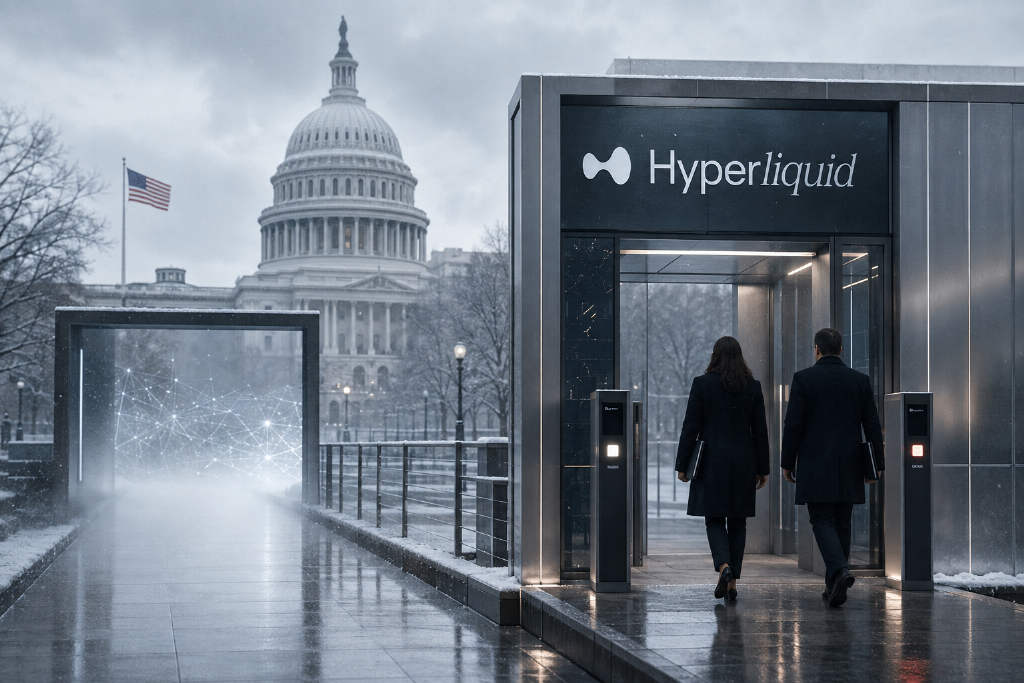
Hyperliquid is still geoblocked in the United States because its permissionless on-chain infrastructure conflicts with U.S. market structure law, which restricts futures trading to registered trading venues, clearinghouses and brokers. According to the article, Hyperliquid Policy Center has urged the Commodity Futures Trading Commission and the Securities and Exchange Commission to modernize those rules and allow regulated firms to build products on HyperCore through builder and deployer seats, so long as those firms carry the compliance burden themselves.
The piece says that, with Trump publicly backing a plan tied to Hyperliquid’s U.S. onshoring, a permissioned HIP-3 decentralized exchange now looks like one of the clearest paths for bringing the protocol into the domestic market.
Reframing Hyperliquid as market infrastructure
The article says most of the work around Hyperliquid over the past year has focused on changing how it is described. Instead of presenting it as a decentralized perpetuals venue, supporters have tried to frame it as modern market infrastructure: a globally accessible, composable platform for perpetual futures, spot trading and prediction markets.
That framing sets Hyperliquid apart from vertically integrated crypto platforms such as Coinbase and BN, which handle customer onboarding, custody and execution inside a single stack. In the article’s telling, Hyperliquid looks more like traditional finance, where responsibilities are split across separate entities. A designated contract market, or DCM, lists contracts and matches trades. A derivatives clearing organization, or DCO, handles margin and settlement. A futures commission merchant, or FCM, manages customer access and trade routing.
Hyperliquid’s modular architecture is described in similar terms. HyperCore serves as the trading and clearing layer, with matching, margin accounting and settlement embedded in protocol logic. It marks positions using validator oracles and liquidates through a deterministic liquidation waterfall. Deployers must post 500,000 HYPE as slashable collateral. They are responsible for token listings, contract specifications, leverage limits and oracle configuration, and they can retain as much as 50% of the fees generated by their market. Builders are positioned as the broker layer, bringing in users and routing order flow to HyperCore in return for a share of trading fees.
Still, the article stresses a major difference. Hyperliquid reconstructs those layers on-chain and enforces them in code. Market creation and access can be permissionless. Users self-custody assets. Other applications can build on top of the system. All assets trade on a single global platform around the clock, without the geographic and legal fragmentation seen in traditional market structure.
Why U.S. rules do not fit the protocol
The article identifies regulation as Hyperliquid’s main obstacle. U.S. market structure rules were built for a traditional legal and institutional model, and each required registration category sits awkwardly with Hyperliquid’s design.
- A designated contract market must satisfy 23 core principles under Section 5(d) of the Commodity Exchange Act, including market surveillance and customer identification. HyperCore, by contrast, is available to anyone with a wallet.
- A derivatives clearing organization must calculate margin using a board-approved model with a 99% confidence level and settle through approved settlement banks under 17 CFR §§39.13–39.14. HyperCore calculates margin in protocol logic and settles at the consensus layer.
- A futures commission merchant must segregate customer funds under Section 4d of the Commodity Exchange Act. Hyperliquid users self-custody assets instead of using a custodial FCM model.
The article says those requirements help explain why even centralized KYC platforms such as Coinbase have had to register as FCMs and acquire existing DCMs for U.S. operations. Hyperliquid did not choose that route because buying a DCM and adapting itself to the current framework would run against its goal of reworking the market’s base infrastructure. It geoblocked the United States instead, leaving the world’s largest capital market outside its reach.
HPC’s policy campaign
According to the article, Hyperliquid does not intend to remain offshore forever. In February 2026, it announced Hyperliquid Policy Center and funded it with 1 million HYPE, worth about $72.5 million at the current price cited in the piece. The goal was to push for a legal framework in the United States that could accommodate this type of market structure.
In July, HPC and Phantom asked the CFTC to confirm that publishing on-chain software, by itself, should not trigger registration requirements. They also argued that licensed firms should be allowed to run matching, settlement and margin functions on on-chain infrastructure, and that non-custodial wallets should have an exemption allowing them to route users to regulated derivatives products.
In August, HPC and TradeXYZ brought the same approach to the SEC. The article says they proposed a framework for pre-IPO perpetuals, including products tied to names already traded on Hyperliquid such as SpaceX and Cerebras, along with disclosure and eligibility rules needed to open those markets to U.S. investors.
The piece says early signs suggest the strategy is gaining traction and that regulators have shown openness. The most visible signal, it adds, was Trump’s announcement that Chair Selig planned to push for Hyperliquid’s onshoring.
At the same time, HPC is not asking regulators to let Hyperliquid serve U.S. investors directly through a no-KYC front end. Its position is narrower. Hyperliquid should be treated as neutral infrastructure, the article says, and U.S. firms that use it should be allowed to do so if they can satisfy the compliance obligations already required by law. In that model, a broker that handles KYC could route customer flow to HyperCore, while a deployer could take on the role of a registered venue, including listing discretion, market surveillance and emergency controls.
Permissioned HIP-3 on testnet
As the Washington push continues, Hyperliquid Labs has also rolled out testnet updates that the article presents as practical compliance tools. The clearest example is a permissioned version of the HIP-3 deployer.
Unlike Hyperliquid’s native markets and current HIP-3 deployments, which are open, these new deployments are limited to whitelisted users. The article says that creates a direct route for regulated entities to launch markets, run KYC and approve specific users for trading.
Those compliant venues would operate with separate order books because markets such as BTC and real-world asset products would need to be listed again. Even so, whitelisted market makers could bridge liquidity between the two books and reduce fragmentation. The article argues that these new deployments could keep independent order books while still drawing on Hyperliquid’s deeper liquidity.
It points to earlier examples of split order book structures, including early BN US and Lighter’s deployment on Robinhood Chain. But Hyperliquid is different in one important respect: both markets would run on the same layer-1 chain and share collateral and margin. There would be no need to move funds across chains or across separate venues, allowing liquidity to move between books rather than staying trapped in silos.
The article also mentions another control in the payload, labeled PA. This gives a decentralized exchange authority to act directly on user accounts by submitting reduce-only orders, canceling orders and transferring USDC within the DEX. The piece compares that authority to the close-out rights an FCM has over customer accounts.
Taken together, those features are presented as a toolkit for U.S. brokers and institutions to build compliant Hyperliquid products on HyperCore. The article says that path is additive rather than replacement-based: Hyperliquid’s native markets can remain permissionless, and the protocol can still be positioned as neutral infrastructure.
The article’s conclusion
The article concludes that Hyperliquid’s recent activity in Washington shows compliant entry into the U.S. market has become a central priority. It also says there is little ambiguity on the legal point: operating directly in the United States through the protocol’s native no-KYC front end would not comply with current law.
Its view is that HPC’s effort outlines a workable route for KYC-compliant access. Companies that provide access would shoulder the regulatory obligations, while Hyperliquid would remain the underlying infrastructure. With permissioned HIP-3 deployments and PA account controls now appearing on testnet, the article argues that a compliant channel for U.S. investors to access Hyperliquid markets is starting to take shape without changing the protocol’s core identity.