


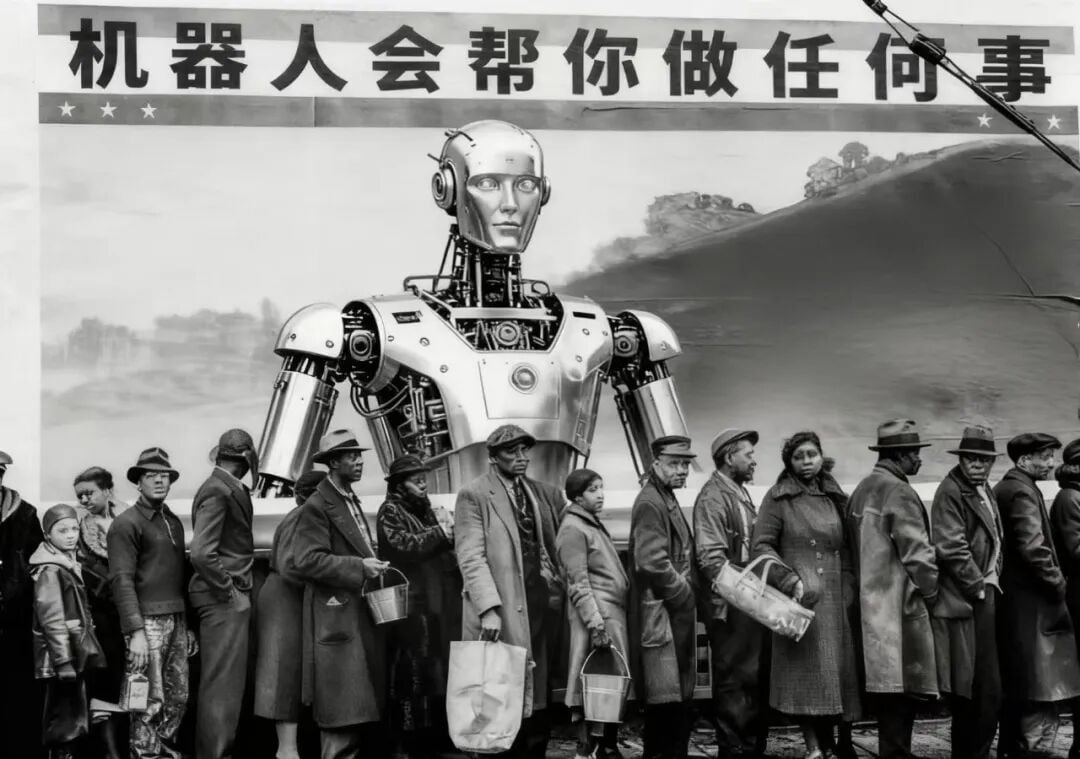
The argument is no longer just about whether robots will take jobs. It is about what a society does if work stops being the center of economic life.

More than 200 years ago, textile workers in Britain smashed machines. More than 200 years later, a similar mood has appeared at an auto plant in South Korea. In July, Hyundai Motor’s Korean union carried out a series of partial strikes. On the surface, it was a familiar labor dispute over wages, performance bonuses and retirement age. This time, though, one more issue appeared in the bargaining agenda: job protection in the age of AI and robotics.
During the strike vote in June, the union had already asked for employment safeguards tied to advanced robotic technology. South Korean media later connected that demand to Hyundai Motor Group’s plan to introduce Boston Dynamics’ Atlas humanoid robot. In the end, more than 86% of roughly 40,000 union members supported the strike.
That makes it inaccurate to reduce the episode to a simple story about workers protesting robots for taking away jobs. The July strikes were still rooted first in the breakdown of wage-related negotiations. Robotics was not the sole trigger, or even the most direct one. But another fact now matters just as much: robots have formally entered the union’s bargaining field. They have not yet arrived on Hyundai’s production lines at scale, but they have already pushed tens of thousands of industrial workers to think about a question that once felt distant—what happens to people?
The image naturally recalls the Luddites during Britain’s Industrial Revolution. Yet the more important issue today may not be whether people are about to smash machines again. It may be a subtler mismatch: humanoid robots may still be far from replacing large numbers of skilled industrial workers, while the social conflict around that possibility is already arriving early.
Workers are anxious before robots have fully arrived
At the same moment that anxiety is surfacing, Elon Musk has been presenting an almost opposite vision of the future. In a recent interview published by The Economist, Musk again described his long-term view of AI and robotics. Digital AI, in his framing, will take on more and more cognitive labor, while robots become the physical execution layer for that intelligence. If that trajectory continues, nearly all necessary work could eventually be handled by machines.
Hyundai workers are worried that Atlas could remove some jobs from the assembly line. Musk is imagining a future in which human labor is no longer needed for most jobs at all.
The real divide becomes clear here. The issue is not only whether robots replace labor. It is how people understand the loss of work itself. Modern society still rests on a durable chain: work generates income, and income supports consumption and daily life. Lose the job, and economic security usually goes with it.
Musk is sketching another model. If AI and robots drive the production capacity of goods and services high enough, society could enter a state of extreme abundance. The cost of supplying food, housing, transportation, healthcare and many services would keep falling. People would no longer need to sell labor in order to secure the basics of life. Work would shift from a necessity for survival to a matter of choice.
That is the backdrop to his repeated calls for “Universal High Income.” In this view, AI and robots generate enormous productive power, and the gains from technology become broadly shared prosperity. Robots taking jobs could even be the condition that allows humanity to move beyond the need to work in order to live.
That leaves two sharply different readings of the same machine. Luddite thinking sees unemployment risk. Musk sees the possibility of freedom. Hyundai workers want to protect jobs before robots enter the factory in force. Musk hopes robots will one day erase the need for compulsory work itself. Put together, those two logics sharpen one question above all others: as machines create more wealth, who gets to share it?

The concerns inside Hyundai are not hard to understand. Hyundai Motor Group has openly shown an aggressive robotics push, and Boston Dynamics’ Atlas has been moving from lab demonstrations toward industrial tasks. In that setting, an auto worker watching Atlas carry items, walk and handle parts, while management keeps talking about AI, smart manufacturing and automation, could naturally ask: five years from now, will the person standing next to this production line still be me?
Social media compresses that fear into an easy chain of cause and effect: companies buy robots, robots enter factories, human workers lose jobs. A capability demo, a procurement plan or an experimental video can quickly turn into a story about a profession entering its final countdown. A long-term technology trend gets folded into an apparently immediate reality. The imagined pace of replacement starts running ahead of the robots themselves.
Real industrial production is more complicated than that. Auto manufacturing is already one of the most automated industries in the world. Welding, painting, stamping and material handling in highly standardized settings have been covered by industrial robots for decades. The tasks humanoids still need to crack are exactly the ones conventional automation has never fully solved: flexible assembly, wiring harness work, movement across workstations, temporary exception handling, and constant small variations across parts and conditions.
The most valuable part of an experienced industrial worker is not simply a pair of arms. It is tacit knowledge built over years: how to install a part when tolerance is slightly off, what a change in hand feel means during fastening, where to check first when a machine makes a certain sound, how to compensate for a subtle deviation from the previous step. That knowledge rarely exists in full inside a written SOP, yet it often determines whether a production line runs stably.
That is also one of the hardest barriers for robots today. Picking up a part in a demo environment and repeating the same motion thousands of times over eight straight hours are two very different engineering problems. Completing one assembly does not mean meeting the yield, takt time, safety demands and costly downtime constraints of a live factory. For many robotics companies, moving from “can do” to “can do reliably over time” is still a long industrial path.
From that perspective, the claim that tens of thousands of auto workers are about to be replaced by humanoids is an oversimplification. A more grounded reading is that the long-term possibility of the technology has already been priced in by public imagination. People are worrying about the future before robots have developed the capacity for comprehensive replacement.
That does not make the anxiety meaningless. If a technology may rewrite production relations, social tension often surfaces before the technology fully matures. Such anxiety may not predict tomorrow with precision, but it can still put forward a question that societies will eventually have to answer.
What workers fear is not just the machine itself
“Luddism” is now often used as a mildly dismissive term. Oppose a new technology and you are called a Luddite. Raise concerns about AI or robotics and you can quickly be placed on the anti-technology side. Over time, the label has become shorthand for moving backward.
The historical Luddites were more complicated than that. In the early 19th century, Britain’s textile industry mechanized rapidly. Many of the people involved were skilled craftsmen trained over years. Machines did not just raise output. They also disrupted the old structure of skills, wages and labor relations. Scarce craftsmanship could lose value quickly. Lower-skilled labor could enter production with machine assistance. The bargaining power of skilled workers fell, and some livelihoods were hit directly. Machines became the most visible object onto which that anger could be projected.
Looking back after more than two centuries, it is easy to say that machines did not destroy human society. The Industrial Revolution produced an economy far larger than the artisanal era and created many jobs that had not existed before. From today’s vantage point, it seems easy to conclude that the Luddites overstated the threat and understated the new opportunities technological progress would bring.

But that kind of hindsight misses something important. A worker in 1811 did not know how much the global economy would grow 100 or 200 years later, or when new occupations would appear. What that worker could feel was immediate and concrete: wages were falling, skills were losing value, and the next job was nowhere in sight. The broad gains from technological progress often take a long time to spread. The costs of substitution can land quickly and heavily on a specific group of people.
Hyundai workers confronting Atlas are in a similar position. Robotics companies tell them automation will improve efficiency. Economists say new technologies will ultimately create new jobs. Tech firms describe a future in which people are freed from repetitive labor. All of those claims may be true. But the questions workers actually ask are narrower and harder: when does my station disappear? What is a skill built over 20 years worth five years from now? If the company gains productivity from robots, will any of that return to employees? If industrial transition carries costs, why should the people being displaced bear those costs first?
Seen this way, the return of Luddite sentiment in the robotics era is not just fear of new technology. It is a demand for clarity about distribution. The textile workers of two centuries ago and the auto workers of today are pressing the same issue: once machines raise efficiency, who receives the benefits?
The hardest part is not the destination but the road there
Musk is describing a society where work becomes optional. By his judgment, around 2036, AI and robotics may push productivity high enough that money itself matters less than it does today, and people may no longer need to work to survive.
It is an attractive endpoint. It also depends on a major condition: the enormous productivity created by robots, and the material abundance that follows, must be shared across society rather than captured narrowly.
Not everyone believes that will happen. As scholar Zhang Xiaoyu wrote in Technology and Civilization: Our Era and the Future, “If slave laborers benefit from technological progress, that only happens because productivity growth turns what used to be luxuries into mass consumer goods.”
If machines belong to a small number of companies, computing power is concentrated in a small number of companies, and data and capital are concentrated as well, while the goods and services produced by robots are still distributed through the old income structure, then rising efficiency does not automatically mean rising wealth for everyone. In the last internet wave, the phrase “tech aristocracy” had already become attached to Silicon Valley entrepreneurs.
That is also why Musk ends up needing the idea of Universal High Income. In one sense he sits at the opposite end of the spectrum from Luddism. In another, he still has to answer the same question the Luddites raised more than 200 years ago: how should the wealth created by machines be distributed?
The truly difficult issue may not be Musk’s distant endpoint at all. If robots one day can perform most necessary labor, society may by then have built a matching income system, welfare structure and social contract. The real pressure point is the transition period between the present and that future—the phase many people expect to be painful.
Robots will not jump in a single step from replacing 0% of jobs to replacing 100%. A more plausible pattern is gradual substitution: first 5%, then 10%. Some highly standardized roles decline first. Certain skills lose value. Some people become direct beneficiaries of AI- and robot-driven productivity gains, while others absorb the early costs of transition. The worst case is one in which companies book higher profits, retraining systems for workers remain underdeveloped, and new roles emerge in places that do not match the people losing old ones.

Technological capability usually rises along a continuous curve. Social institutions do not automatically upgrade at the same speed. That is why Michael Burry, whose profile inspired The Big Short, responded to Musk’s view on AI, robotics and Universal High Income with a stark line: “Before that, there will be revolution.”
Whether that is too pessimistic is open to debate. What it does capture is the section Musk-style futurism often skips over: how does a society built on labor income actually travel across the decades between here and a world where work is optional?
The anxiety inside Hyundai sits right at the front edge of that long transition.
Technology does not create its own rules
For that reason, the return of Luddite sentiment in the robotics era does not need to be mocked. Smashing machines will not stop an industrial revolution. History has shown that if a technology keeps lifting productivity and lowering cost, resistance alone is unlikely to keep it out of society. The same is true for humanoid robots. If costs keep falling, reliability keeps improving and return on investment gradually makes sense, robots are likely to move into factories, warehouses, commercial services and even household life over the long run.
But recognizing that direction is not the same as saying society should wait passively for technology to decide everything. The past two centuries of industrial civilization were never just about engines, electricity, computers and robots. The eight-hour workday, minimum wage, workplace safety, labor contracts, social insurance, product liability and industrial standards were part of that civilizational package too. Many of those rules were once treated as limits on efficiency. In time, they became part of the foundation that let technology scale into society.
Today’s expanding frameworks for AI, robotics, data, safety and ethics are part of the same process of drawing boundaries around a new technological wave. As robots move deeper into production and everyday life, those rules are likely to become more concrete: what kind of labor consultation is required before robots enter a production line; how productivity gains from automation are allocated; who pays retraining costs when workers are displaced by technology; how liability is assigned after a robot-related safety incident; and which high-risk settings must keep humans in the loop.
None of these questions is as visually exciting as a robot running, backflipping or completing a difficult task. Still, they may decide whether robots can move from demonstration to real industrial adoption.
As the article puts it with a classical Chinese line, “Wood shaped by the line becomes straight; metal sharpened on the whetstone becomes keen.” Constraints can look restrictive, yet they are often what allow a material to become useful. Technology is no different. A mature form of technological optimism does not pretend technology creates no problems. The more a society believes robots will eventually produce enormous gains, the more it needs to bring distribution, job transition, safety, responsibility and human dignity onto the table before those gains are released at full scale.
That is why the concerns voiced by Hyundai workers in South Korea may have arrived early, but not too early. Humanoid robots are still a long way from becoming reliable replacements for skilled auto workers over sustained periods. The discussion over how society should respond when robots really do enter the factory, however, is not premature.
If anything, it should begin even earlier.