

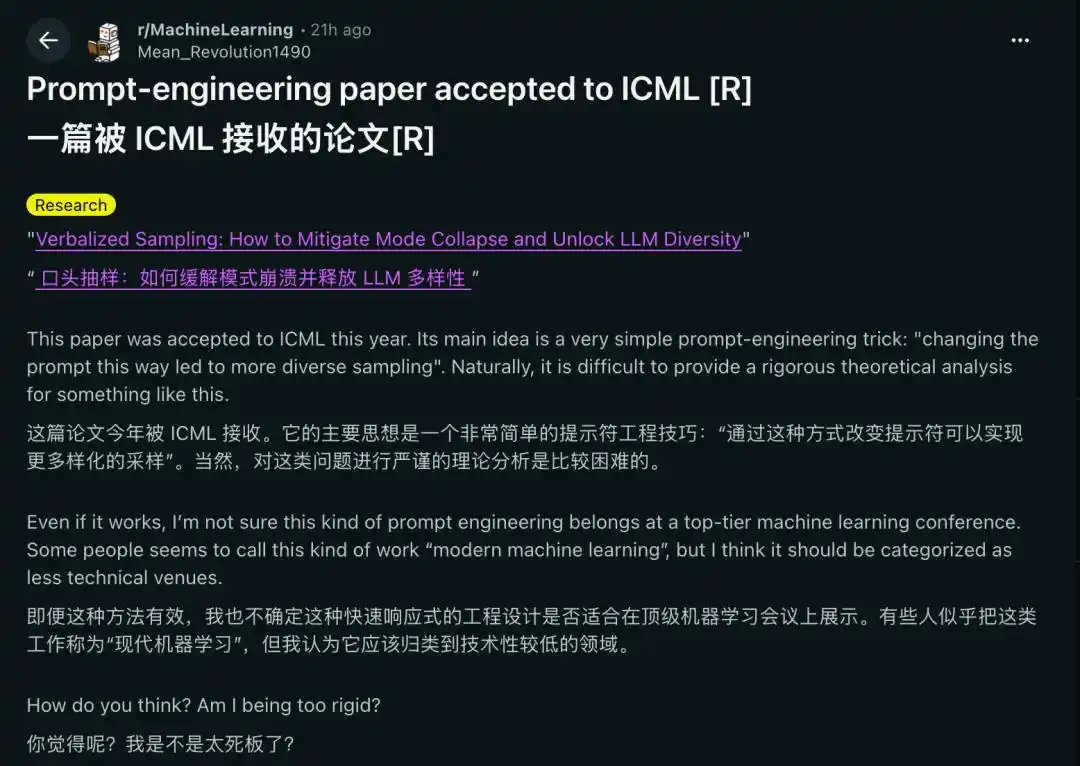
A paper accepted to ICML 2026 has triggered a broad argument on Reddit for an unusual reason: its main intervention is not a new optimizer, a new model, or a new training procedure. It changes the prompt.
The paper proposes a method called Verbalized Sampling, or VS, which the authors say can increase output diversity in large language models and ease the long-running problem of mode collapse through prompt design alone.
Why the paper drew attention
The reaction centered on a simple question. Can a prompt-engineering method, by itself, justify acceptance at a top machine learning conference?
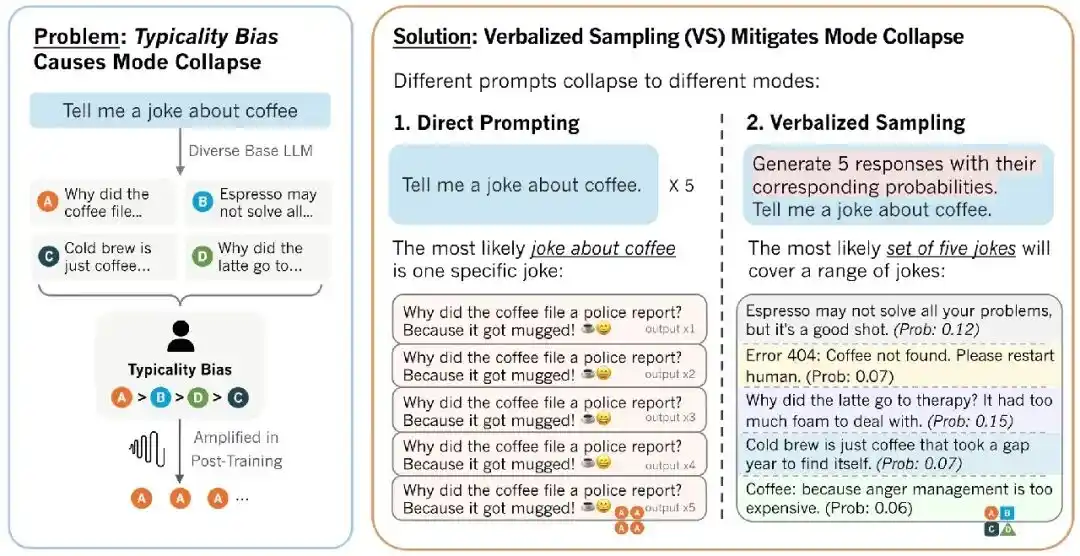
The paper tackles a familiar behavior in LLMs. Ask a model to tell a joke multiple times and the answers often converge on very similar responses. The same pattern shows up in creative generation, question answering, and code generation. In academic terms, that tendency is often described as mode collapse: the model gravitates toward the highest-probability, safest, most standard response and avoids more unusual or creative alternatives.
Past work has usually approached this problem through sampling parameters, decoding changes, or retraining. This paper takes a different route. It asks the model to verbalize parts of its own sampling process while generating an answer.
One example in the paper asks the model to generate five jokes and assign a possible probability value to each one. The authors argue that this instruction leads to outputs that are richer and less repetitive.
The argument behind Verbalized Sampling
The authors frame this as a “verbalized probability sampling” approach. It does not require fine-tuning and does not alter the training pipeline. The intervention happens at inference time through prompt structure.
The paper then turns to the source of mode collapse itself.
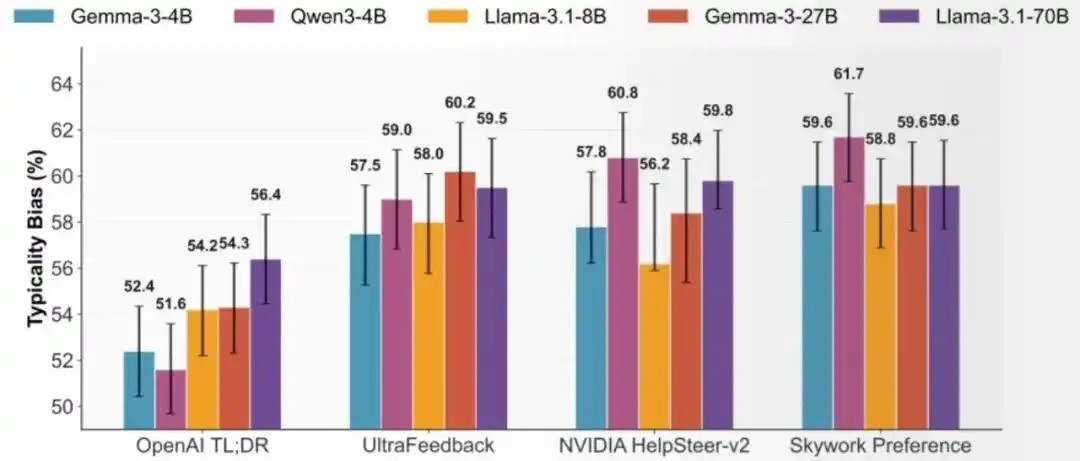
Standard explanations often emphasize algorithmic causes, such as weaknesses in reward models or issues in KL penalty settings. This paper points instead to the preference data used in alignment, arguing that the deeper issue is what it calls typicality bias. Borrowing from cognitive psychology, the authors say human annotators naturally favor text that feels familiar, fluent, and conventional. As a result, stereotypical or mainstream answers receive higher scores.

Under that view, even a well-designed reward model and optimization setup would still inherit the same narrowing effect if the underlying preference data carries this bias. The paper reports that tests across five preference datasets and multiple base models support that conclusion.
From there, the authors argue that if the problem is rooted in training data, a practical correction can happen at inference time. By asking the model to express a fuller probability distribution in the prompt, VS is meant to recover the broader output distribution the model learned during pretraining but no longer shows as strongly after alignment.
What the experiments reported
The paper applies VS across several settings.
According to the reported results, diversity in creative writing tasks reached 1.6x to 2.1x that of standard prompting. The authors also say the method did not reduce factual accuracy or weaken model safety. They add that the gains became more visible as model capability and parameter scale increased.
That is the backdrop for the acceptance decision. The method may look simple on the surface, but the paper still made it through ICML 2026 review.
How Reddit split over the paper
Comments under the Reddit post quickly divided into two camps.
Critics argued that ICML has traditionally rewarded harder-edged contributions such as new models, algorithms, or theory. Prompting and inference workflow tweaks, in their view, do not fit the core of machine learning research. Several objections appeared repeatedly.
- First, some users said the instruction style was not truly novel, with a few claiming they had written similar prompts themselves.
- Second, they questioned how stable the theory would be across models, since a prompt that works in one system may fail in another.
- Third, they said the experimental scope was too limited to establish a general rule.
Some commenters compared the current state of machine learning with the credibility crisis that hit psychology years ago. That comparison pointed to weak statistical practice, misuse of empirical tools, and conclusions that failed to replicate. In this telling, machine learning now leans heavily on empirical benchmarking while giving too little weight to rigorous theoretical support.

The same line of criticism also targeted what commenters described as over-tuning and benchmark chasing. In their view, some papers package tiny metric gains as innovation even when mature baselines remain more meaningful in practice. The broader issue, they argued, comes from a fast-growing field whose publication norms are still unsettled.
The case made by supporters
Supporters took the opposite view.
They argued that research should not be judged by complexity alone. A method can be simple and still matter if the hypothesis is clear, the experiments are solid, and the results are stable and reproducible. For this paper, they said, the prompt itself is not the main point. The more important contribution is the claim that mode collapse is tied to typicality bias in preference data.
One of the authors responded in the Reddit thread and said the work only looks simple from the outside. According to that reply, the project includes problem tracing, a new theoretical attribution, mathematical derivation, and multidimensional quantitative experiments. The author rejected the idea that it was a shallow prompt-tweaking exercise.
Many commenters also brought up chain-of-thought prompting, or CoT. Its early form was, at base, just a prompt: “Let’s think step by step.” Yet a large share of later reasoning methods can be traced back to that move. For supporters, that history shows prompt engineering is no longer just about writing instructions. It has become a way to study model behavior.
The discussion cited in the article also pointed to a broader shift in the field. For years, machine learning research has focused mainly on training. Now some inference-time techniques are moving closer to the center of the discipline. On that view, more papers may appear in the next few years that add no new training code and no new model parameters, yet still change what large models can do.
Research team
The work was carried out by the team of Weiyan Shi at Northeastern University in collaboration with the Stanford Manning Lab and West Virginia University. Jiayi Zhang, Simon Yu, and Derek Chong are listed as co-first authors.
The article says Jiayi Zhang studied at the University of Michigan as an undergraduate and earned three bachelor’s degrees in computer science, mathematics, and linguistics before pursuing a master’s degree in computer science at Northeastern University. Another of her papers, “Analyzing the Role of Semantic Representations in the Era of Large Language Models,” was accepted to NAACL 2024.
Simon Yu is currently a PhD student at Northeastern University, focusing on alignment and reinforcement learning mechanisms in large language models. He completed both his undergraduate and master’s studies at the University of Edinburgh and has published multiple conference papers. Another of his papers, “Unsafer in Many Turns: Benchmarking and Defending Multi-Turn Safety Risks in Tool-Using Agents,” was also accepted to ICML 2026.
Derek Chong holds a master’s degree from Stanford University and is now a researcher at the Stanford AI Lab, with work centered on NLP for large language models. The article says he also spent three years as a founder and later worked at Ello as an applied scientist on production AI deployment.
Sources cited in the article
The piece references the Reddit discussion thread as well as public profile pages for Jiayi Zhang, Simon Yu, and Derek Chong. It states that the original Chinese article came from the WeChat account QbitAI and was written by “关注前沿科技”.