
U.S. and Canadian markets are closed Monday for Labor Day, cutting liquidity across equities and forcing early closes in gold, silver and oil trading. Even so, the market tone had already shifted before the holiday after a stronger U.S. jobs report revived rate-hike expectations.

The U.S. added 162,000 jobs in August, well above the 55,000 expected by the market, while the unemployment rate held at 4.1%. After the release, market pricing for a September Federal Reserve hike rose from about 49% to 58%, putting the combination of firm labor data and elevated oil prices back at the center of trading.
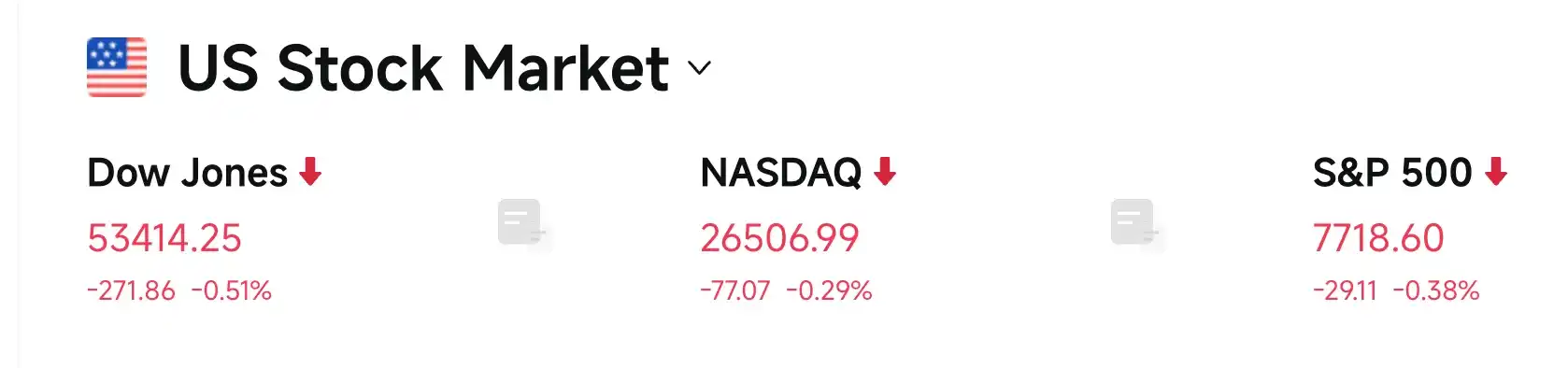
On Friday, all three major U.S. indexes closed lower. The Dow Jones Industrial Average fell 0.51%, the S&P 500 lost 0.38%, and the Nasdaq Composite slipped 0.29%.
Inflation data now becomes the week’s main test
The next question for traders is whether higher energy costs are moving into the broader economy. That puts Thursday’s Producer Price Index and Friday’s Consumer Price Index at the top of the week’s macro calendar, with both reports seen as the last major pieces of evidence before the Fed’s September policy meeting.
Federal Reserve Governor Christopher Waller has already outlined a rough threshold. If monthly core CPI comes in at 0.2% or lower, he leans against another hike. If it reaches 0.3% or more, a hike would be under consideration.
Wall Street is split on the outcome. Bank of America expects monthly core CPI at 0.22% and says that would be enough to support a September increase. Citi expects 0.184% and argues that most officials would likely leave rates unchanged.
Middle East tensions and unchanged OPEC+ output keep oil firm
Tensions in the Middle East escalated again over the weekend. The U.S. said it struck three Iranian oil tankers, while Iran threatened to establish a “restricted zone” near the Strait of Hormuz. OPEC+ on Sunday left October production unchanged, offering no extra supply buffer.
Oil futures opened higher in early trading. Brent crude moved near $93, while WTI crude rose about 0.99% to around $92.4. Morgan Stanley raised its fourth-quarter target to $100.
Donald Trump remains another market variable. He posted a series of images on social media tied to Iran, the Space Force and Intel earnings, and wrote, “I am doing this for the country, not for myself.” At the same time, the U.S. side continued to say it would “strangle” Iran’s economy. The report said rising energy prices are already feeding back into his approval ratings and the Republican midterm-election outlook.
Treasury yields approach a pressure zone as the dollar stays elevated
The U.S. bond market is already under strain. The 10-year Treasury yield is trading around 4.79%, close to the 5% level widely seen as a clear headwind for equity valuations.
The U.S. Treasury will also launch its expanded buyback program this week, effective Sept. 9, in an effort to improve liquidity in the long end of the market. At 1:00 a.m. on Sept. 10, the Treasury will auction 10-year notes. The previous sale stopped at 4.68 with a bid-to-cover ratio of 2.53. This round will be a direct test of whether global investors are willing to step in at current yield levels.
The dollar index is consolidating near 99. Gold has come under short-term pressure and briefly fell below $4,400 an ounce, though geopolitical risk in the Middle East and central-bank buying are still providing support. Three major banks remain constructive on the metal.
- Citi set a 0- to 3-month target of $4,800 an ounce and a 6- to 12-month target of $5,000.
- Goldman Sachs said the gold bull market is only in an “extended pause,” adding that sovereign and institutional buying is offering support around $4,000 an ounce.
- UBS said U.S. fiscal risks and “fiscal dominance” are turning gold into a long-term allocation asset.
Silver is also moving into a new trading phase. CME will expand 100-ounce silver futures to 24-hour trading on Sept. 11. After round-the-clock trading was introduced for 1-ounce gold futures, liquidity in precious metals during weekends and Asian hours is set to deepen further.
AI hardware holds up while mega-cap tech pulls back
The decline in headline indexes did not mean broad-based weakness across the board. Apple, Microsoft and Tesla weighed on the tape, but memory, optical communications and semiconductor-equipment names tied to AI demand moved higher.
Goldman Sachs Asia-Pacific chief equity strategist Timothy Moe kept a bullish call on South Korea, maintaining a 12,000 target on the Kospi. That implies nearly 80% upside from current levels. He said the market is underestimating how durable AI demand could be for memory-chip makers and expects capital spending by U.S. tech giants to exceed $1.2 trillion next year.
Nvidia remained the center of the AI supply chain. Jensen Huang praised OpenAI’s GPT-6 Astra in public, saying it was trained on more than 100,000 Nvidia Grace Blackwell NVLink72 chips, and added that “AGI has arrived.” Goldman Sachs’ Delta One desk also said Astra may represent the capability breakthrough that AI bulls had been waiting for.
There are still clear risks. Bank of America chief investment strategist Michael Hartnett warned that if Democrats sweep both chambers in the midterm elections, U.S. stocks could fall by more than 10%, the dollar could weaken and bond yields could decline, while the AI bubble would also face the risk of bursting. In his view, the jump in global bond yields is itself the biggest threat to the AI capex boom.
Stock moves across sectors
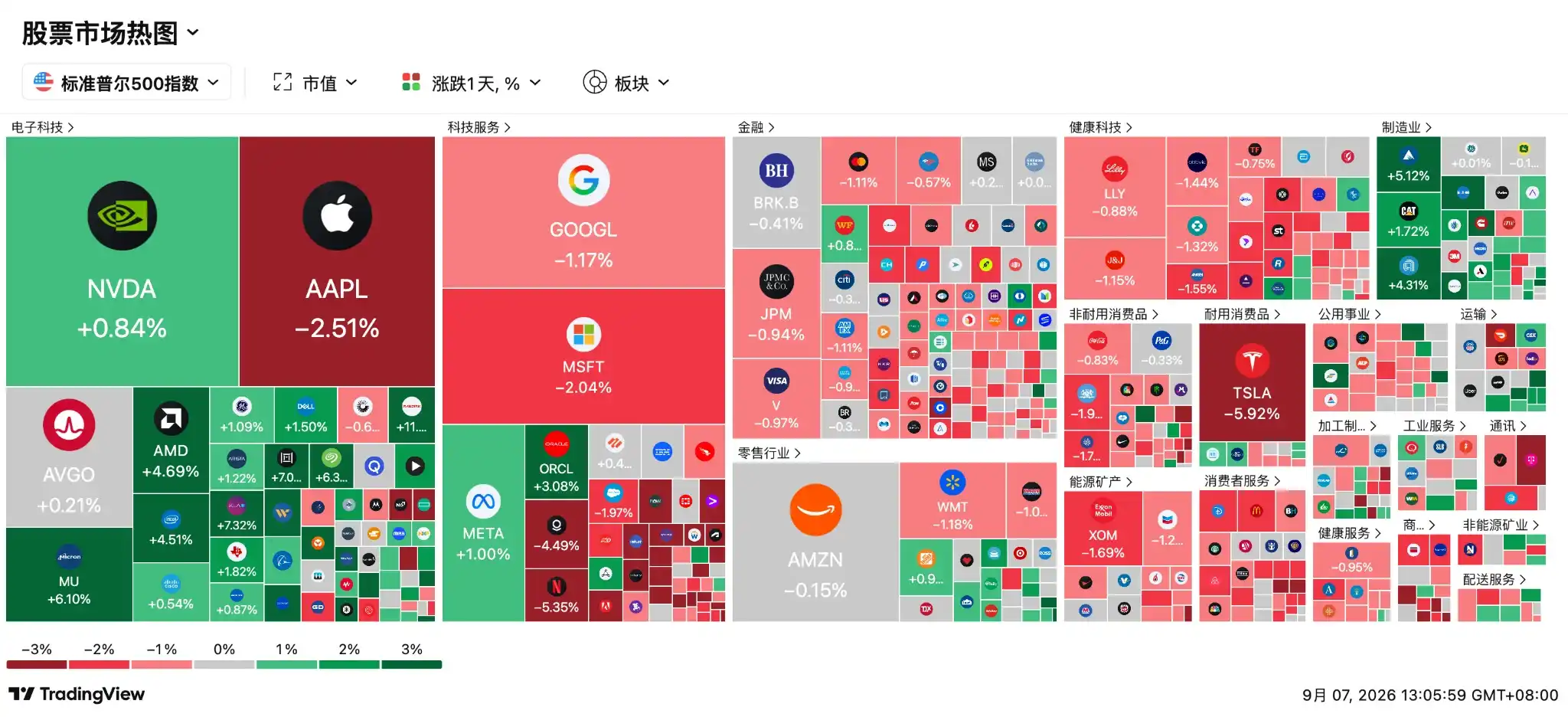
Micron Technology rose 6.10% as investors focused on expectations for higher HBM output. The company plans to lift monthly HBM capacity to about 100,000 wafers by year-end, nearly double last year’s level, and speed volume production of its 12-layer HBM4 product for Nvidia’s “Vera Rubin” architecture. Memory names mostly climbed with it: Sandisk gained 11.9%, SK Hynix rose more than 8%, Western Digital added more than 5%, while Seagate Technology fell more than 6%.
Nvidia added 0.84%. Alongside Huang’s remarks on Astra, the market also tracked reports that Nvidia is acquiring open-source AI platform Hugging Face for $12.9 billion. Traders said Nvidia is moving from chip supplier toward a hidden price setter across the AI developer ecosystem.
Semiconductor equipment and materials stocks also advanced. Aehr Test Systems rose 13.1%, Cohu gained 10.31%, KLA added 7.32%, Entegris rose 6.15%, Lam Research gained 5.12%, and ASML advanced 4.17%.
Tesla dropped 5.92%. Its Cybercab event came in below market expectations, the presentation was not livestreamed, and Elon Musk did not appear. More importantly, the U.S. National Highway Traffic Safety Administration has started reviewing about 1,000 Cybercabs for compliance with safety standards, adding a regulatory overhang.
Apple fell 2.51% as traders focused ahead of its launch event on cost and pricing pressure. Apple is set to unveil its first foldable iPhone and the iPhone 18 Pro lineup early on Sept. 10. Morgan Stanley called it Apple’s most important launch event in nearly a decade, but also said Pro models may be priced $200 to $500 higher, while the foldable iPhone could start at $2,399. In related names, Xiaomi Corp-W was last down 3.94%. Huawei Mate XT 2 and Xiaomi 18 Fold are both due this week, putting foldables, memory, displays and precision manufacturing into an event-driven window.
Lululemon sank 17.38% after second-quarter revenue fell 4% year over year, comparable sales dropped 9%, North America fell 12%, sales of its core yoga pants plunged 20%, and the company cut full-year revenue guidance for a second straight quarter.
Among other major names, Microsoft fell 2.04%. Morgan Stanley said changes to Microsoft’s reporting structure do not alter its fundamentals, though they reduce visibility into margins for some businesses. Microsoft and OpenAI were also sued by U.S. newspapers over AI training data. Alphabet slipped 1.11% after launching the more advanced WeatherNext 3 global weather forecasting model. Meta Platforms gained 1% as it used steep discounts to attract customers to its AI models while continuing to build agent and coding capabilities. Amazon fell 0.15% after a Prime Air cargo aircraft accident in Miami, with the FAA investigating. SpaceX lost 1.2% after SpaceX, Blue Origin, Stoke Space and Starcloud canceled their attendance at the Paris Space Summit under pressure from the White House.
Key events on the week ahead
Sept. 7, Monday
- U.S. and Canadian equity markets are closed for Labor Day, with early closes in gold, silver and oil trading. Lower liquidity could amplify moves tied to Middle East developments, oil gaps and dollar swings, leaving Asian and European sessions to do more price discovery.
- Huawei Mate XT 2 launches at 14:30, and Xiaomi 18 Fold at 19:00. Huawei’s new tri-fold flagship will debut HarmonyOS 7, while Xiaomi 18 Fold will use the Xuanjie O3 AI flagship processor.
- The expansion of Stock Connect takes effect, with Baidu Group-W and Manycore Tech among the additions to the eligible list.
Sept. 8, Tuesday
- At 00:00, Canada’s retaliatory tariffs on about $20 billion of U.S. goods take effect.
- At 9:20, Longsys lists in Hong Kong. The company plans to raise no more than HK$6.28 billion, with the H-share offering at a sizeable discount to its A shares.
- At 23:00, the New York Fed’s 1-year inflation expectations reading for August is due.
Sept. 9, Wednesday
- At 00:00, the U.S. Treasury’s expanded buyback plan becomes effective. The maximum size of each buyback will at least double to more than $4 billion, running through Nov. 4, with the aim of improving long-end liquidity.
- At 01:00, the U.S. will auction $58 billion in 3-year Treasuries.
- From Sept. 9 to Sept. 10, the Republican midterm election convention takes place in the U.S., with attention on Trump and the party’s comments on tariffs, fiscal policy, immigration and energy.
- From Sept. 9 to Sept. 10, the Paris Space Summit is scheduled, with attention on possible political or commercial friction in U.S.-Europe space cooperation.
- From Sept. 9 to Sept. 10, the 11th Belt and Road Summit will be held at the Hong Kong Convention and Exhibition Centre, attended by John Lee.
- Youdi Robotics will list in Hong Kong.
Sept. 10, Thursday
- At 01:00, Apple’s fall product event is scheduled to unveil the first foldable iPhone, iPhone 18 Pro and iPhone 18 Pro Max. It will also be the first major product test for new CEO John Ternus.
- At 01:00, the U.S. will auction $39 billion in 10-year Treasuries.
- At 20:15, the European Central Bank announces its rate decision, followed by Christine Lagarde’s press conference at 20:45.
- At 20:30, the U.S. releases August PPI. The market expects monthly PPI at 0.4% and annual PPI around 5.2%-5.3%.
- OPEC will publish its monthly oil market report.
Sept. 11, Friday
- Oracle and Adobe report earnings after the close, offering separate reads on AI infrastructure and AI application monetization.
- At 01:00, the U.S. will auction $22 billion in 30-year Treasuries.
- CME will expand 100-ounce silver futures to 24-hour trading.
- From Sept. 11 to Sept. 13, the 2026 China Computing Power Conference opens in Langfang, focusing on compute infrastructure and AI buildout.
- At 20:30, the U.S. releases August CPI and core CPI. The market expects headline CPI up 0.4% month over month and 3.4% year over year, with core CPI up 0.2% month over month and 2.5% year over year. If monthly core CPI is 0.2% or lower, the odds of a Fed pause in September would rise. If it reaches 0.3% or more, rate-hike expectations would be repriced.
Sept. 12, Saturday
- Elon Musk has flagged the opening of the release window for Grok 4.7, with the market watching the capability jump, inference cost and pricing strategy of its 2.1 trillion-parameter model.
- The 18th BRICS leaders’ meeting is also on the calendar, with focus on emerging-market cooperation, energy settlement, trade arrangements and de-dollarization topics.