
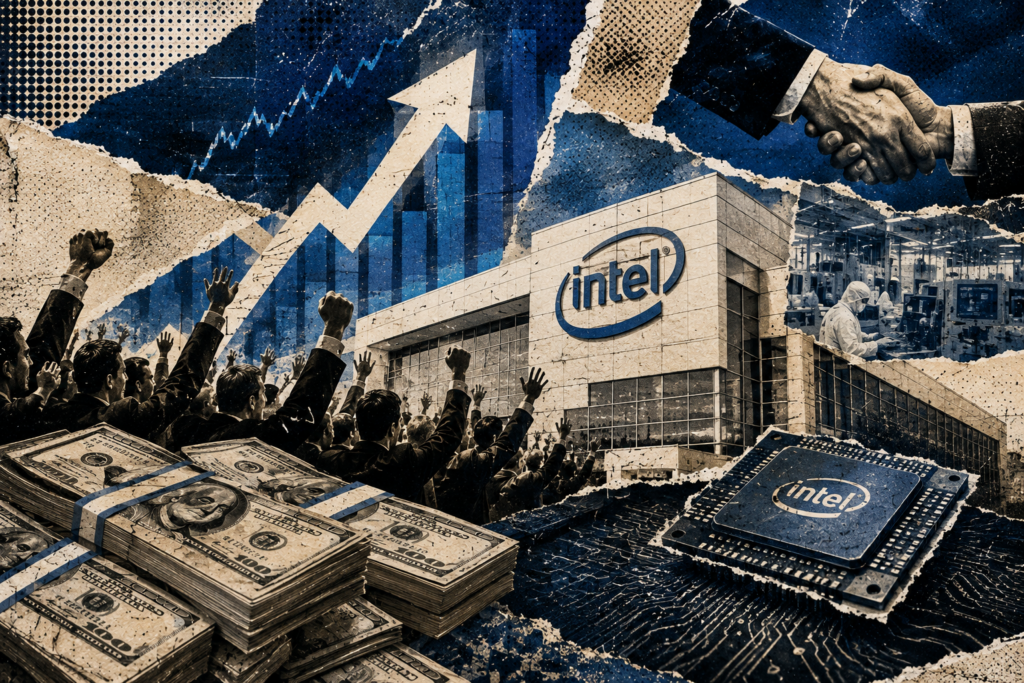
Intel’s Aug. 10 common stock offering has attracted more than $100 billion in orders, according to people familiar with the matter, prompting the company to consider increasing the size of the deal from $15 billion to about $20 billion.
If completed at that level, the transaction would mark Intel’s largest equity fundraising effort in recent years and signal strong investor appetite for the company’s AI transition story.
Deal terms point to heavy demand
People familiar with the matter said the offering is being underwritten by JPMorgan, Goldman Sachs, Morgan Stanley and Citigroup. The indicated sale price is about $95 a share or higher, representing a discount of roughly 6.5% to last Friday’s closing price.
In addition to the base offering, underwriters hold a 30-day over-allotment option to buy up to $2.25 billion in additional shares. If that option is exercised in full and Intel lifts the main deal size to about $20 billion, total proceeds could rise further.
Intel shares fell 4% on Monday after the offering was announced, closing at $97.52, as investors weighed dilution. Even so, the stock has surged about 175% this year and has risen more than fourfold over the past 12 months, making it one of the stronger performers in the Philadelphia semiconductor index.
Funds earmarked for capex and manufacturing buildout
Intel said the proceeds would be used for general corporate purposes, including capital expenditures and working capital. The company said it plans to focus spending on physical AI, custom chips, advanced packaging and foundry operations.
CFO Sinsner said, 「We are sending a signal to customers that we are confident in all of our business units.」
CEO Chen Liwu said that 「AI demand is outstripping supply,」 adding that demand tied to agentic AI and inference workloads has been especially strong and that CPU orders now exceed existing manufacturing capacity.
Capex plans keep moving higher
Intel raised its 2026 capital expenditure forecast in July from $18 billion to more than $20 billion as it works to absorb incoming orders. Sinsner also said 2027 capital spending would be 「significantly higher」 than this year’s level, a sign that the company is moving into a more aggressive equipment expansion phase.
From 2021 through 2026, Intel’s cumulative spending on equipment and facilities in the United States has approached $100 billion, according to the article.
The report said the fundraising amount is close to what Intel spends in a full year on capital expenditures. The money is expected to go mainly toward foundry capacity and advanced packaging technology as the company tries to compete with TSMC in AI chip manufacturing. The article also said the U.S. government’s earlier investment in Intel has been viewed as a catalyst for the share price and investor confidence.
Strong quarter, but execution questions remain
Intel reported second-quarter revenue of $16.1 billion, up 25% year over year, its fastest quarterly growth rate in 15 years. Revenue from data center and AI operations reached $6.3 billion, up 59% from a year earlier. Adjusted earnings per share came in at $0.42, nearly double the market estimate of $0.22.
Still, analysts have flagged risks. Goldman Sachs maintained a Neutral rating and a $150 price target on Intel, saying, 「What the market really cares about is whether the long-term transformation succeeds, not a single quarter’s earnings report.」
Goldman pointed to four issues that investors are watching closely:
- whether 18A and 14A process technologies can improve yields on schedule and enter mass production
- whether Intel’s foundry business can win major external customers
- whether the company can hold its server CPU market share
- whether heavy capital spending can ultimately turn into profits and cash flow
Even with those questions unresolved, the more than $100 billion in demand shows that investor interest in AI infrastructure trades remains strong.