
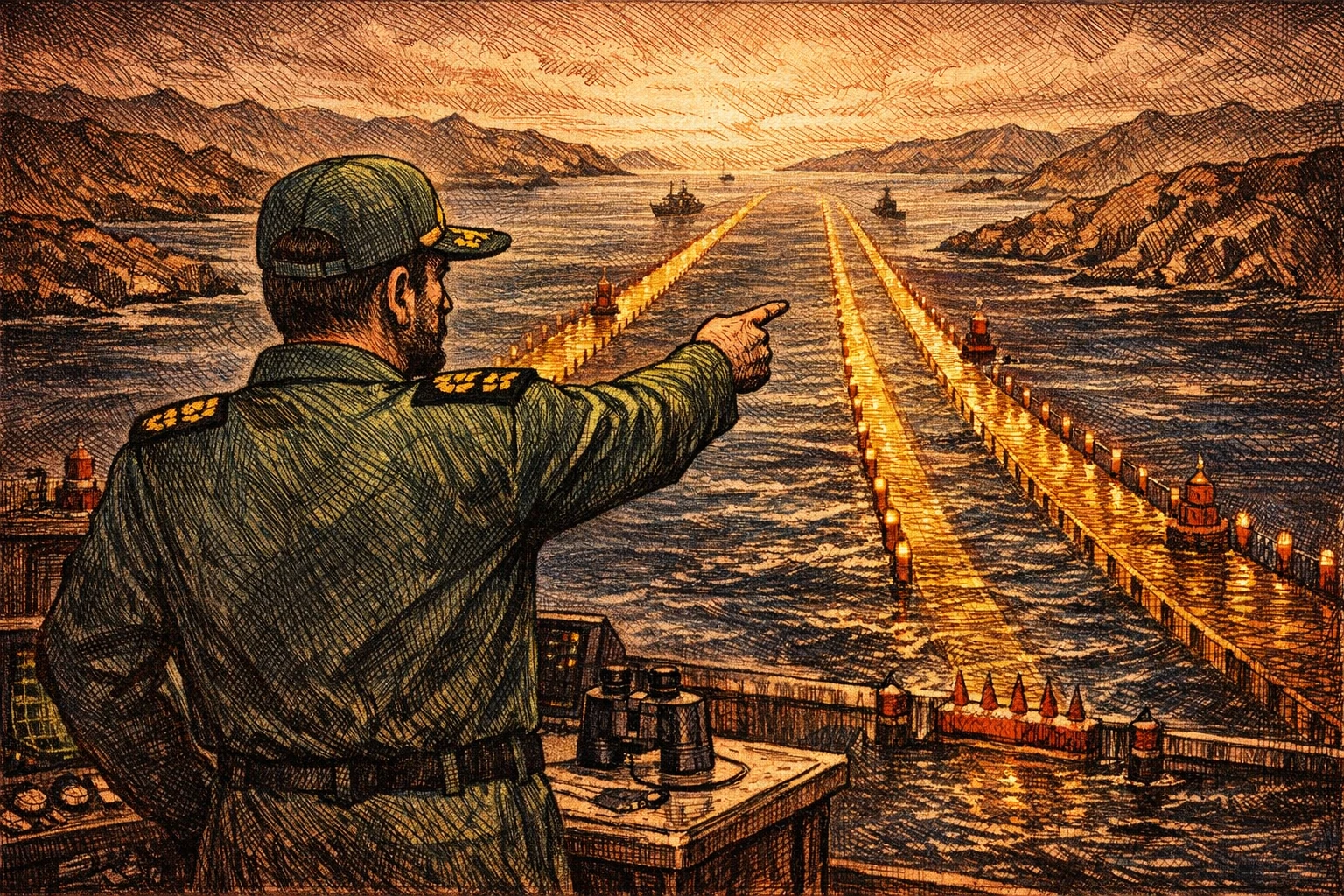
Iran’s Islamic Revolutionary Guard Corps Navy has designated two safe shipping lanes in the Strait of Hormuz for vessels entering and leaving the Persian Gulf, while making clear that ships still cannot cross the strait without Iranian permission. Tehran said any vessel that strays from the prescribed routes will face a “decisive response.”
Inbound and outbound routes run near Iranian territorial waters
According to Xinhua, the route map released by the IRGC Navy shows that ships entering the Persian Gulf should travel north from the Gulf of Oman and pass north of Larak Island. Outbound traffic is directed through a lane running south of Larak Island toward the Gulf of Oman. Both lanes are positioned at the northern edge of the strait, close to the Iranian side.
Iran’s rules require vessels to submit full documentation, obtain a transit code, and accept escort by the IRGC Navy. The lanes provide a defined path for passage, but control over movement in the strait remains tightly held by Iranian forces. The message is direct, and so is the enforcement posture.
Iran says other parts of the strait may contain mines
The Iranian military also warned that other areas of the strait “may be mined.” That warning sharply raises the risk outside the designated corridors. For commercial vessels, the room to adjust course appears limited, and any deviation could trigger the response Iran has publicly threatened.
About 1,600 ships remain stuck on both sides
At present, about 1,600 ships remain stranded on both sides of the strait, involving crews from 87 countries and around 23,000 seafarers. Saudi media had reported earlier that the United States and Iran reached a consensus on a “gradual reopening” of Hormuz, and Trump had also paused the “Freedom Plan” escort operation. Even so, the new lane rules released by the IRGC show that diplomatic movement has not yet translated into free navigation through the strait.