
Jefferies told clients during an optical experts call on July 15 that demand for optical modules is climbing faster than supply, leaving both 800G and 1.6T products in shortage and putting the market on track to reach three times its 2025 size by 2027, according to a TechFlowPost write-up of the note.
The central question, as framed in the report summary, is not only how large the market becomes but which parts of the supply chain capture the economics as capacity remains tight in several hard-to-replace segments.
800G and 1.6T are both running short
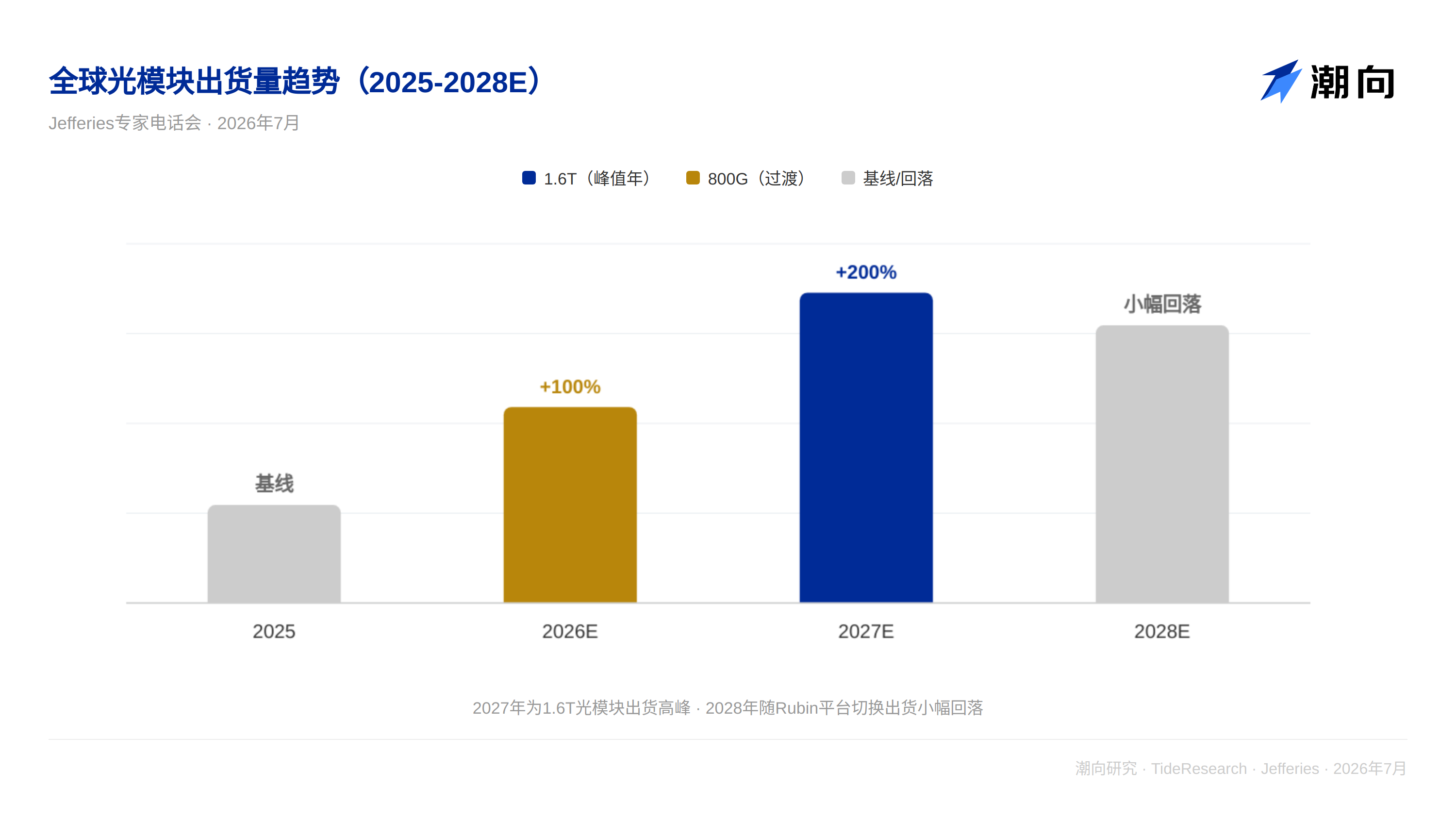
On the demand side, Jefferies estimates 800G optical module shipments at about 40 million to 42 million units in 2026, against demand of more than 45 million units, implying a shortage of roughly 10%. Shipments are then expected to rise to 80 million units in 2027 before easing slightly in 2028.
The gap is wider in 1.6T. Jefferies projects 2026 shipments at about 18 million units versus demand for around 26 million, leaving the segment 30% short. In 2027, shipments are expected to reach 55 million units, while demand is seen at more than 75 million, with the shortfall still at 30%.
For the next generation, 3.2T samples are expected to ship in the fourth quarter of 2026, while small-scale commercial deployment is projected for the fourth quarter of 2027. By 2028, Jefferies expects 1.6T shipments to reach 100 million units, while 3.2T begins from roughly 2.5 million units.
Based on that ramp, the firm says the optical module market in 2027 will be three times the size recorded in 2025.
DSP and 200G EML remain the main choke points
The note identifies DSP and 200G EML as the two main upstream constraints.
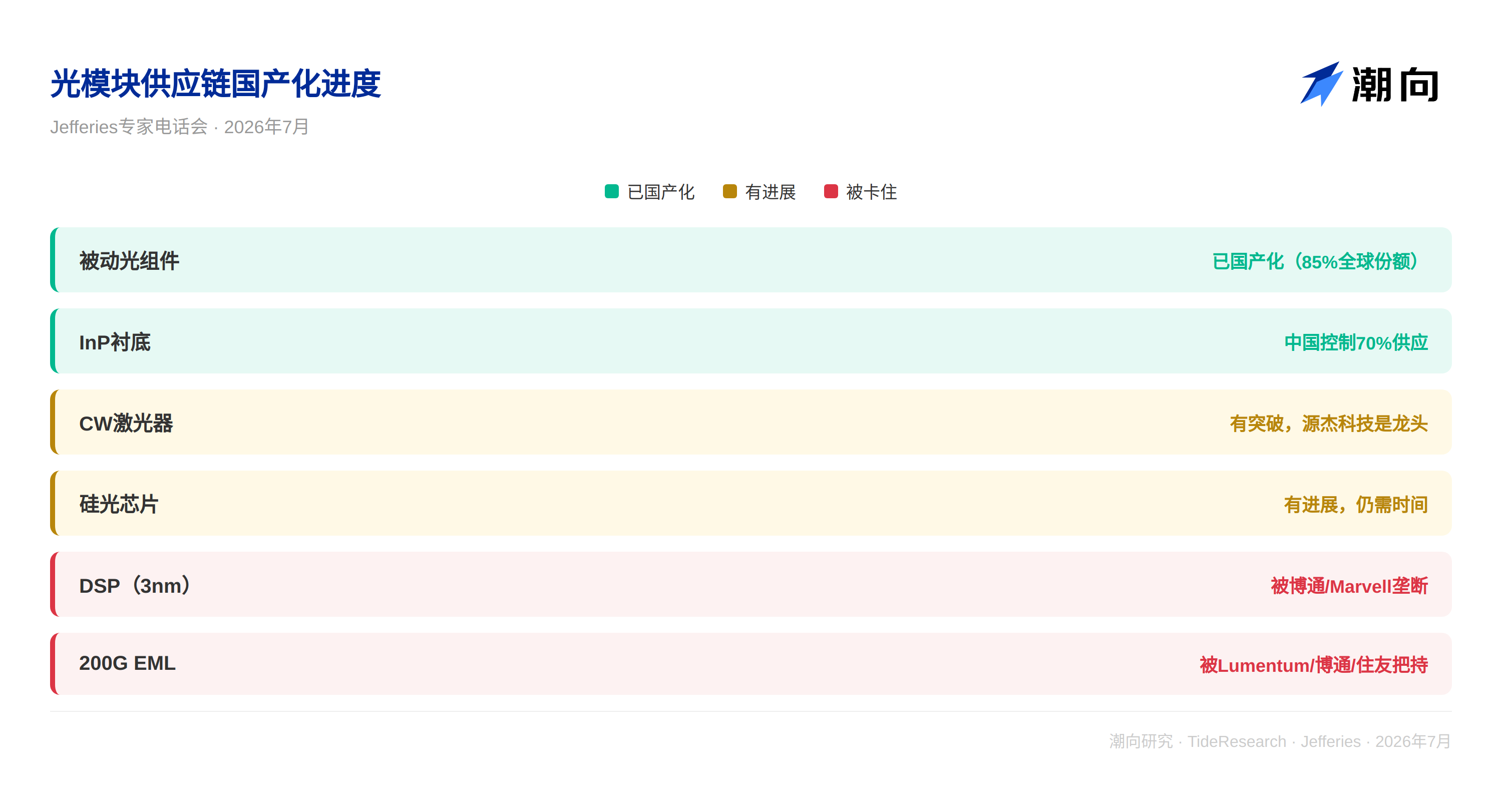
For 1.6T products, 3nm DSP chips are described as being dominated by Broadcom and Marvell. In 200G EML, the leading suppliers named are Lumentum, Broadcom and Sumitomo Electric. According to the report summary, China does not yet have a mature 200G EML supplier, and Desay Battery is expected to begin mass production in the second half of 2026.
Localization progress differs by segment. In passive optical components, including isolators, filters, lenses and AWG, China already accounts for 85% of global share, the report says. In CW lasers, Yuanjie Technology is identified as the leading domestic player, with four other companies also active. Electronic chips and silicon photonics chips have made progress, though the note says more time is needed.
At the complete module level, the report names Eoptolink, Innolight, Accelink Technologies and TFC Communication as major participants.

InP stays central across technology shifts
Jefferies describes the 800G era as one still led by EML. At 1.6T, silicon photonics is expected to capture more than 60% of the market because it uses 15% less power, comes with lower cost, and offers higher integration. On cost, the note says a silicon photonics design needs only two to four CW lasers, compared with eight in an EML design.
At 3.2T, however, EML is expected to regain leadership because silicon photonics does not provide enough frequency performance, according to the report.
The broader point is that indium phosphide, or InP, sits underneath both routes. EML requires InP substrates, and the CW lasers used in silicon photonics and co-packaged optics, or CPO, also rely on InP. The report says China controls 70% of global InP supply and names Yunnan Germanium as the core target in that part of the chain.
Jefferies also notes that thin-film lithium niobate could emerge as a new modulation material in the 3.2T era, but only for the modulation function. The light source would still depend on InP-based CW lasers. On that basis, the note argues that InP remains irreplaceable in data-center optical interconnect architectures.
What the report says to watch
TechFlowPost wrote that demand growth in optical modules looks relatively clear, but the split of profits depends on the upstream supply structure. In its summary, U.S. companies hold the key positions in DSP and high-end EML, while Chinese companies hold advantages in InP substrates and passive optical components.
The article points to two areas worth tracking in the Jefferies note: the InP supply chain, because 70% of global supply is in China, and China’s progress in 200G EML, with Desay Battery’s expected mass-production start in the second half of 2026 described as a key milestone.
The original article states that it is a summary and interpretation by Chaoxiang Research of a third-party brokerage report from Jefferies dated July 16, 2026. It adds that the ratings, target prices, earnings forecasts and related judgments cited in the piece are the views of the brokerage’s analysts, represent only their institution’s position, and do not constitute investment advice.
The piece also says market participants should make decisions independently and that the article should not be used as a basis for buying or selling securities.