
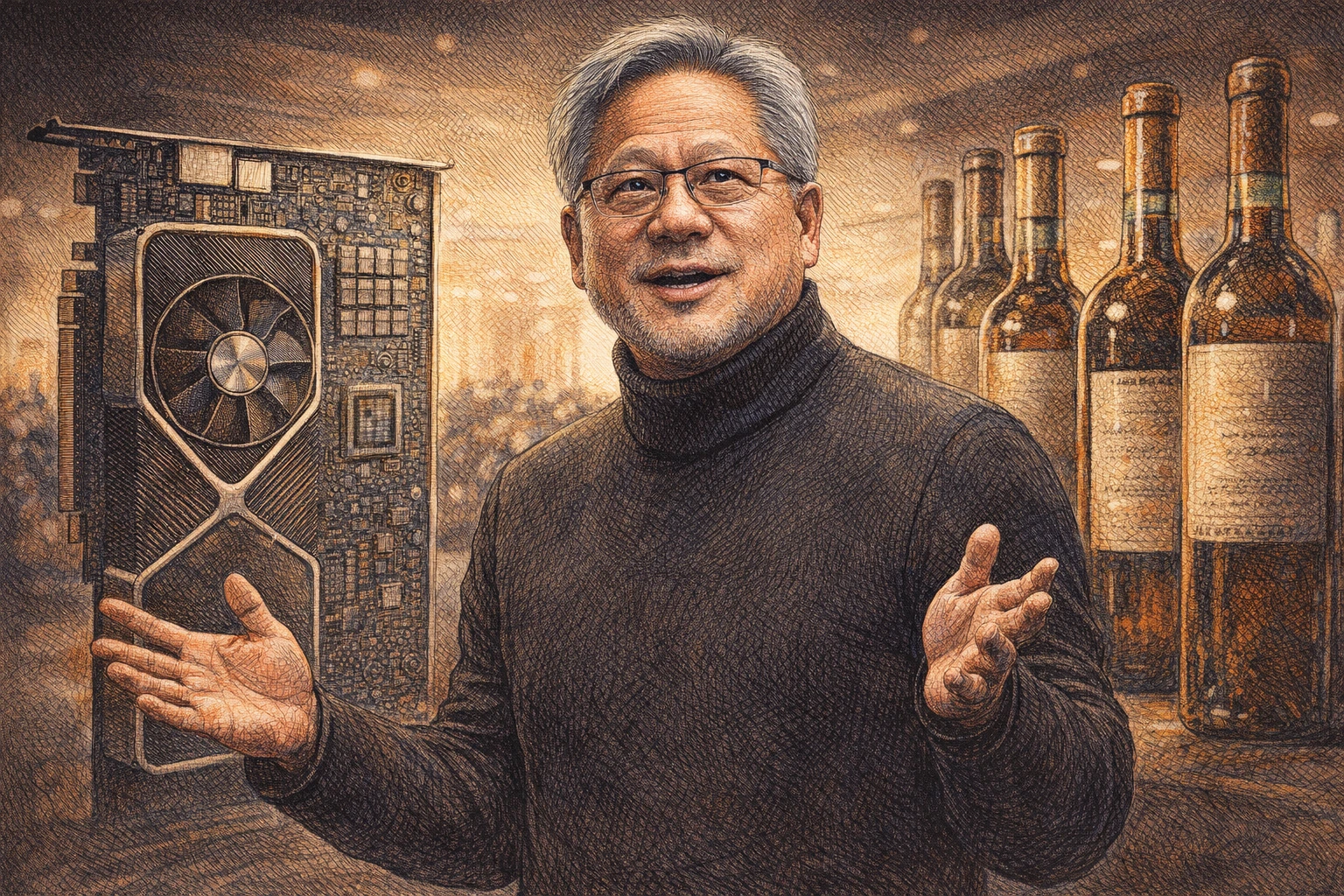
The AI boom has turned GPUs into one of the most sought-after computing resources globally, with even 4-to-5-year-old chips experiencing continuous price hikes. NVIDIA CEO Jensen Huang described this phenomenon as the 'Fine Wine Effect', comparing old GPUs to aged wine that grows more valuable over time—and at a faster pace than actual vintage wine.
Origin of 'Fine Wine': From Performance Optimization to Price Appreciation
According to reports, the term 'Fine Wine' originally surfaced during the AMD Vega GPU era, referring to driver-based performance improvements over time. In the AI era, its meaning has fundamentally shifted—now describing GPU prices rising as they age. Huang noted that even 4-to-5-year-old products maintain strong market demand and are in a state of continuous appreciation.
AI Computing Demand Drives GPU Supply-Demand Imbalance
NVIDIA stated that AI demand is propelling the GPU market into explosive growth. Almost all data centers running AI workloads rely on GPUs as their core computing source. While CPU demand is also growing, GPUs remain irreplaceable. Global semiconductor capacity is severely constrained across the entire supply chain—from wafer fabrication to GPU, CPU, DRAM, and AI cloud platforms—keeping hardware prices elevated, including for older GPU models.
CoreWeave CEO: Demand for Older GPUs Accelerating, Prices Rising
CoreWeave CEO Mike Intrator echoed Huang's view, stating that demand for older GPUs is accelerating. Prices for models such as H100, H200, L40S, and A100 have all increased quarter-over-quarter. Intrator noted that CoreWeave's computing resources have been sold out for an extended period, a situation common across the industry. Analysts believe that with AI model parameters expanding and enterprise AI deployment accelerating, the GPU supply-demand imbalance is unlikely to ease in the short term. Even 'outdated' GPU models remain hot in secondary markets and cloud rental markets, giving real-world support to Huang's 'fine wine' analogy.