
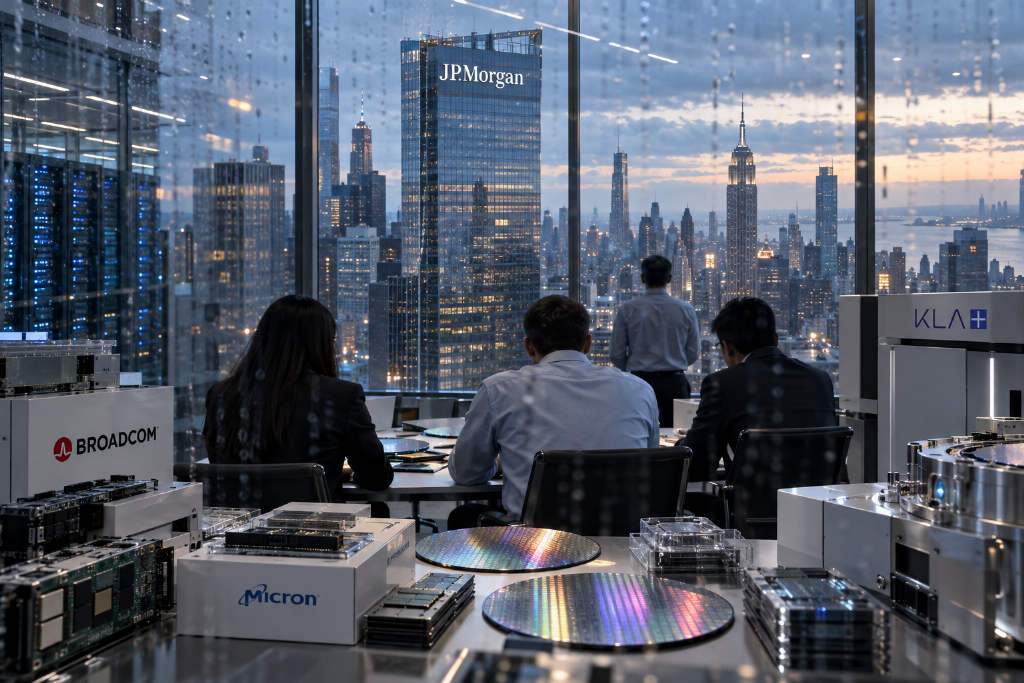
JPMorgan said in its Sept. 18, 2026 U.S. semiconductor and semiconductor equipment autumn report that industry fundamentals are strengthening and that the recent sector pullback is 「constructive」. Its model points to semiconductor industry growth of 118% in 2026 and 35% in 2027. Wafer fab equipment is projected to grow 31% in 2026 and 38% in 2027.

The bank said the main sources of volatility remain the durability of AI infrastructure spending, uncertainty around investment by frontier labs, elevated valuations, and geopolitical risk. Even so, it said underlying demand and supply fundamentals remain solid.
JPMorgan says the last four downturns were demand-driven
Analyst Harlan Sur wrote that semiconductor cycles over the past decade have been driven by demand, while the supply side has shown more discipline in expansion. According to the report, the last four downturn cycles were all demand-driven, and the supply chain has been more restrained in adding capacity.
JPMorgan argued that the structural difference in the current cycle is that supply discipline and broader end-market diversification have reduced cyclicality, shifting more of the industry’s focus toward profitability and free cash flow expansion.
Cloud capex is seen at $954 billion in 2026
JPMorgan’s cloud capex dataset puts 2026 cloud capital spending at $954 billion, followed by $1.41 trillion in 2027 and $1.54 trillion in 2028. The bank said those expectations have been revised sharply higher since the start of the year.
It said early AI monetization and ROI signals are becoming more visible, with faster growth in cloud and AI revenue, expanding backlogs, more long-term contracted capacity, and improving profitability in cloud and AI operations.
If those trends hold, cloud service providers would have a strong economic case to maintain high levels of AI infrastructure spending. JPMorgan said improving AI economics support a higher-for-longer spending environment and stronger semiconductor fundamentals. In its view, continued upward revisions to cloud capex are the core support for semiconductor demand visibility.
Custom AI ASIC market estimated at $60 billion to $70 billion
JPMorgan estimates the custom AI ASIC market at roughly $60 billion to $70 billion in 2026, with a compound annual growth rate of 40% to 50% over the next several years. As AI workloads become more specialized, hyperscalers and frontier model builders are increasingly looking for workload-optimized chips to improve performance, cut power use, lower cost per token, and secure supply.
The report said custom AI ASIC development requires deep expertise in multi-die SoC design, high-speed SerDes, HBM memory interfaces, advanced packaging, networking, and system-level productization. JPMorgan said most customers cannot replicate those capabilities internally at scale. It estimates that Broadcom and Marvell dominate the high-end ASIC market, with market shares of 80% to 85% and 10% to 12%, respectively.
Broadcom’s AI revenue is projected to rise from $58 billion in FY26 to $135 billion in FY27 and $245 billion in FY28, driven by projects tied to Meta, Google, Anthropic, OpenAI, and SoftBank/ARM. Marvell’s data center revenue is projected to increase from $10 billion in CY26 to $16 billion in CY27 and $28 billion in CY28, supported by optical DSP, Amazon Trainium 3+4, Microsoft Maia, and incremental Google XPU programs.
Memory pricing is forecast to jump about 250% in 2026
JPMorgan expects blended DRAM pricing to rise about 250% in 2026 and about 30% in 2027. NAND pricing is also seen rising about 250% in 2026 and about 25% in 2027. On the demand side, DRAM bit demand is projected to grow 29% in 2026 and 32% in 2027, while NAND bit demand is expected to increase 24% in 2026 and 29% in 2027.
The bank said long-term strategic customer agreements have become a key catalyst shaping the cycle by locking in DRAM and NAND pricing and supply, which improves visibility. Capital spending has remained disciplined, and capital intensity is below historical averages, limiting the risk of oversupply. The main demand-side risk, it said, is BOM inflation-driven destruction, especially in client and consumer markets. JPMorgan rates Micron overweight.
Analog recovery is broadening
JPMorgan said the analog recovery is broadening into a more durable upcycle. Texas Instruments, Analog Devices, and Microchip Technology have all pointed to improving industrial demand, faster AI and data center exposure, stronger aerospace and defense demand, and resilient automotive content growth.
Forward demand signals are improving, channel inventories are healthier, order activity is stronger, and lead times are better. Pricing, lead times, and margins are also improving. Texas Instruments, Analog Devices, and Microchip Technology all said demand is strengthening, lead times are extending, and pricing is becoming more supportive, while higher utilization and product mix should help margins. JPMorgan rates Analog Devices overweight with a $500 price target.
Wafer fab equipment outlook raised to 31% and 38%
JPMorgan raised its wafer fab equipment growth forecast to 31% for 2026 and 38% for 2027. The bank said expanding AI demand is pulling tool purchases forward ahead of multi-year greenfield and brownfield expansion. Foundry and logic spending is supported by TSMC’s N2 and N3 buildout, while Intel adds incremental upside.
Its Asia checks indicate a more aggressive TSMC roadmap, with multiple fab shells starting construction in the first half of 2026 and equipment orders rising from the second quarter of 2026. Memory wafer fab equipment spending is also broadening, led by DRAM capacity additions, while NAND spending ahead of a potential greenfield upside in the second half of 2028 is being driven more by conversions and migrations.
JPMorgan said KLA offers the best risk-reward, supported by 2027 foundry and logic wafer fab equipment exposure, Intel’s deeper involvement in yield and cost improvements, and higher capital spending that could lift CY27 consensus. The bank rates KLA, Applied Materials, Lam Research, and MKS Instruments overweight.
Top picks include Broadcom, Micron and KLA
Among large caps, JPMorgan’s top picks are Broadcom, Analog Devices, Marvell, Micron, and KLA. It also favors Nvidia, Applied Materials, and Lam Research. In small and mid caps, its preferred names are Astera Labs, Amkor, and MKS Instruments.
The report said Broadcom is working with four of its six AI ASIC customers on next-generation chip stacking projects on a 3D SOIC reference platform. Marvell, meanwhile, has achieved 33% more HBM stack density, 70% lower interface power, and 25% more XPU silicon area in its custom HBM architecture.
In JPMorgan’s framework, $954 billion in cloud capex supports semiconductor demand visibility, while AI ASICs and memory are the two main themes in the current upcycle.
Note and disclaimer
This article is a整理与解读 by Chaoxiang Research of a third-party broker report from JPMorgan dated Sept. 18, 2026, combined with public market information. The ratings, price targets, earnings forecasts, and related judgments cited in the text are the views of the broker’s analysts and represent only the position of their institution, not the view of Chaoxiang Research, and do not constitute investment advice.
Markets carry risk, and decisions should be made independently. The article should not be used as a basis for buying or selling any security.
By Rita. Chaoxiang Research @chaoxiangooo.
