

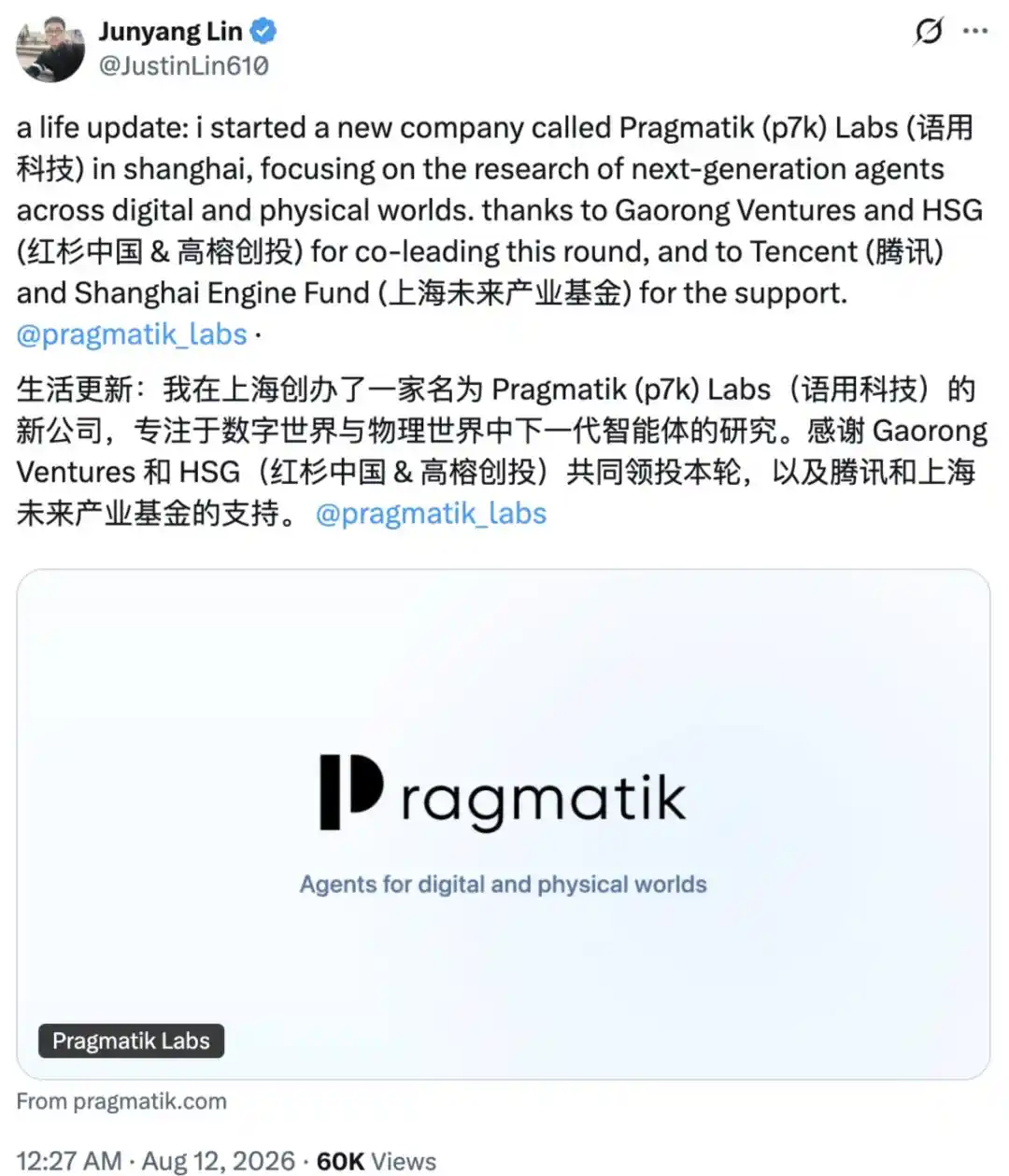
Justin Lin, the former technical lead of Alibaba’s Qwen model family, has officially announced his next move: founding a new AI company in Shanghai called Pragmatik Labs, also referred to as p7k. The company says it is working on next-generation agents that operate across both the digital world and the physical world.
Lin also disclosed the startup’s backers. According to his statement, Gaorong Ventures and HSG co-led the financing round, while Tencent and the Shanghai Future Industry Fund participated with support.
Earlier information cited in the source said the round reached several hundred million U.S. dollars. Gaorong Ventures and HSG were each said to have invested about $100 million, Tencent about $20 million, and the company’s post-money valuation was reported at roughly $2 billion. On that basis, Pragmatik Labs had already entered the 10 billion yuan valuation range before its formal public debut.
A months-long question around Lin’s next step now has an answer
Speculation around Lin’s plans had been running for months. The source traces that timeline from his departure from Qwen in March this year, to reports in May that he had started a company, and then to financing details that surfaced in June. With the public launch of Pragmatik Labs, that sequence is now tied to a named company and a defined research target.
The report says Lin, who had helped push Qwen into the first tier of global large model projects, did not stay at a major tech company and did not frame his new venture as a basic-model effort alone. He chose agents as the focus.
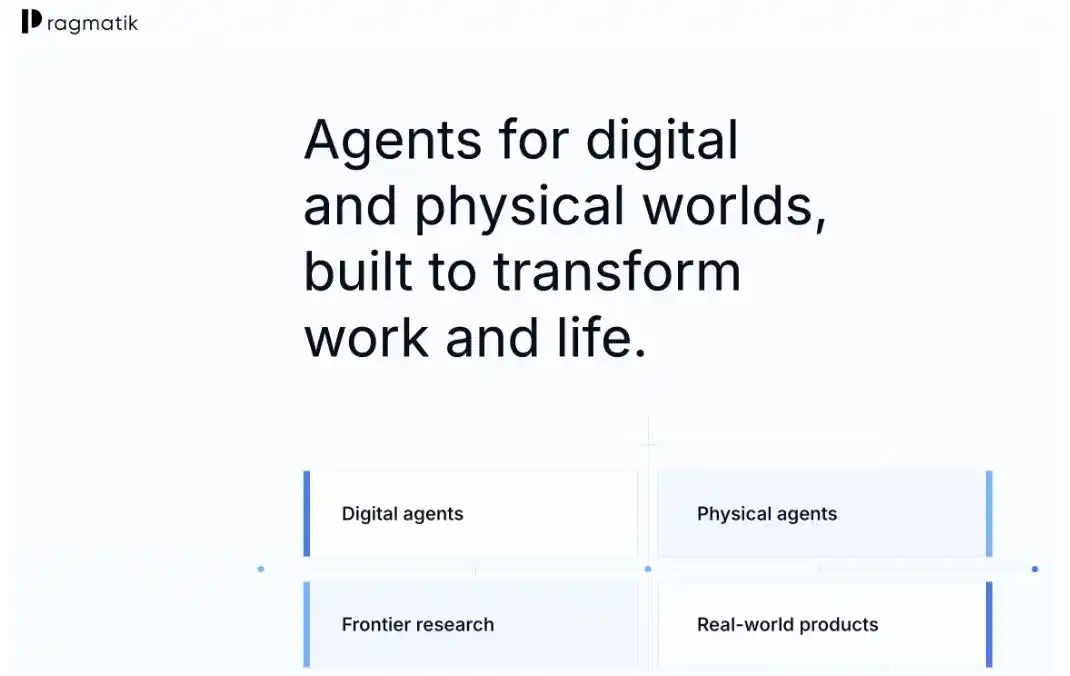
Pragmatik Labs’ website is now online, but the material available so far is limited. The company has not released model parameters, and it has not announced specific products. Still, its technical map is already visible.
The website lays out four research tracks
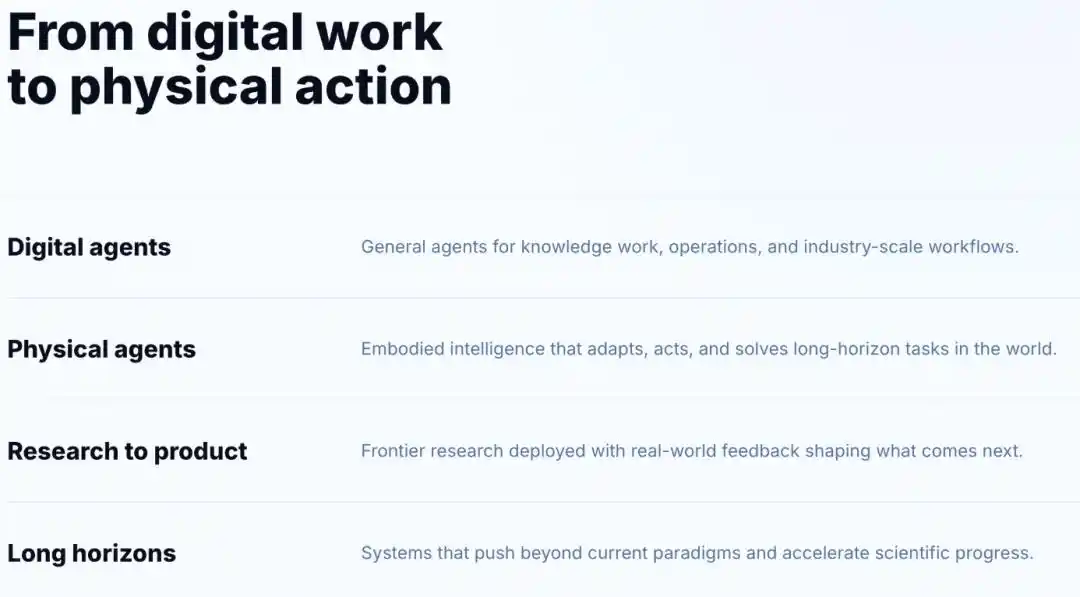
Pragmatik splits its work into Digital Agents and Physical Agents, then breaks that structure into four parts:

- Digital Agents: general-purpose agents for knowledge work, business operations, and industrial-grade workflows.
- Physical Agents: embodied intelligence that can adapt to environments, take action, and complete long-horizon tasks in the real world.
- From research to products: turning frontier research into real products and using real-world feedback to shape the next research direction.
- Long-horizon exploration: building systems that break from current paradigms and accelerate scientific progress.
The direction matches Lin’s earlier writing on agentic systems
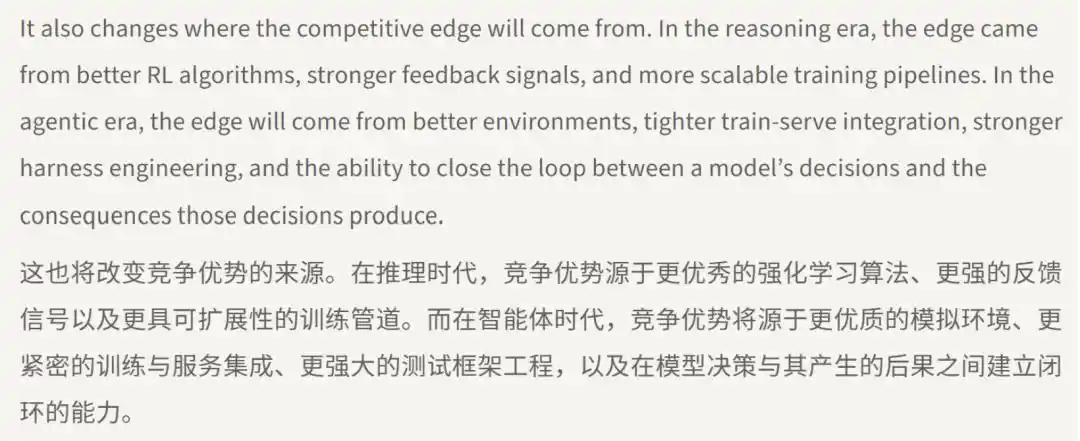
The report notes that this direction did not appear without warning. Back in March, Lin published an article titled From 'Reasoning' Thinking to 'Agentic' Thinking, arguing that the next stage of AI would shift from training models toward training agents, and even systems made up of multiple agents.
The article link provided in the source is: https://justinlin610.github.io/blog/from-reasoning-to-agentic-thinking/
Under Lin’s framing, what needs to be trained in the agent era is not just a model in isolation, but a full system made up of “model + environment.” The source says that includes a harness, training environments, evaluators, and even the way multiple agents collaborate. That, it says, may be what Pragmatik Labs means by “next-generation agents.”
Why the company is called Pragmatik
Lin also explained the name. He said: “I first studied linguistics because a friend recommended pragmatics to me. Later, I shifted to computational linguistics and natural language processing (NLP).
“On one hand, the name means returning to where things actually happen. On the other, it points to pragmaticism — we believe that is the direction AGI should pursue.”
Background: linguistics training, Alibaba, and Qwen
According to the source, Lin was born in 1993. He studied English at the University of International Relations as an undergraduate, while also learning Japanese, Russian, German, and French. He later completed a master’s degree in foreign linguistics and applied linguistics at Peking University.
The report says that during university, Lin tested a corpus of more than 3 million English-German samples and found that conventional machine translation achieved accuracy of about 23%, while an early version of Transformer reached 27%. The source describes that comparison as one factor that helped him spot the future potential of large models.
After graduating in 2019, Lin joined Alibaba’s DAMO Academy Intelligent Computing Lab as a senior algorithm engineer focused on natural language processing.
At the end of 2022, Alibaba moved AI teams covering language, vision, and other areas from DAMO Academy into Alibaba Cloud and formed the Tongyi Lab. Lin then took over the Tongyi Qianwen, or Qwen, large model series as technical lead. Under his leadership, Alibaba released open-source Qwen models across multiple parameter sizes.
In August 2024, after former Tongyi Qianwen head Zhou Chang left and joined ByteDance, Alibaba adjusted pay across core departments, and Lin was promoted to P9, according to the source.
In May 2025, Lin was promoted again to P10, becoming Alibaba’s youngest P10-level technical lead, the report says.
In October 2025, Lin personally set up a robotics and embodied intelligence group within Qwen. The source says that was viewed externally as one of Alibaba’s clearest moves into physical AI systems. At the time, Lin wrote on X that he was trying to move models beyond virtual screens so they could understand space and learn to manipulate the physical world.
Then, in early March this year, Lin announced in a post that he was leaving the Qwen team. He has now formally unveiled Pragmatik Labs, with a research goal centered on next-generation agents across digital and physical settings.
Reference links included in the source:
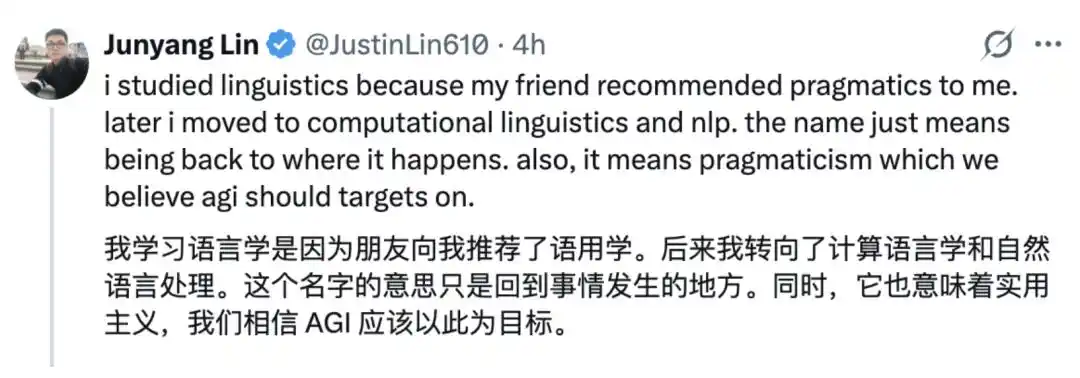
https://x.com/JustinLin610/status/2087214239643730227
https://pragmatik.com/
The original article was credited to the WeChat public account Machine Heart (ID: almosthuman2014), with authorship listed as “Machine Heart following Agent” and editors Youli and Shanhui.