
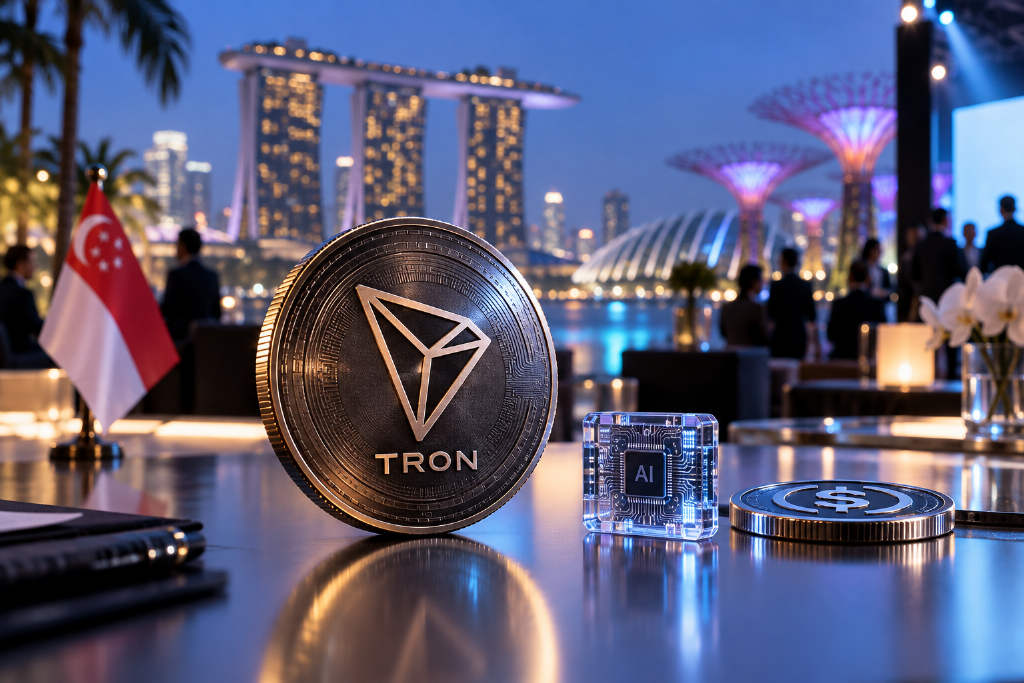
On Oct. 8, TRON founder Justin Sun appeared at the main venue of TOKEN2049 Singapore, where he spoke with Kevin Follonier, founder of the podcast When Shift Happens, about his approach to building in crypto, the overlap between AI and blockchain, and the goals behind the Sun Yuchen Prize.
During the conversation, Sun said the combination of cryptocurrency and AI agents will be one of the most important application areas over the next five years. He used that point to describe how TRON is positioning itself for the AI era.
Sun says crypto products should start with real user demand
Looking back at the early crypto market in 2017, Sun said many builders at the time were focused mainly on the technology itself, while he was more concerned with whether crypto could actually serve everyday users.
He said, 「People should not use cryptocurrency simply because they are interested in it. They should use it because they genuinely need it in daily life.」 Based on that view, Sun said he began early on to push for stablecoins to reach global scale.
Sun added that the TRON ecosystem now serves more than 400 million accounts worldwide. He described that figure as a direct result of sticking to a demand-driven approach.
Comparing crypto infrastructure with the traditional banking system, he said banking has gone through more than a century with little substantive change, while crypto technology, much like AI today, belongs to a software model that can keep iterating. According to Sun, the TRON protocol completes a version update roughly every two weeks. He also said users born after 2000 are more familiar with crypto applications and may gradually rely less on traditional banking services.
AI agents are a key use case for the next five years, Sun says
Sun made the case that AI and crypto belong together and called that convergence one of the most important application areas for the next five years. In his view, AI agents are naturally suited to cryptocurrency-based use cases.
He said crypto systems do not require KYC and AML procedures, which allows AI agents to access stablecoins through a user-friendly interface, make payments, receive funds, and operate on a true 24/7 basis. Traditional banks and exchanges, he said, are limited by existing operating models and are less able to support continuous settlement.
Sun said, 「Blockchain is fundamentally a machine-to-machine technology, while banking services are entirely built around humans.」 As AI agents become more common, he said, the infrastructure value of blockchain will become more visible.
TRON shares figures on stablecoins, protocol assets, and B.AI
Sun said TRON is building a financial network for the AI economy. He put the amount of assets held on the protocol at about $100 billion and said daily transaction volume is between $20 billion and $30 billion.
He added that TRON will continue to support major stablecoins including USDT and USDC, and said the network welcomes more stablecoin issuers.
Sun also said tokenized stocks will be issued on TRON so that all TRON users can gain exposure to U.S. assets.
At the same time, he pointed to B.AI, an AI routing platform built in the TRON ecosystem. Sun said the platform handles about 1.5 trillion calls per day and accounts for around 25% of OpenRouter volume, with room to move higher.
In his view, blockchain and AI are not competing tracks. He described them as mutually reinforcing, with blockchain serving as machine-friendly infrastructure that can support AI over time.
The Sun Yuchen Prize targets math and AI breakthroughs with high-frequency rewards
Sun also used the discussion to talk about the Sun Yuchen Prize. He said he formally announced the award on Sept. 16 and released the first list of winners, recognizing solutions and formal proofs tied to 66 mathematics problems. The article describes it as the world’s first zero-trust, decentralized academic bounty mechanism built around a list of problems.
Sun said traditional awards are usually tied to annual individual achievement, and that pace no longer matches the speed of innovation in the AI era. The Sun Yuchen Prize, he said, is meant to reward contributors in mathematics and AI on a more frequent basis. Humans, AI systems, and human-AI teams are all eligible as long as they solve key problems.
He said the maximum reward for a single problem can reach $1 million, adding that payouts for some problems have recently entered the distribution process.
Sun said, 「We are giving back the results achieved in the crypto industry to mathematics and science, generating more breakthroughs, and then feeding those results back into the growth of the crypto ecosystem.」 He described the effort as both a return to the industry and a long-term investment in the future.
What Sun said about the next decade
Looking beyond crypto infrastructure, Sun said he hopes to explore AI and healthcare over the next 10 years and use AI tools to bring practical benefits to public health.
Disclosure
The original article states that the piece was provided as sponsored content by the contributor, that the contributor has no relationship with BlockTempo, and that the article does not represent the outlet’s position. It also says the content is not intended as investment, asset, or legal advice and should not be treated as an offer to buy, sell, or hold assets. Any services, plans, or tools mentioned are for reference only, with final details subject to the contributor’s own announcements or explanations.