
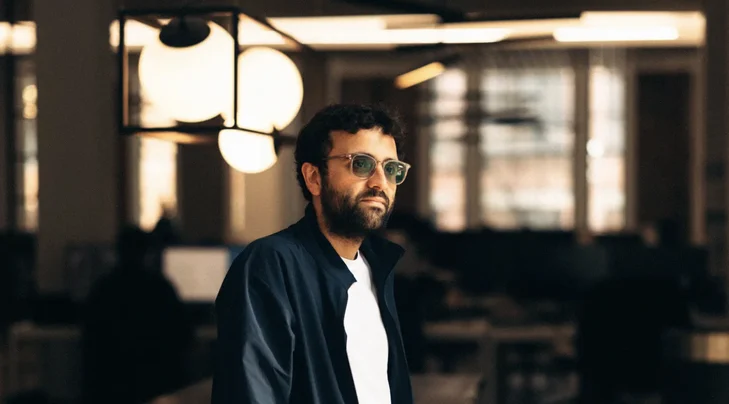
Kalshi CEO Tarek Mansour said prediction markets can help sort signal from noise by forcing people to put money behind their views, framing the model as a tool for pricing reality rather than a dressed-up form of gambling.

In the interview, Mansour described prediction markets as systems that turn subjective and politically charged arguments into mathematical, tradeable probabilities. If participants research carefully and stay grounded in facts, he said, they are more likely to make money. If they act on bias or detached views, they are more likely to lose.
Kalshi was founded in 2018 and opened to the public in 2021. The company was started by two recent Massachusetts Institute of Technology graduates: Mansour and chief operating officer Luana Lopes Lara. The report says Kalshi has about 200 employees, most of them working from an open-plan office in Manhattan’s Meatpacking District, without even occupying a full office floor.
Even so, Kalshi and other prediction-market platforms such as Polymarket have become far more visible. They sponsor major sports events, and media outlets increasingly cite their numbers in political and financial coverage. Users can trade contracts tied to outcomes ranging from football scores and drug-trial results to whether President Donald Trump will mention certain topics in a speech.
Kalshi completed a new funding round in May that valued the company at $22 billion, according to the report. Mansour grew up in Lebanon, while Lopes Lara is from Brazil. Forbes estimated that both founders, now 30, have become billionaires.
Federal oversight, state lawsuits and a widening debate
In the U.S., prediction markets fall under the Commodity Futures Trading Commission, or CFTC. Once approved, a platform can operate nationwide. Gambling companies, by contrast, need licenses state by state. That regulatory split has become a key advantage for the sector.
The report cites a New York Times investigation saying recent staffing cuts and lighter enforcement at the CFTC have helped the industry expand. Investor interest has followed. Among the people tied to the space are Donald Trump Jr., identified in the report as a Polymarket investor and a paid adviser to Kalshi. Meta CEO Mark Zuckerberg is also said to be looking at the prediction-market sector.
Criticism has grown along with that attention. Some lawmakers and regulators argue that prediction markets are gambling under another name. Insider-trading concerns have also surfaced. The report points to a U.S. soldier involved in the capture of Venezuelan President Nicolás Maduro who bet on that event at Polymarket, and a White House teleprompter operator who traded on Kalshi around the contents of a Trump speech.
New York Attorney General Letitia James recently sued Kalshi, accusing it of operating illegally and skirting state gambling laws. Kalshi called the case a “political stunt” and said states do not have the authority to shut the company down. The report says more than 10 states have introduced legislation targeting prediction markets this year.
What Mansour means by “financializing everything”
Mansour was asked about his vision of “financializing everything,” an idea some critics see as dystopian. He said the phrase has been taken out of context. His point, he argued, is not to turn every part of life into speculation, but to build a structure where incentives are visible and outcomes can be judged through prices.
That is where he repeatedly used the word “calibrate.” In his telling, markets reward people who seek the truth and punish those whose views are driven by partisanship or emotion. The value of a prediction market, he said, lies in making motives clear: people are there to profit, and that creates pressure to get things right.
Sports still lead, but politics and crypto are growing
Mansour said sports contracts remain the largest category on Kalshi. He described the user base as people who like math, economics and trading, and who are drawn to thinking in probabilities and variables. Sports, in that sense, are a natural training ground.
He gave a specific shift in mix: sports made up about 95% of trading last year, but now account for close to two-thirds. There are games every week, he said, while political events do not arrive at the same pace. At the same time, sports liquidity has helped support faster growth in crypto, politics and macroeconomic contracts.
For major political events, Mansour said market size can reach $50 million to $100 million. As more people participate, he said, pricing gets sharper and expectations move closer to reality.
A different path from Polymarket
Asked about rumored tensions with Polymarket founder Shayne Coplan, Mansour did not cast Polymarket as his main rival. He named Robinhood, CME Group, Coinbase, Interactive Brokers, large banks and Zuckerberg as the players he watches most closely.

Still, he said the split with Polymarket is real at the level of principle. The core disagreement, he said, is over operating inside a compliance framework versus growing outside it. In his view, Polymarket has not built sufficient market-risk controls, and that could hurt both the company and the broader industry over time.
Mansour said Kalshi supports reasonable regulation and has stuck to a compliant route from the start. In the early years, he and Lopes Lara spent several years planning which contract categories to launch and working to secure a federal license. He said they were 22 at the time and spent the first four years of their careers working with lawyers to help establish a regulatory framework for the sector.
On whether the current environment has gaps, Mansour said every period of innovation comes with regulatory blank spots. If regulation were flawless from day one, he said, new things would not emerge in the first place.
A small group drives most volume
Mansour said he does not have an exact concentration figure for the platform’s order flow, but acknowledged that activity is unevenly distributed. Some users trade occasionally. Some do it as a hobby or side business. A smaller group trades full time, which he called “superforecasters.”
That group may represent less than 2% of users while contributing 70% to 80% of trading volume, he said. He added that Kalshi’s most accurate inflation forecaster is an ordinary person in Kansas, and that the platform’s top 10 political forecasters come from a wide range of backgrounds, including blue-collar jobs rather than Wall Street careers.
How Kalshi says it handles insider-trading risk
Mansour laid out three measures. First, every user must complete identity verification, which gives the platform the ability to trace suspicious activity quickly. Second, Kalshi has built a surveillance system modeled on those used by the New York Stock Exchange to flag unusual trading patterns automatically. Third, the platform publishes all trading data.
He said that transparency cuts both ways. It means any unusual move can trigger immediate suspicions of insider trading. It also means unusual activity is visible to everyone. In his words, anyone trying to trade on inside information would be doing it in public view.
Mansour also acknowledged the tension in the debate. Insider information can, in one sense, make prices more efficient. Some economists have argued that it could improve predictive accuracy and make market conclusions more trustworthy. Kalshi still bans insider trading, he said, because fairness comes first and ordinary users will leave if they believe the game is rigged.
Management style, structure and rapid-fire answers
On expansion, Mansour said he and Lopes Lara work long hours and often keep going on weekends. As the company matures, more tasks can be standardized and delegated. Lopes Lara runs internal operations, while he handles external matters.
He described Kalshi as deliberately flat. There are few management layers, and the people doing the work are also the ones leading it. He said that creates urgency and helps prevent managers from taking credit for frontline employees’ output.
Mansour linked that style to his upbringing in Lebanon, saying the country’s uncertainty taught him early that the world is unstable. He made a similar point about artificial intelligence, saying the field changes almost every two weeks and companies need structures that can adapt. That is why, he said, Kalshi avoids rigid hierarchies and prefers teams that can regroup quickly around new challenges or opportunities.
In the closing rapid-fire section, Mansour said the Kalshi contract that recently caught his attention was tied to compute-power pricing. His favorite job-interview question is: “What do you think of Elon Musk?” He said his most contrarian view is that the success of any great company does not fundamentally depend on its executives, and when asked whether he sees himself as a manager, he replied: “No, I’m not good at managing people.”
He also said he recently asked ChatGPT about the probability of Democrats winning the 2028 midterm elections, adding that AI can now draw on Kalshi data for that kind of analysis. The worst advice young founders hear, in his view, is to gather too many opinions. Startups have no universal formula, he said, and much of the advice people give has little value. His own advice was not to treat his words as truth, but to take bold, controlled risks. On meetings, his answer was blunt: “If you can avoid one, don’t have it.”