

Kalshi Chief Executive Officer Tarek Mansour said sports contracts made up about 95% of trading on the platform last year and now account for close to two-thirds, a shift he said has helped bring liquidity into categories such as crypto, politics and macroeconomics.
In the same interview, Mansour said Kalshi’s disagreement with Polymarket is not mainly about head-to-head competition. He described it as a philosophical split over how a prediction market should grow: through a regulated framework or outside it.
Kalshi was founded in 2018 and opened to the public in 2021. Its founders, Mansour and Chief Operating Officer Luana Lopes Lara, had just graduated from the Massachusetts Institute of Technology. The company said in May that it completed a new funding round at a $22 billion valuation. Mansour grew up in Lebanon, while Lopes Lara is from Brazil. Forbes estimated that both, now age 30, have become billionaires.
The company has about 200 employees, most of them working from an open-plan office in Manhattan’s Meatpacking District. Mansour’s comments came as prediction markets, including Kalshi and Polymarket, have become common reference points in sports, politics and financial coverage.
Regulation, lawsuits and industry scrutiny
In the United States, prediction markets are regulated by the Commodity Futures Trading Commission, or CFTC. Once approved, they can operate nationwide. Gambling companies face a different structure and generally need licenses state by state. A New York Times investigation found that recent staff cuts and lighter enforcement at the CFTC have, in practice, helped the sector expand.
That growth has drawn investors and new entrants, including figures linked to the Trump family. Donald Trump Jr. is an investor in Polymarket and also serves as a paid adviser to Kalshi. The report also said Meta Chief Executive Officer Mark Zuckerberg is looking at the prediction-market sector.
Some lawmakers and regulators argue that prediction markets are gambling under another label. Insider-trading concerns have also surfaced in recent months. One U.S. soldier involved in the capture of Venezuelan President Nicolás Maduro placed bets on Polymarket tied to that event, while a White House teleprompter operator placed bets on Kalshi related to the contents of a Trump speech.
New York Attorney General Letitia James recently sued Kalshi, accusing the company of operating illegally and bypassing state gambling law. Kalshi has called the lawsuit “political theater” and said states do not have the authority to shut it down. More than 10 states have introduced bills this year aimed at regulating prediction markets.
In materials from its previous financing round, Kalshi said annualized trading volume had surged to $178 billion. Mansour argued that markets where people back their views with money have real value because they help “calibrate” a world that is overloaded with information but short on truth.
Sports still dominate, but less than before
Mansour said users are naturally drawn to sports markets because they are a strong training ground for probabilistic thinking. He described Kalshi users as people who like math, economics and trading, and who enjoy weighing the variables that shape outcomes.
On the numbers, he said sports-related trading made up roughly 95% of activity last year. That share is now close to two-thirds. His explanation was straightforward: sports events happen continuously each week, while political events do not. Sports contracts, in his view, create the liquidity that helps support growth in crypto, political and macro contracts.
On political markets, he said a major political contract can reach a market size of $50 million to $100 million. As participation rises, he said, pricing becomes more accurate and expectations move closer to reality.
“Financializing everything” and the case for oversight
Mansour said critics have taken his “financializing everything” phrase out of context. He argued that prediction markets convert subjective, emotional and partisan arguments into a mathematical and more objective system with clear incentives. People who research deeply, analyze rationally and work to find the truth are more likely to make money, he said. People driven by bias or extreme views are more likely to lose.
He said this creates a distinct kind of order because market participants can better judge the motives behind other people’s opinions. In his telling, people enter these markets in search of truth and profit at the same time.
Asked what comes next for Kalshi, Mansour said there have to be limits and that the company supports reasonable regulation. He said Kalshi deliberately chose a compliant path and spent years in its early life deciding which categories it could list while pursuing a federal license. At the time, he and Lopes Lara were 22 years old, and he said the first four years of their careers were spent largely working with lawyers to help build the regulatory framework around the business.
On whether the current framework has gaps, Mansour said every era of innovation leaves blind spots in regulation. If regulation were flawless from the start, he said, the country would not produce anything new.
Why he says Kalshi and Polymarket differ
When asked about reports of tension with Polymarket founder Shayne Coplan, Mansour did not describe Polymarket as the rival he cares about most. He named Robinhood, CME Group, Coinbase, Interactive Brokers, major banks and Zuckerberg as the players he watches more closely.
His line on Polymarket was blunt: the two companies differ at the level of philosophy.
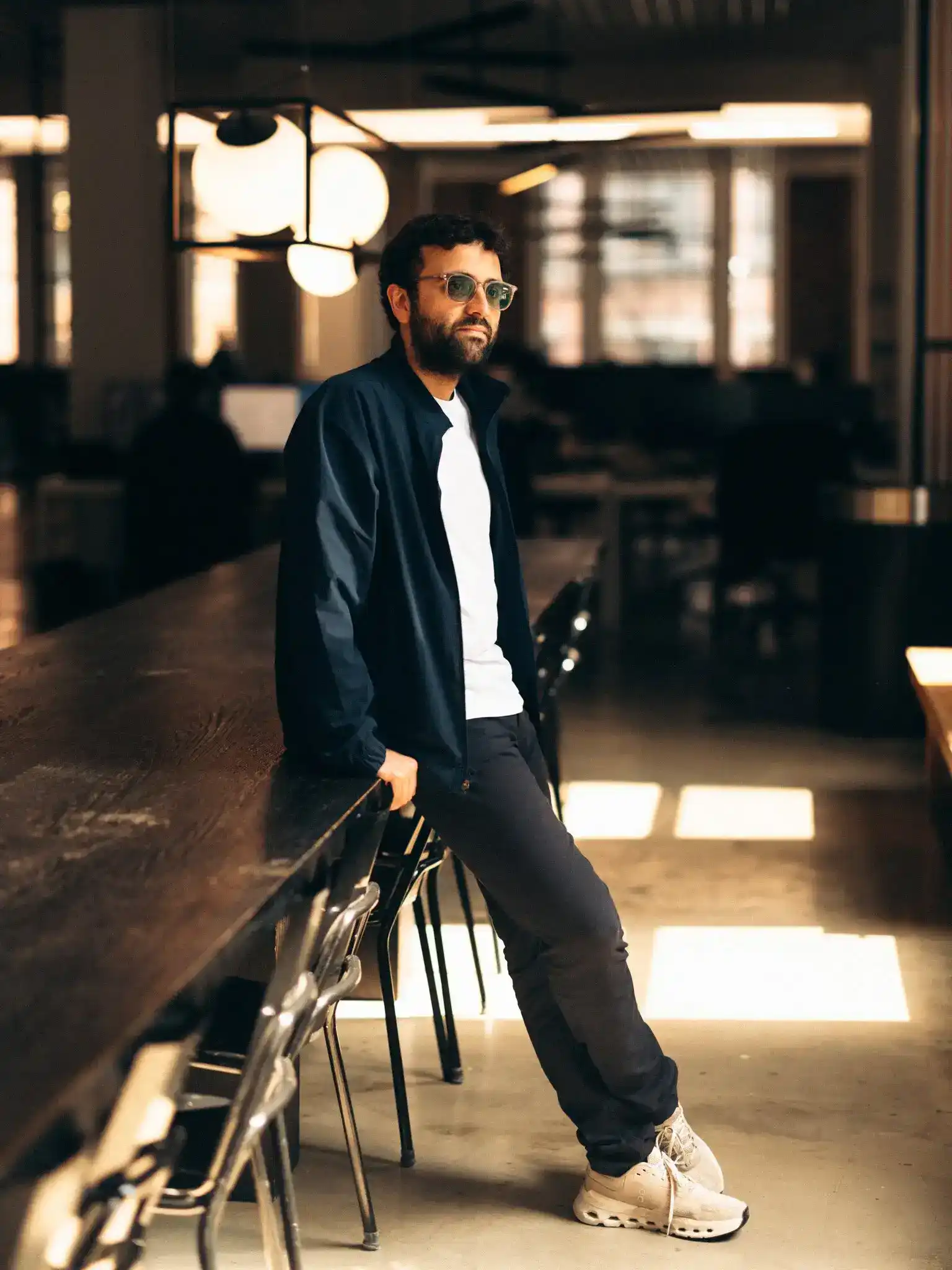
Pressed on the substance of that gap, Mansour said it comes down to development strategy. One path is regulated operation. The other is unregulated expansion. He said he believes Polymarket has not built a sufficient floor for market risk controls, and that this could hurt both the company and the wider industry over time.
Who trades on Kalshi
Mansour said he does not have an exact figure for how concentrated Kalshi trading is, but he acknowledged that volume is unevenly distributed. Some users trade only occasionally each month. Others treat it as a hobby or side job. A smaller group participates full time, what he called superforecasters.
That group may make up less than 2% of users, he said, yet account for 70% to 80% of trading volume.
He added that Kalshi’s most accurate inflation forecaster is an ordinary person in Kansas, and that the platform’s top 10 political forecasters come from varied backgrounds rather than Wall Street. Some, he said, are blue-collar workers.
How Kalshi says it polices insider trading
Mansour listed three measures that Kalshi uses to address insider trading.
- Every user must complete identity verification, allowing the platform to trace suspicious activity back to a real person.
- The company built systems he said are comparable to those used by the New York Stock Exchange to flag unusual trading patterns automatically.
- Kalshi publishes all trading data, making the market fully transparent.
He said that transparency cuts both ways. Because everyone can see the tape, unusual activity quickly draws allegations of insider trading. At the same time, the same visibility allows broad public scrutiny. Anyone trying to trade on inside information would be doing so in full view of the market.
Mansour also said insider trading is a subtle issue. In one sense, he acknowledged, inside information can make prices more efficient. But Kalshi still bans it because it undermines fairness and pushes ordinary users away. Even if some economists argue that insider trading can improve predictive accuracy and increase confidence in market conclusions, he said fairness comes first.
Management style and company structure
Mansour said he and Lopes Lara work intensely and often on weekends. As the business has matured, he said, many tasks have been standardized and handed off to teams. Their split is simple: she runs internal operations, while he spends more time on external matters.
He described Kalshi as a highly flat organization with very few management layers. The aim, he said, is to move quickly and keep managers from taking credit for the work of frontline employees. In that structure, the people doing the work lead the work, which he said creates urgency and internal drive.
Asked where that style comes from, Mansour pointed to growing up in Lebanon, where uncertainty was a constant part of life. That experience, he said, taught him early that the world itself is unstable. With artificial intelligence changing fast, sometimes every two weeks, he said companies need structures that can match that pace. Kalshi has intentionally avoided rigid hierarchy so teams can be reorganized quickly around major problems or new opportunities.
On advice from his parents, he said his mother always told him to give 120%, because the difference in outcomes is often found in the last 20% of effort.
Quick answers
In a rapid-fire section at the end of the interview, Mansour said the Kalshi trade that recently caught his attention was a contract tied to compute prices. The interview question he most likes to ask candidates is, “What do you think of Elon Musk?”
He also said his most unconventional view is that the success of any great company does not mainly depend on executives, and he added that he does not see himself as someone particularly skilled at managing other people.
Asked what he recently asked artificial intelligence, Mansour said he queried ChatGPT about the odds of winning the 2028 midterm elections and said AI can now use Kalshi’s data in that process.
For young founders, he said one of the worst pieces of advice is to collect as many opinions as possible. Startups do not follow a universal formula, he said, and much advice has little value. His own advice was not to treat anyone’s words as doctrine and to experiment boldly and take risks within reason.
His best advice on meetings was the shortest answer of the interview: if a meeting is not necessary, do not hold it.