
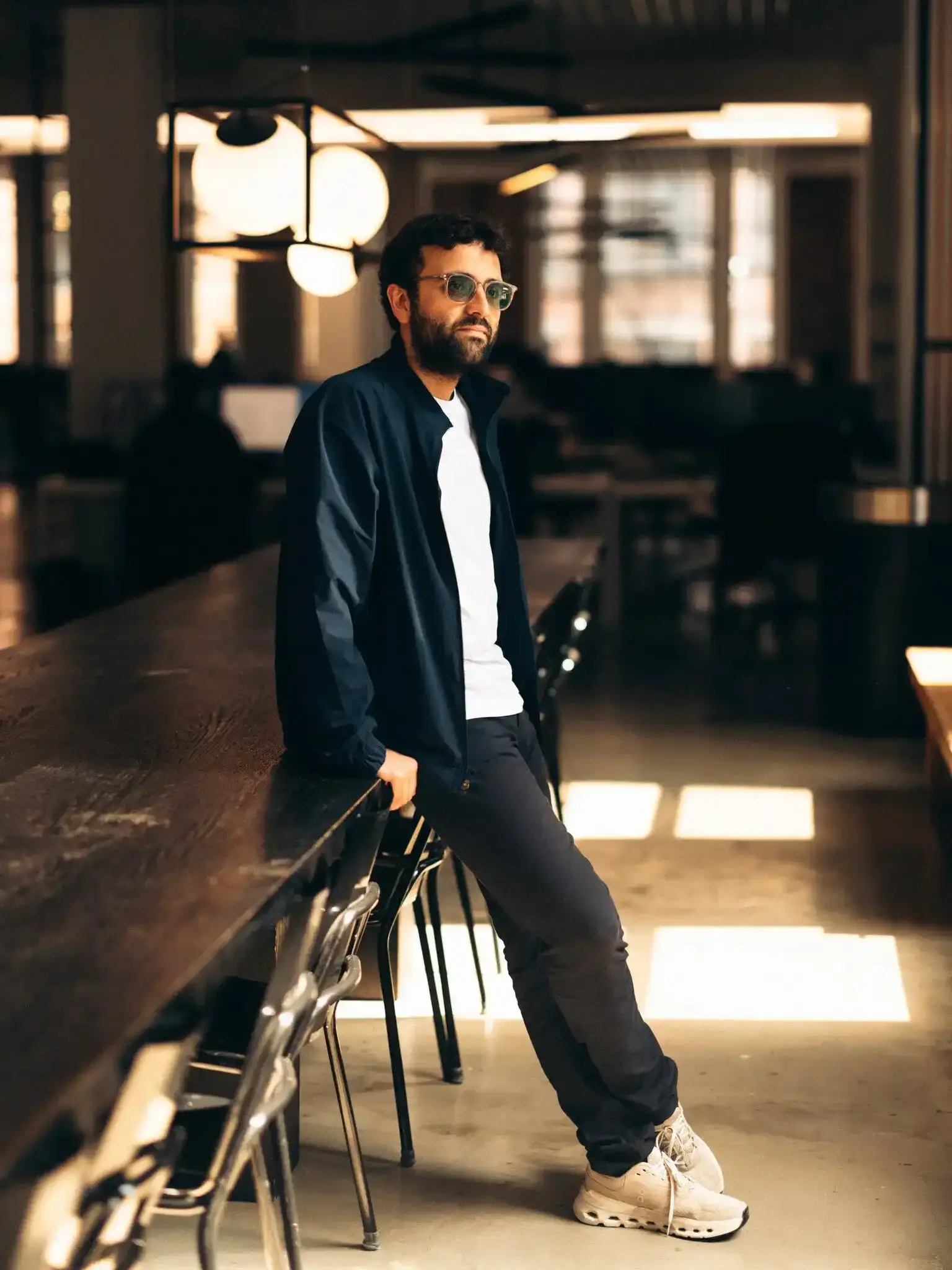
Kalshi chief executive Tarek Mansour said he does not view Polymarket as the most important rival in prediction markets, framing the split instead as a disagreement over compliance, regulation, and market safeguards.
The comments appeared in an edited interview republished by ChainCatcher from The New York Times. In that discussion, Mansour described Kalshi as a relatively small company in headcount terms, with about 200 employees, most of them working from an open-plan office in Manhattan’s Meatpacking District rather than occupying an entire office floor. Even so, Kalshi and other prediction-market platforms, including Polymarket, have become hard to miss in sports sponsorships and in media coverage tied to politics and finance.
Kalshi’s profile has risen even though the company remains small in staff size
Kalshi was founded in 2018 and opened to the public in 2021. The company was started by two recent Massachusetts Institute of Technology graduates: CEO Tarek Mansour and COO Luana Lopes Lara. In May this year, Kalshi completed a new funding round at a $22 billion valuation.
Mansour grew up in Lebanon, while Lopes Lara is from Brazil. According to Forbes estimates cited in the report, both are 30 years old and have already reached billionaire status.
In the United States, prediction markets fall under the oversight of the Commodity Futures Trading Commission, or CFTC, and once approved can operate nationwide. Gambling companies, by contrast, generally need licenses state by state. The report said a New York Times investigation found that recent staff cuts and looser enforcement at the CFTC have, in practice, helped fuel growth in the prediction-market industry.
That growth has drawn more investors and new entrants. The report said Donald Trump Jr. is both an investor in Polymarket and a paid adviser to Kalshi. It also said Meta CEO Mark Zuckerberg has shown interest in the prediction-market space.
Regulatory and political scrutiny is building
Some lawmakers and regulators have argued that prediction markets are little more than gambling under a different label. The sector is also facing questions about insider trading. The report pointed to two recent examples: a U.S. soldier involved in the effort to capture Venezuelan President Nicolás Maduro placed bets on a related event on Polymarket, and a White House teleprompter operator bet on the content of a Trump speech on Kalshi.
New York Attorney General Letitia James has recently sued Kalshi, accusing the company of operating illegally and sidestepping state gambling law. Kalshi has rejected that framing, calling the lawsuit “political theater” and arguing that states do not have the authority to shut the company down. The report added that more than 10 states have introduced legislation this year aimed at prediction markets.
In disclosures tied to its last funding round, Kalshi said its annualized trading volume had climbed to $178 billion. Mansour said markets that let people back their forecasts with money serve an important function in what he called a world with too much information and too little truth. He repeatedly used the word “calibrate” to describe that role.
Mansour’s case for prediction markets and “financializing everything”
Asked about his stated vision of “financializing everything,” which some critics have described as dystopian, Mansour said the phrase had been taken out of context. He argued that prediction markets turn subjective, emotional, and partisan debates into a mathematical and objective system with transparent incentives.
His view was straightforward: people who do deep research, think rationally, and work to find the truth are more likely to make money, while people whose views are biased, detached from reality, or highly ideological are more likely to lose money.
Mansour said this creates a distinct sense of order because participants can more easily judge the motivations behind other people’s views. In his telling, people enter the market to seek truth and to earn returns.
Sports still dominates, though its share has dropped sharply
Mansour said sports trading remains a major activity on Kalshi. He described the platform’s user base as people who tend to like math, economics, and trading, and who enjoy thinking in probabilities and about variables that can shift an outcome. Sports, he said, is an ideal training ground for probabilistic thinking.
He gave a concrete measure of how the mix has changed. Sports-related trading accounted for about 95% of Kalshi’s volume last year. That share is now close to two-thirds. He said the difference reflects the constant stream of sports events each week, while political events do not arrive at the same pace. Sports trading, in his account, also supplies liquidity that helps crypto, political, and macroeconomic contracts grow faster.
On politics, he said a major political event market can reach between $50 million and $100 million in size. As more participants join, he said, prices become more accurate and expectations move closer to reality.
Compliance, not unchecked expansion
When asked what comes next for Kalshi, Mansour said everything has limits and that the company supports reasonable regulation. He said Kalshi has followed a compliance-first path from the start.
According to Mansour, the company spent years in its early life planning which contract categories could be launched and seeking federal approval. He said the process was difficult, and that he and his co-founder were only 22 at the time. Much of the first four years of their careers, he said, was spent working with lawyers and helping push for an industry regulatory framework.
On the current environment, Mansour said regulation will always contain gaps anywhere innovation exists. If regulation were ever perfect and complete, he said, the country would stop producing new things.
“Not really a direct competition” with Polymarket
Asked about rumors of tension with Polymarket founder Shayne Coplan, Mansour said people like to imagine conflict between peers, but he does not see this as a simple head-to-head rivalry.
He named a broader list of competitors he takes seriously: Robinhood, CME Group, Coinbase, Interactive Brokers, major banks, and Zuckerberg as someone watching the sector. Competing on the same field as those players, he said, is what excites him.
His clearest line on Polymarket was that the problem is philosophical. He said the core disagreement is about the route a company takes: compliant operation versus unregulated growth. In his view, Polymarket has not built a full market risk-control baseline, and that is not good over the long term either for Polymarket itself or for the industry.
A tiny share of users drives most of the volume
Mansour said the industry’s continuing growth is itself evidence of user trust. People are still willing to place funds on the platform, he said, and if they stopped trusting it or felt harmed, they would stop using it and would warn others.
He did not provide an exact concentration ratio for trading volume, though he acknowledged it is unevenly distributed. Some users trade only occasionally each month. Others treat it as a hobby or side job. A smaller group trades full time as so-called super forecasters.
That group, he said, may account for less than 2% of users while generating 70% to 80% of the trading volume. He added that Kalshi’s most accurate inflation forecaster is simply an ordinary person in Kansas, and that many of the top 10 political forecasters come from blue-collar and non-Wall Street backgrounds.
Identity checks, surveillance tools, and public data
On insider trading, Mansour laid out three measures. First, every user must complete identity verification, giving the platform the ability to trace unusual activity back to a real person. Second, Kalshi has built a surveillance system modeled on the New York Stock Exchange that automatically flags suspicious patterns. Third, the platform makes all transaction data public.
Mansour described that transparency as a two-sided arrangement. The downside, he said, is that any unusual move can quickly attract accusations of insider trading because everyone can see the record. The upside is the same: unusual conduct is exposed to scrutiny from everyone. Anyone attempting insider trading, he said, would effectively be doing it in public view.
He also said the issue is subtle. In one sense, inside information could make prices more efficient. Even so, Kalshi firmly bans insider trading because it undermines fairness and could drive ordinary traders away. He acknowledged that some economists argue insider trading could improve prediction accuracy and increase confidence in market outcomes, but said fairness remains the company’s baseline.
Flat structure, long hours, and a dislike of meetings
Mansour said he and Luana Lopes Lara work intensely and often put in time on weekends. As the business becomes more stable, he said, many tasks can be standardized and handed off to teams. Their split of responsibilities is clear: she handles internal operations and he focuses mainly on external matters.
He said Kalshi uses a highly flat organizational structure to keep execution fast. Management layers are limited, and the company tries to avoid a setup in which managers claim credit for the work of frontline employees. The people doing the work are the ones leading it, he said, which creates urgency and internal drive.
Mansour linked that management style to growing up in Lebanon, where he said uncertainty is a constant feature of life and adaptability is common. That experience taught him early that the world is inherently unstable. He added that artificial intelligence now changes so quickly that something new seems to happen every two weeks, making flexibility inside a company essential.
Asked about advice from his parents, Mansour said his mother always told him to give 120% and push to the limit, because the difference in outcomes often lies in the last 20% of effort.
Quick-fire answers
In the shorter closing segment of the interview, Mansour said the Kalshi trade that recently caught his attention was a contract tied to hash-price levels. His favorite interview question for job candidates is how they view Elon Musk. The most contrarian idea he offered was that the success of any great company does not fundamentally depend on senior executives.
Asked whether he sees himself as a manager, he answered no and said he is not particularly good at managing people. He also said he recently asked ChatGPT about the probability of winning the 2028 midterm elections, adding that AI can now use Kalshi data for modeling. The worst advice young founders often hear, in his view, is to collect as much advice as possible. His advice to founders was not to treat his own words as gospel, but to take bold, controlled risks and keep testing. On meetings, his answer was blunt: if a meeting can be avoided, skip it.