


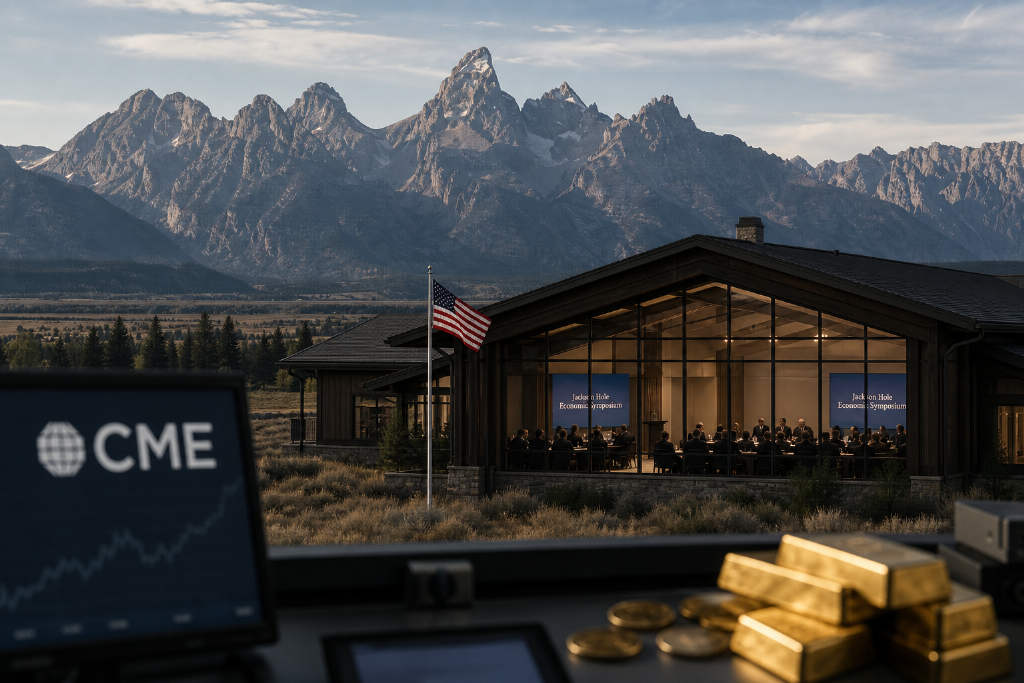
Federal Reserve Chair Kevin Warsh delivered a pointedly hawkish message at the Jackson Hole symposium on Friday night Beijing time, saying the U.S. economy and labor market remain resilient, financial conditions are difficult to describe as clearly restrictive, and inflation is still well above the central bank’s 2% target.
Warsh spoke at 22:00 Beijing time in a speech titled In Our Time. The remarks offered his most detailed public explanation yet of how he views inflation, policy communication, and the limits of forward guidance.
He said: “My standard is this: We must be confident that underlying inflation is moving clearly, and fast enough, toward our objective. Otherwise, we still have work to do.”
Warsh added that although summer CPI and PCE data came in better than expected, “they have not led me to conclude that the underlying inflation trend has improved in a meaningful way.”
By 22:45 Beijing time, after the speech had ended, the CME FedWatch tool showed the market-implied probability of a September Fed rate hike rising to nearly 60%, up from 35% a day earlier. Spot gold fell $50 in a sharp move, with the latest price around $4,550 an ounce.
Speech setting and opening remarks
According to the text released on the Federal Reserve’s website, Warsh delivered the speech on Aug. 28, 2026, at the Economic Policy Symposium in Jackson Hole, Wyoming. The symposium, hosted by the Federal Reserve Bank of Kansas City, was themed “Financial Innovation: Implications for Payments and Policy.”
Warsh opened by thanking Kansas City Fed President Jeff Schmid and his colleagues. He also used a lighter tone at the start, recalling past hiking experiences in Jackson Hole with former Federal Reserve Vice Chair Don Kohn and former Fed Chair Ben Bernanke, before turning to the substance of the address.
He said gatherings like Jackson Hole help participants clear their minds and think more clearly about the world and the era they are living through. Tying his remarks to the symposium’s theme of innovation, Warsh said innovation in how the Fed implements policy can help it achieve price stability while also reaching full employment.
He then laid out four parts for the speech: long-run questions the Fed is studying, including artificial intelligence and where it may take the economy; the practice of forward guidance and the interaction between central banks and financial markets; the core principles he believes should guide monetary policy implementation; and his assessment of current economic conditions.
Warsh says AI may become a new factor of production
In discussing the policy environment ahead, Warsh contrasted current conditions with the period before and after the 2008 financial crisis, when economists and policymakers often spoke of “secular stagnation” and a “global savings glut.” At the time, a widely accepted view held that too little attractive investment would leave excess capital sitting idle for a long time and keep growth weak.
He said the era has changed and the economy has reached a historical turning point. As the clearest example, he pointed to artificial intelligence, a term with an 80-year history that is now being used to describe the latest wave of technology. Its progress, he said, has outpaced even the expectations of its most enthusiastic supporters just a few years ago.
Warsh argued that the potential for materially faster growth is rising, larger pools of capital are flowing into AI-related infrastructure, some form of “super-Moore’s Law” appears to be playing out, and scale effects are changing both the method and pace of innovation.
He said capital and labor have combined to create the large language models at the center of AI. Users buy tokens to gain access to those models. According to reports cited in the speech, annualized token sales at just two leading AI labs have already exceeded $100 billion, up more than 500% from a year earlier.
Warsh said the Fed is watching these developments closely and sees AI as a new variable, or possibly a new factor of production, that will affect both the economy and the conduct of monetary policy.
Questions the Fed is studying around AI
Warsh listed a wide range of open questions the central bank is examining:
- Whether AI adoption will lift economy-wide productivity in a significant and sustained way, and if so, when.
- Whether token use will complement labor or compete with it.
- Whether the next generation of AI models will require even greater capital intensity, or whether the models themselves will eventually help design less capital-intensive solutions.
- What market structure will ultimately emerge, where returns to capital will land, and how long the process will take.
- How much economic surplus in the early stage will flow to owners of scarce assets such as AI labs, chipmakers, energy producers, and cloud service providers, and how much value will eventually accrue to businesses and consumers.
- What these changes mean for workers and for the employment side of the Fed’s mandate.
- What the equilibrium price of tokens may be, whether different kinds and grades of tokens will emerge, and whether older-generation model tokens will eventually fall to marginal cost.
To study those issues, Warsh said the Fed will rely on a “Productivity and Employment Working Group.” He added that he has recently held initial discussions with the leaders of that group and four others, and called their early progress encouraging.
He also made clear that those working-group recommendations will come later and will not affect decisions in the current policy setting. Even so, he said, doing the intellectual work now will leave the Fed better prepared for future policy challenges.
Forward guidance should not be routine, Warsh says
A central section of the speech focused on Warsh’s strongest critique yet of forward guidance.
He said he has already begun changing the form and function of what is known as the Fed chair’s forward guidance. Transparent communication about future policy decisions is not an inherent good in itself, he argued. Communication has to serve the Fed’s most important responsibility, which is getting monetary policy right.
Looking back to the global financial crisis, Warsh said he and his colleagues established forward guidance as a standard practice because it was essential at the time. But like other legacies of that crisis, he said, it has lasted too long.
In normal times, he argued, forward guidance should be limited and bounded. Otherwise, it can create confusion in the name of clarity. Excessive disclosure of policy deliberations and too much commitment about future decisions can mislead markets, businesses, and households. It can also reduce policymakers’ freedom to make the right choice when a decision actually has to be made.
Warsh said the Fed needs clear market signals, and those signals should be as unfiltered as possible. He listed market microstructure, sector-level asset prices and their changes, U.S. Treasury prices and trading volumes, the foreign-exchange value of the dollar, the cost and availability of credit, and broad commodity prices among the indicators the Fed should monitor.
Those measures, he said, should help the central bank judge near-term activity and the inflation outlook across the business cycle. They should also reveal the state of broader financial conditions and the risks and uncertainty embedded in the financial cycle. At the same time, market participants should track real information across the economy for themselves, form their own judgments on output, employment, and inflation, and stay alert to risk.
“The Federal Reserve should be humble, but it must not be naive,” Warsh said in substance. Because the central bank sets the path of short-term interest rates, market participants will always try to anticipate what it does next. But the Fed should not encourage a system in which traders make their next move mainly by trying to infer what the Fed will do.
That concern led him to the “hall-of-mirrors problem.” If markets rely heavily on Fed guidance and the Fed in turn relies on market prices, everyone becomes more likely to miss new developments, get caught off guard when conditions turn abruptly, and make policy mistakes.
Warsh said the largest costs of that distortion may not be borne by market participants themselves. Those hit hardest, he suggested, are likely to be people without financial assets. If the Fed misjudges both inflation and the economy, the people who end up facing high inflation or unstable employment are ordinary workers, not high-net-worth investors in financial markets.
No mechanical reaction function
Warsh also pushed back on the idea that, if routine forward guidance is inappropriate, a new Fed chair should at least commit to a clear reaction function.
He said that would require a degree of precision in understanding the economy that policymakers simply do not have. A simple and dependable rule, perhaps something close to a Taylor-rule framework, might be appealing in theory. In practice, he said, the economy is not that easy to map, and the most important determinants of appropriate policy change over time.
Forecasts used to display the Fed’s reaction function look better in theory than in real life, and better in the laboratory than in actual implementation, he said. As one example, Warsh argued that the Fed’s 2021 forward guidance likely slowed its later policy response to high inflation.
During his tenure, he said, he and his colleagues will work to build more reliable models and sturdier rules to guide decisions. That effort, however, will rest on intellectual humility. With geopolitics, global supply chains, and technology all changing quickly, he said, policymakers should be honest about what they know and what they do not.
He added that on any question that could affect monetary policy, the Fed should hear a wide range of views. If the goal is to make the best possible decisions, different perspectives on the economy should not be shut out.
Warsh’s core principles for monetary policy
Warsh then set out the principles that guide his thinking on monetary policy implementation.
First, he said policymakers often mistake yesterday’s news for what is happening now. The real challenge is telling the difference. The Fed has to keep testing reality so it does not make forward-looking policy based on stale or inaccurate data. Single data points should not dominate; trends matter most. Because the Fed must choose under uncertainty, the data it relies on should be relevant, timely, accurate, and directly useful for decision-making.
Second, the Fed acts to keep aggregate demand broadly aligned with aggregate supply. But policymakers can directly observe only economic activity. What is happening on the supply side must be inferred, which makes assessments of current and future balance between demand and supply inherently imprecise.
Third, the Fed’s 2% price-stability goal, measured by the Personal Consumption Expenditures price index, is fixed and firm. Price stability does not restore itself automatically, he said, and inflation is not necessarily mean-reverting by nature. Achieving price stability is the Fed’s job.
Fourth, the Fed also has a maximum-employment responsibility. Over the medium term, the two sides of the dual mandate are not a binary trade-off. Warsh said he does not see the dual mandate as internally conflicting, because high inflation itself damages prosperity.
Fifth, short-term interest rates are the main tool for achieving the dual mandate. Unconventional policies may fit genuine crises, but outside those moments they should be used sparingly, if at all.
Sixth, money matters. Warsh said that view may not be fashionable, but there is an important relationship between money and monetary policy. Policymakers should watch both money created by the central bank and money created by banks and the broader financial system. Financial innovation and other forces may change the transmission mechanism among the monetary base, velocity, and the wider economy, but that is no reason to ignore money’s eventual effect on financial conditions and prices.
Finally, he said a quieter and more purposeful Federal Reserve will be better able to accomplish its goals. Whether the Fed has done its job should be judged through accountability for results, which he described as the only true test of credibility. He quoted General Chuck Yeager: “When the moment of truth arrives, there are either reasons or results.”
Current economic assessment: demand and employment are solid, inflation remains the main concern
Turning to the economy, Warsh said the July meeting minutes already showed a unanimous Federal Open Market Committee view that the labor market is stable, output is solid, and inflation remains too high.
He said he and most of his colleagues believe it is wiser to wait for more information between meetings, especially given the possibility of new developments in supply chains, investment flows, and geopolitics, before deciding whether a rate adjustment is appropriate. At the same time, they have made clear they are prepared to act as needed.
Warsh said he has been impressed by the overall performance of the U.S. economy and believes it has strengthened. One way to judge whether an economy is strong, he said, is to see how well it withstands shocks. By that measure, both Main Street and Wall Street have shown unusual resilience.
Capex, profits, and financial conditions
Business capital spending, which he called the seed corn of future growth, is rising rapidly. Investment in equipment and intangible assets increased about 9% over four quarters, the fastest pace since 2021. More than half of this year’s capex growth is likely tied to AI-related infrastructure, he said.
For S&P 500 companies, profits rose more than 20% over the past year. Profit margins remain high by historical standards, and overall equity-market volatility is low. The Fed is watching market internals closely and monitoring how performance differs across sectors.
Warsh said expectations for future growth in both capital spending and corporate earnings are quite high. He plans to watch not only growth itself but also the change in the pace of growth, what he referred to as the second derivative, and the effects that may have on asset prices, business confidence, household income, and consumer spending.
On financing conditions, credit spreads on corporate bonds and leveraged loans are near the low end of historical ranges, and issuance in those markets has been strong this year. In banking, the July Senior Loan Officer Opinion Survey showed that banks see standards for commercial and industrial lending as relatively easy by historical standards, which helps explain why this category of lending has grown this year.
Warsh said credit and loan markets show little sign of being materially constrained by monetary policy. Some sectors, including housing and agriculture, are under pressure, but he said it is hard to make the case that broad financial conditions are restrictive.
Consumption, employment, and the labor market
Consumer demand remains resilient as well. Real consumer spending grew more than 2% over the past four quarters despite multiple shocks, Warsh said. Combined with strong investment, private domestic final purchases, or PDFP, have also risen and are growing at close to 3% so far this year. Compared with gross domestic product, he said, PDFP often carries a stronger signal, and that signal remains positive.
On employment, Warsh said the U.S. is performing well and the labor market is stable. The unemployment rate stands at 4.1%, still low by historical standards and little changed over the past few years. Initial jobless claims on a four-week moving average basis are near their lowest levels in decades, a real-time measure he described as well-tested and relatively robust.
He said labor-market churn is relatively low in part because employers and workers went through a large rematching process after the pandemic. When labor supply is barely growing, monthly job gains will naturally be lower.
Warsh acknowledged that some pockets of the labor market deserve attention, including recent graduates. Even so, he said people who want work are still broadly able to keep jobs or find jobs. For now, in his view, the U.S. labor market remains consistent with maximum employment.
Inflation remains elevated
On the price-stability side of the mandate, Warsh was much less comfortable. The Fed’s preferred inflation gauge, the PCE price index, rose 3.7% over the past 12 months, while the six-month annualized rate stands at 4.1%. Comparable readings for the Consumer Price Index are also high, and both PCE and CPI core measures remain elevated.
No single measure is perfect, he said, but they all tell a similar story: inflation is still above the 2% target. For that reason, prices should remain the Fed’s primary focus.
Warsh said policymakers need to identify the underlying trend in inflation, meaning broad-based price changes across the economy after stripping out special and idiosyncratic factors. The task is not only to determine whether underlying inflation is rising, falling, or stalling, but also to judge the speed of that movement.
Those broad inflation gauges are all down sharply from their 2022 highs, he said, but progress over the past two years has been fairly limited. Better-than-expected PCE and CPI readings over the summer still do not amount to meaningful improvement in the trend.
He added that wage growth currently looks moderate, but wage gains have not proved to be a reliable long-run predictor of future inflation.
PCE components and inflation expectations
Warsh said it is useful to break down the 199 components of the PCE price index when assessing underlying inflation. Over the past 12 months, 54% of items in the PCE basket posted price increases above 3%. That is well below the post-pandemic peak of about 77%, but still far above the 32% average seen during the 20 years before the pandemic.
Looking only at the most recent six months leads to a similar conclusion. About 49% of goods and services in the PCE basket posted annualized price increases above 3%. Again, that is clearly below the post-pandemic peak, but still notably high.
Warsh also flagged the recent rise in broad commodity prices as something worth close attention. The question, he said, is whether those trends point to upside inflation risk.
He said another critical issue is whether more than five years of inflation data have started to seep into expectations. The good news, in his telling, is that medium-term inflation expectations remain broadly stable, and inflation-compensation measures in swap markets are sending a similar and strong signal.
Even with recent developments, market prices still reflect confidence that the Fed can restore price stability. Warsh said that confidence speaks to the institution’s credibility and to its best traditions, adding: “And I can assure you … the market is right.”
Still, he warned that market-based inflation expectations often look very firm until the moment they stop being stable. Those expectations do not shift easily, and for now they remain well anchored, but the Fed has to watch them closely and make sure they do not become unanchored.
He also said there is one signal no one should ignore: 65 months of persistently elevated inflation place responsibility squarely on the central bank, exactly where that responsibility belongs.
Warsh closes by promising discipline, not a single policy move
In closing, Warsh said what he was promising was discipline, not any single policy decision.
He said that in such an important era, he and his colleagues are not the first to hold these views, but they are determined to meet the highest standard they can. He described their approach as humble in attitude but firm in resolve.
Warsh said a great deal depends on the choices policymakers make. Sound monetary policy can help families and businesses prosper. If implemented well, it can widen and deepen the forces behind U.S. economic growth and help reinforce the country’s leadership in the world.
He ended by calling it a great honor to serve the Federal Reserve again and thanking colleagues and participants for their support, advice, and patience.