
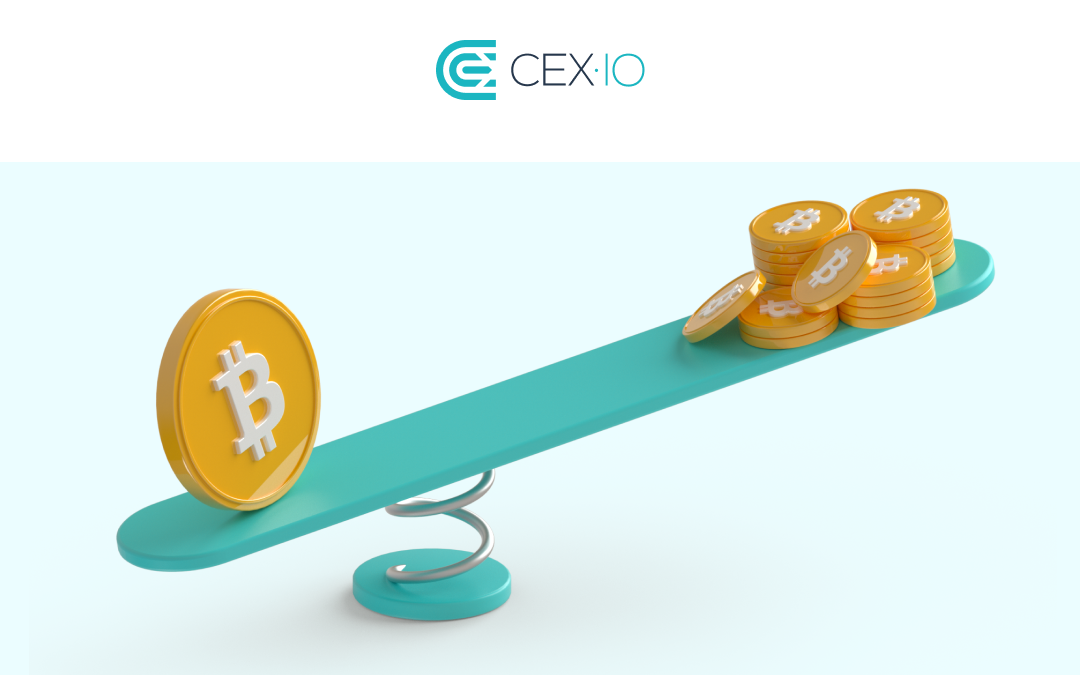
Leverage lets a trader use borrowed funds to control a position larger than the cash they actually hold. In margin trading, the trader’s own funds act as collateral, while leverage describes how much market exposure that collateral can support. The two terms are closely linked and describe the same mechanism from different angles.
Leverage is usually shown as a ratio between personal capital and total tradable value. If a trader needs only 100 USDT in the account to open a 1,000 USDT trade, that equals 1:10, or 10x leverage. Margin can also be derived from leverage. The source notes that a 2% margin requirement is equivalent to 1:50 leverage, showing the inverse relationship between the two.
How a 5x leveraged Bitcoin long works
In the example, a trader expects Bitcoin to rise and has $1,000 in the account. With BTC trading at $50,000, the trader wants to open a long position of 0.1 BTC, worth $5,000. To do that, the trader uses 1:5, or 5x leverage. The $1,000 stays locked on the platform as collateral until the position is closed.
If BTC climbs from $50,000 to $55,000, the position generates a profit of $500, calculated from the $5,000 price increase multiplied by 0.1 BTC. Once the trade is closed, the borrowed funds are returned to the broker, and the trader’s original $1,000 collateral is released. The account balance then becomes $1,500, which means a 50% return on the initial collateral.
Without leverage, the same $1,000 could buy only 0.02 BTC at $50,000. If the price later reached $55,000, the position would be worth $1,100, producing a gain of just $100. That is a 10% return. The source uses this comparison to show that with price moving in the trader’s favor, 5x leverage makes the return five times larger than a spot position funded only with the trader’s own cash.
Losses expand by the same multiple
The same effect appears when price moves the wrong way. If BTC drops from $50,000 to $45,000, the 0.1 BTC leveraged position records a $500 loss. That loss is covered by the collateral locked before the trade was opened. After closing the position, only $500 of the original $1,000 remains in the account, which translates to a -50% return.
Without leverage, the loss would be much smaller. Using the same logic in the source material, the negative return would be about 10%. This is the central point of margin trading: leverage magnifies outcomes in both directions, not just gains.
The article also notes that the example is meant to show what happens behind the scenes. In live trading, floating profit and loss, or FPL, updates with market price changes so traders can see how their balance would change if they closed the position at that moment.
This content is for informational purposes only and does not constitute investment or financial advice. Digital assets involve risk.