
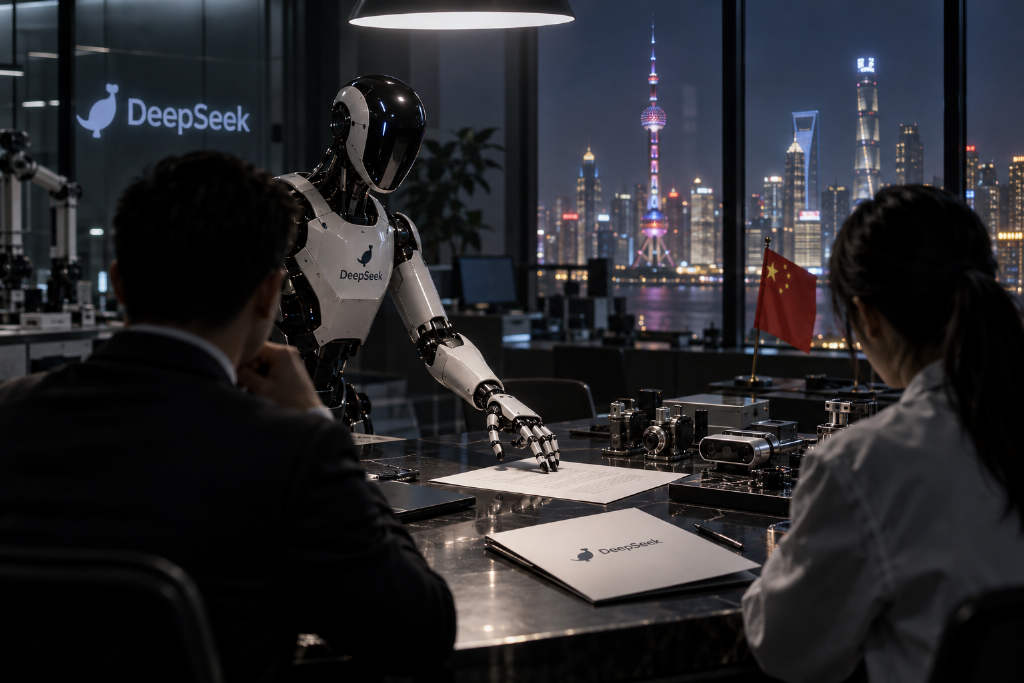
Liang Wenfeng is increasingly being seen by the market as a potential buyer in embodied AI.
After DeepSeek recently brought in a CFO, attention has shifted to reports that Liang is moving into venture investing. Two names have surfaced in particular: former Tencent scientist Hu Han and former AgiBot foundation model lead Yu Tao. Their startups are both said to be tied to embodied intelligence. A person close to Hu also told the publication that he has indeed started a company, that the direction is related to an embodied brain, and that hiring is already underway.
The timing matters. The report said coding capability is approaching a ceiling and is likely to enter a slower growth phase, while GPT-6 Astra has just demonstrated strong general-purpose foundation model capability. Against that backdrop, DeepSeek’s interest in embodied AI appears to be becoming more explicit. At the same time, companies in the embodied AI sector are dealing with tighter fundraising conditions and a tougher IPO market.
Within the industry, that has given rise to a line of dark humor: sell the company to Liang Wenfeng. One joke cited in the report went further, saying founders might as well open an office across from DeepSeek so Liang can at least see them in physical space. As large model companies prepare to move into embodied AI, the report argued, some opportunities may disappear while an old kind of market fervor may return.
DeepSeek said to be backing two early embodied AI startups
The report described Liang’s venture style as moving in early, and the two companies now being discussed are both still in the early stage.
According to Bloomberg, DeepSeek has agreed to lead the seed financing of Winverse AI, a startup founded by former Tencent scientist Hu Han. The round was reported at tens of millions of dollars, with a post-money valuation of about $400 million. People familiar with the matter, however, said the deal has not yet been finalized, and the financing size, valuation and investor participation could still change.
As for what Winverse AI actually does, most outside assumptions come from what Hu disclosed when he left Tencent in July: his startup would focus on embodied intelligence and world models. A researcher close to Hu told the outlet that the company’s direction is tied to an embodied brain and that it is hiring against standards commonly seen in the large model industry.
Hu is not the only founder mentioned. The report also said Yu Tao, formerly in charge of foundation models at AgiBot, has launched a startup focused on LLM plus embodied AI. According to people cited in the story, the company was valued at $70 million in its first round and $200 million in its second. Alongside a top-tier and first-line fund, DeepSeek was said to be among the investors.
Earlier market coverage had already pointed to Liang’s growing attention to embodied AI. Those reports said he had been closely tracking the field and speaking with multiple founders about robots, large models and interaction with the physical world.
The publication also said Liang is considering whether DeepSeek should move further into embodied AI. Options under discussion include building an in-house team to conduct research or entering the sector through investments in related companies.
That shift has triggered speculation that scenes once associated with investors lining up to see Liang for allocations may soon be repeated by embodied AI founders. Some job seekers in the segment are also starting to wonder whether DeepSeek could open robotics roles.
Why the timing is drawing attention
The report argued that DeepSeek’s timing is one of the more important parts of the story.
For some time, large model companies had shown reluctance toward embodied AI because of the difficulty involved. But GPT-6 Astra, released in September, changed part of that thinking with what the report called a widely recognized display of strong general-purpose model capability. One of the views cited in the piece was that OpenAI’s large model team was not itself an embodied AI team, yet it still produced a model that surprised the embodied AI community.
At the same time, coding is increasingly viewed as nearing its upper limit, with growth likely to slow from here. For large model companies, the report said, that raises the pressure to find the next direction capable of delivering another major technological jump.
An embodied AI researcher quoted in the report said large model companies may previously have believed VLA had little chance of becoming general, and that they had more important tasks such as coding to focus on. GPT-6 Astra changed that, the researcher said, because it showed companies that even without deep embodied expertise, highly generalized embodied models could still be built.
The same researcher said moving into embodied intelligence is a necessary choice for both large model companies and big tech groups. Looking globally, OpenAI, Anthropic and Meta have all already formed robotics teams of their own.
The report also pointed back to comments Liang made in May when he laid out DeepSeek’s AGI roadmap. At that time, he described a progression from language models to chain-of-thought reasoning, to agents, to continual learning, to self-iteration, and then to embodied intelligence. In that framework, AGI was broken down into a series of technical stages that could be advanced and validated step by step. The article said DeepSeek now appears to be accelerating toward the embodied intelligence stage.
Earlier signs had also been picked up through hiring. People in the AI industry had speculated from DeepSeek job postings that the company might be preparing an embodied AI push. A role for a multimodal understanding researcher included the line that AGI will not stop at text, and that a key step toward AGI is giving models the ability to understand the physical world.
Even so, the report stressed that it is not easy for a large model company to build a full embodied AI stack on its own. One investor cited in the story said robotics is fundamentally a software and hardware coupled problem, and that large model companies also have limited real-world deployment scenarios and data of their own. In that view, starting from the embodied brain is more practical.
That makes one scenario easier to imagine: major large model companies, including DeepSeek, may turn more often to outside investment and even acquisitions of embodied AI companies.
The same researcher added that most embodied AI teams today are still thinking in terms of VLA and WAM. If DeepSeek invests in or acquires companies, teams with a large-model background and spatial intelligence capability may stand out more.
Cooling funding conditions and a harder IPO path
The line "hope Liang Wenfeng notices us" has started to circulate among some embodied AI founders, the report said. The reason is straightforward: market conditions have become much harsher in the second half of the year.
That change is most visible in fundraising. The report said embodied AI had been one of the hottest sectors over the past year and more. In the first half of 2026 alone, total financing in China’s embodied AI segment exceeded RMB 90 billion, five times the level of the same period in 2025, and more than 20 embodied AI companies reached valuations above RMB 10 billion. In the second half, however, the direction changed sharply. At many top institutions, fewer embodied AI projects were making it to investment committees, and financial advisers active in the field were finding their projects harder to move.
One investor said the leading embodied AI companies in the market have already raised most of the money available to them, and their valuations are now so high that firms which did not get in earlier are struggling to enter later rounds.
Policy messaging has also shifted to a more restrained tone. In August, Li Chao, deputy director of the Policy Research Office of the National Development and Reform Commission, said the robotics industry must guard against blind following and herd-style expansion. Another publicly discussed development came from The Information, which reported that regulators had issued informal window guidance limiting humanoid robot IPO approvals to companies with recurring revenue capability, a trajectory of narrowing losses, or genuine technological innovation.
"IPO has become harder" is now treated in the report as a point of broad agreement across the sector.
Even so, about 40 to 50 robotics and embodied AI-related companies are still waiting outside the Hong Kong Stock Exchange, making it the most crowded track in the 18C specialist technology listing channel. The report added that some embodied AI investors have recently begun seeking exits through sales of existing shares.
It cited Xiangfeng Investment managing partner Xia Zhijin, speaking at the 2026 SuperLink conference organized by PEdaily, as saying that there is not yet a large technology gap between embodied AI companies valued above RMB 10 billion and younger startup teams. "The only thing that can really be called a barrier may be the financing barrier. Some people simply raised more money," he said.
With the IPO outlook unclear, being acquired is starting to look acceptable to more founders. As the report put it, many in the sector are now waiting for Liang Wenfeng.
The original article was published by the WeChat public account PEdaily (ID: pedaily2012) and written by Feng Yuchen.