Lighter, a perpetual futures DEX backed by a team with former Citadel quant experience, has drawn renewed market attention as its token LIT keeps pushing to new highs. According to Foresight News, LIT has been setting records since Aug. 20 and reached as high as $3.8 on Aug. 26, up nearly fivefold from its roughly $0.78 low on March 30 this year.
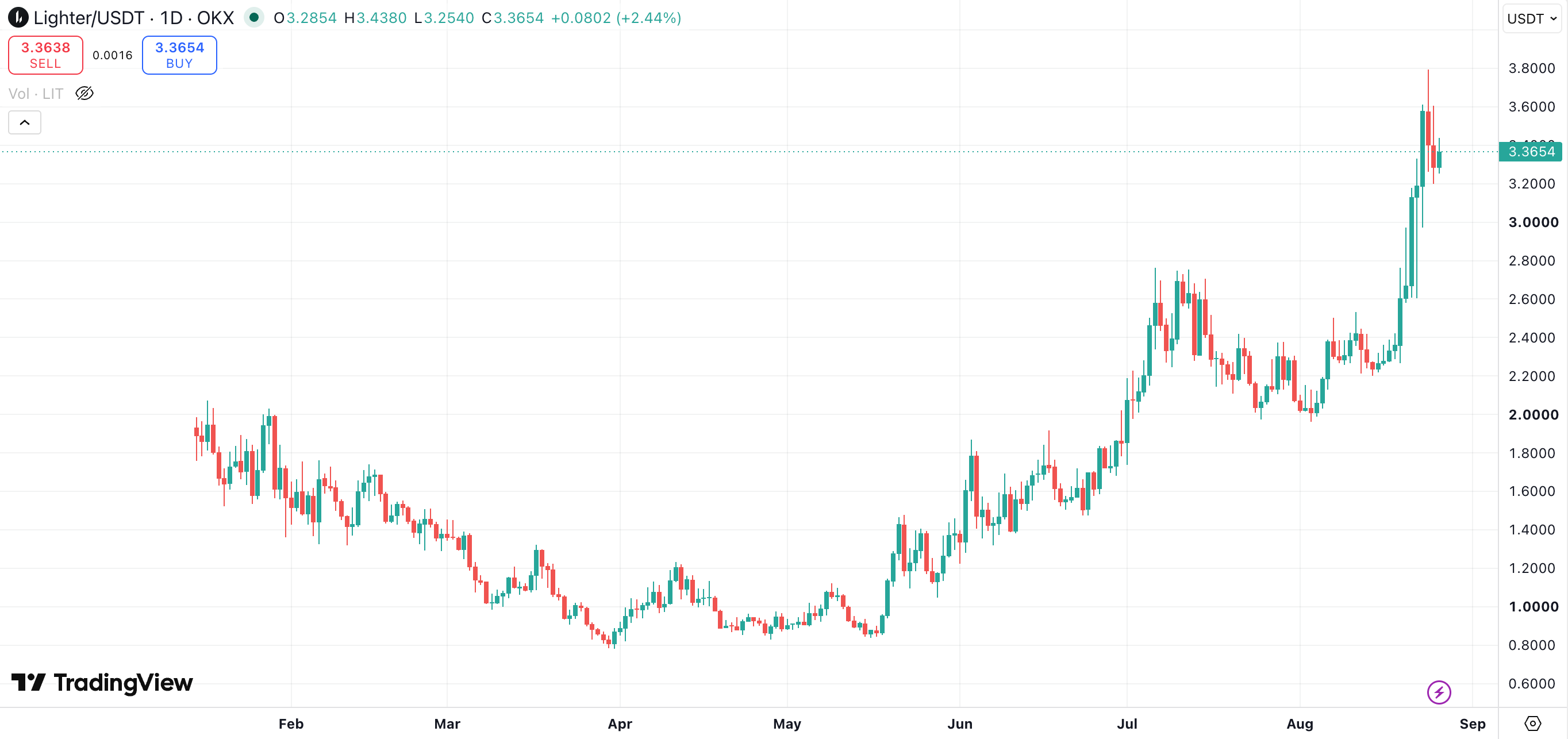
One supply-side factor stands out. Only about 25% of LIT is currently circulating, while team and investor allocations are locked until Dec. 30, 2026. At this stage, the main source of sell pressure comes from staking rewards, and that amount remains limited. As the token rises, users have stronger incentives to stake and hold.
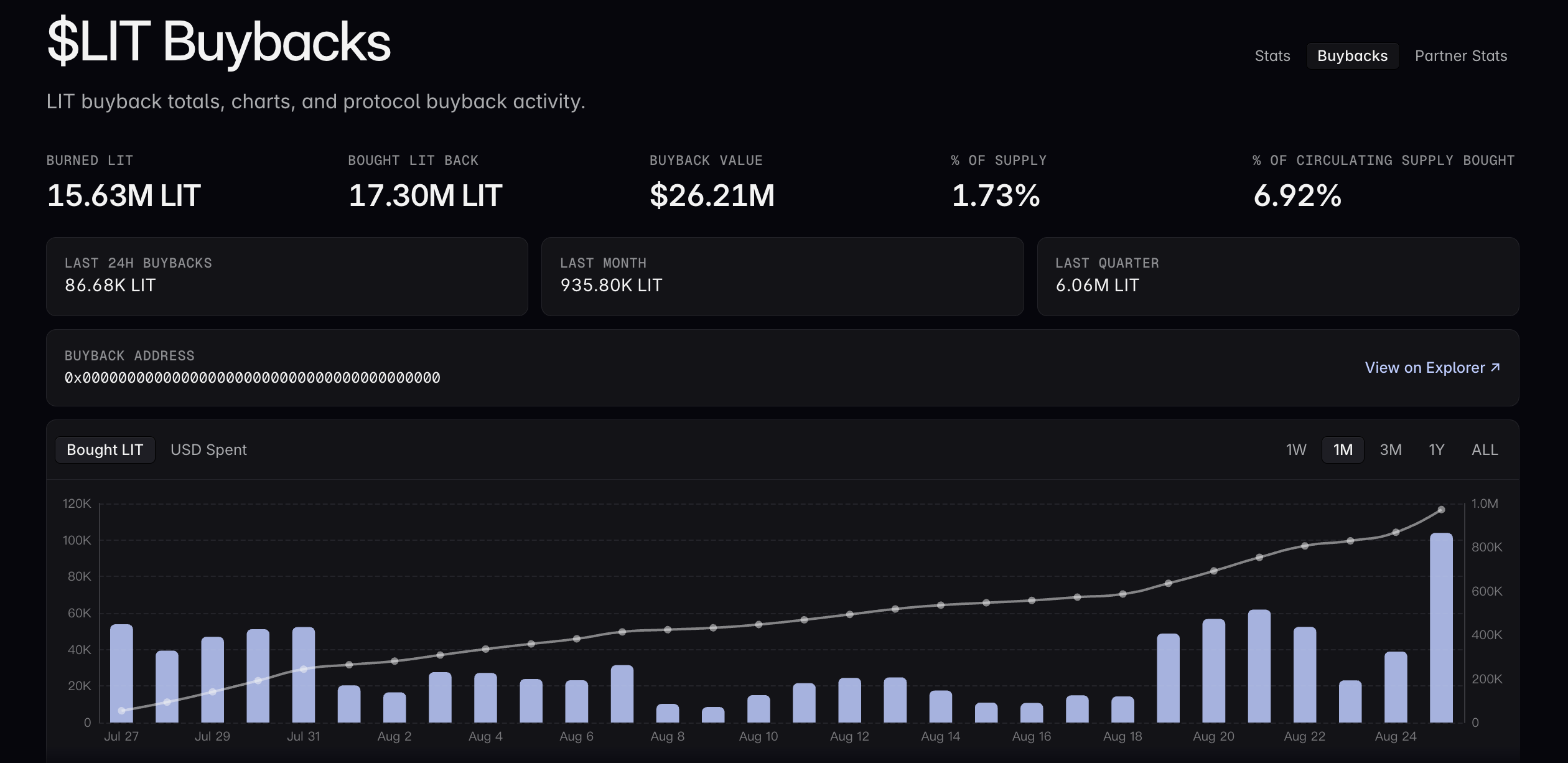
Buybacks and burns have also been meaningful under those circulation conditions. Based on Lighter’s official dashboard, the protocol has bought back 17.3 million LIT so far, equal to 1.73% of total supply and 6.92% of circulating supply.
Foresight News noted that in July, in an earlier article titled Is Lighter Playing a Bigger Game Alongside Robinhood?, it had already discussed business-side drivers behind LIT’s continued gains, including the buyback-and-burn mechanism and Lighter’s partnership with Robinhood. In the latest piece, the focus shifts to the chain and system architecture itself.
A different answer to on-chain derivatives tradeoffs
Before Lighter, on-chain derivatives platforms largely faced an unavoidable tradeoff. General-purpose Layer 2 networks such as Arbitrum are not well suited to high-frequency order placement because of fees and latency. Standalone chains such as dYdX v4 and Hyperliquid give up some degree of security. StarkEx-style hybrid order books depend on centralized matching, which introduces censorship and MEV risk.
Hyperliquid chose to build its own Layer 1. Through HyperBFT consensus, it runs the matching engine directly inside the validator set, which brings sub-second finality and throughput above 200,000 transactions per second. The tradeoff is that the chain carries its own security model, is supported by only dozens of validator nodes, and depends on bridges for cross-chain asset movement.
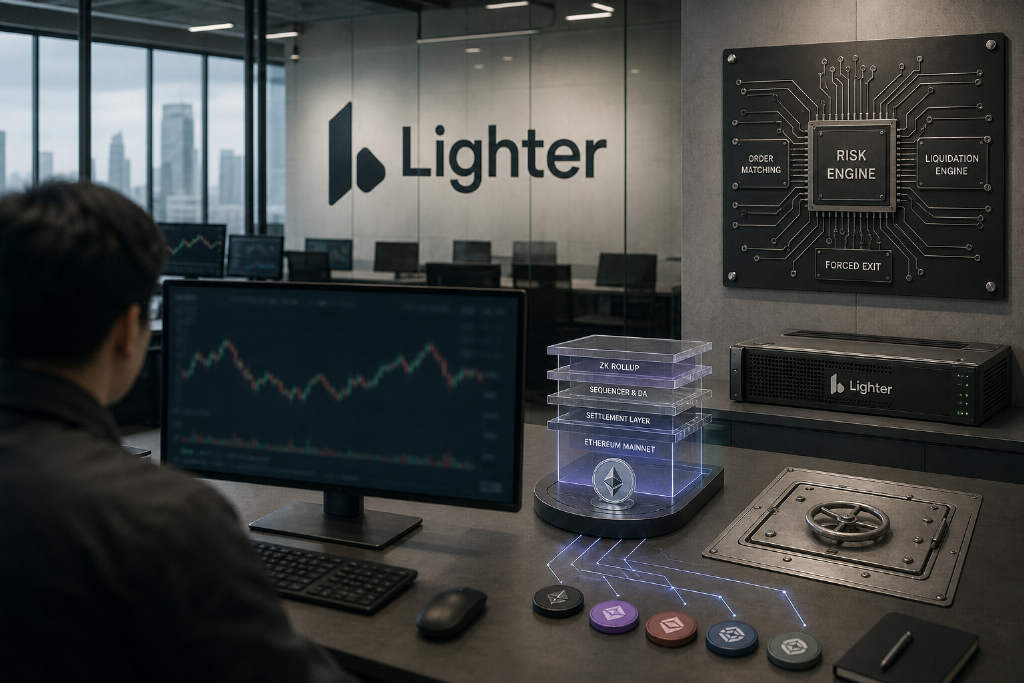
Lighter went in another direction. It built a ZK Rollup designed specifically for trading. Matching, liquidation and risk controls are packaged inside its self-developed Lighter Core, which generates zk-SNARK proofs through a customized proving engine and then posts compressed state updates to Ethereum mainnet. Compared with a general-purpose zkVM, the design gives up flexibility in exchange for proof speed, stable latency and execution efficiency for a high-frequency order book.
Lighter’s own metrics put matching latency below 5 milliseconds, with up to 20,000 orders and cancellations packed into a single block.
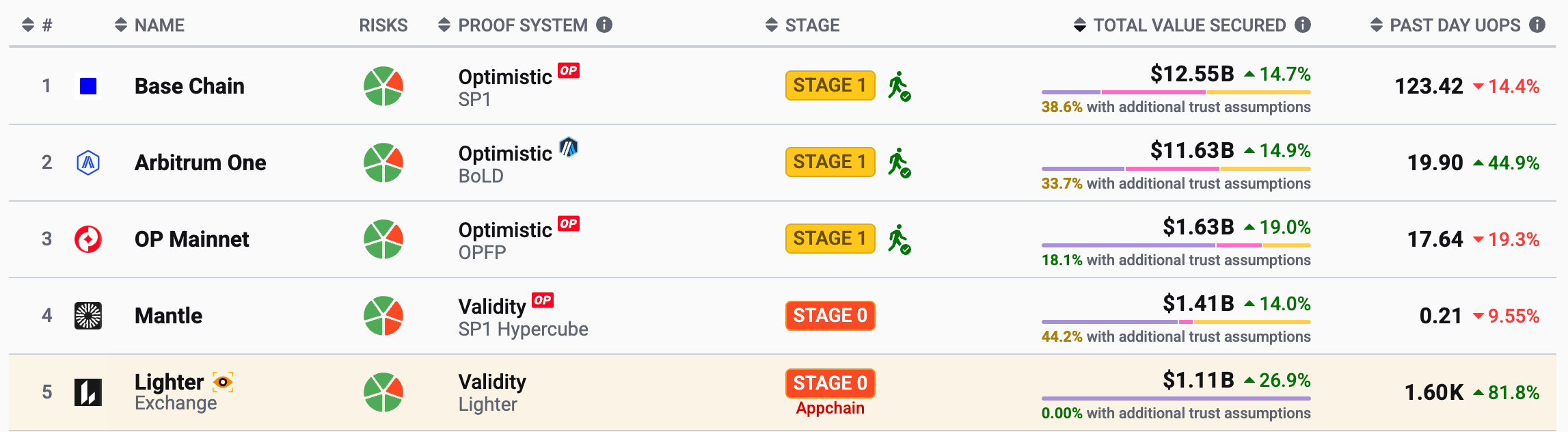
Data from L2BEAT shows that Lighter, developed independently without using an existing ZK Rollup stack, has more than $1.1 billion in TVL. That places it fifth, behind Base, Arbitrum, OP Mainnet and Mantle.
Encoding exchange rules into the circuit
The system is built around three roles. A sequencer orders transactions on a first-in, first-out basis and provides soft finality. A prover generates a proof for each block. Smart contracts on Ethereum hold user funds, store the state root and verify each proof.
Foresight News argues that Lighter’s real point of separation is not simply that it uses zero-knowledge proofs, but what exactly it proves. Most rollups prove only that a state transition is valid. Lighter also encodes the exchange rules themselves into zk constraints.
It uses a binary prefix tree structure called Order Book Tree, which writes price-time priority into leaf indexing while keeping proof complexity logarithmic. In practice, that means the protocol can cryptographically prove that the highest-priority orders matched first, funding rate caps were enforced correctly, and liquidations used the right formula.
That matters especially for perpetual contracts. Leveraged positions are margin-based, and liquidations are automatic and mechanical. If users cannot verify whether liquidations were executed correctly, they are forced to trust the platform at the moment when the platform has the least incentive to be honest with them. Foresight News says verifiable liquidation is not a marketing slogan but the core meaning of this architecture.
Ethereum security, forced exits and liquidity access
As an Ethereum Layer 2, Lighter inherits two things that standalone Layer 1 chains cannot offer in the same way.
The first is an exit guarantee. If the sequencer keeps censoring transactions, users can force-submit transactions on Layer 1. If those transactions still go unprocessed for more than 14 days, the system freezes into Desert Mode. Users can then reconstruct state from on-chain data and submit a balance proof to withdraw funds, without cooperation from the operator.
Foresight News added that L2BEAT has reproduced this process in practice, rebuilding the state root from Layer 1 blob data and verifying it against the chain head. That escape hatch works only because all state data required to build proofs is published on-chain.
The second is the liquidity network effect. User funds are held in Ethereum contracts, and deposits can come directly from Ethereum, Arbitrum, Base and Solana. Users can also tap assets from Aave, Uniswap and the Ethereum stablecoin ecosystem without relying on complex cross-chain bridges.
By comparison, Hyperliquid’s composability is largely confined to HyperEVM and cannot directly access Ethereum’s TVL, which the article describes in the hundreds of billions of dollars.
LighterEVM and faster verification
Another part of the system is the horizontal architecture called LighterEVM. The core trading engine runs inside custom ZK circuits, while general smart contracts run in a parallel zkVM environment. The two logic domains are separated but can share state atomically.
That allows the core order book to keep matching at speed even if on-chain lending protocols become congested. At the same time, developers can build structured products on the EVM side that read directly from the order book.
On the day before the article was published, Lighter also outlined its latest progress on the verification system. Over the past month, its average block verification time fell from about 5.3 minutes to about 1 minute through two separate improvements.
The first was what it called a “heavy/light decomposition,” which splits verification circuits based on transaction complexity. More than 98% of transactions are simple trades, and under this change they incur lower proving costs. That alone cut verification time by half.
The second came from a prover optimization competition held jointly with Eigen Labs. The work focused on the Plonky2 prover at the infrastructure layer. The first batch of results went live on Aug. 23 and cut verification time by more than half again.
Why the market may be assigning a premium
Foresight News also pointed to an earlier market pattern. When tokenized real-world assets were just beginning to gain traction, ZKsync held the largest amount of on-chain RWA assets. The reason, the article says, was security.
Even now, ZKsync still ranks in the top 10, ahead of chains such as Arbitrum, Polygon and Base that may appear stronger on paper. The advantage of ZK proofs is that while strict finality still depends on Ethereum mainnet confirmation, transaction credibility is already verified on Layer 2. For institutions, the article argues, slightly slower speed or higher cost can still be acceptable.
Compared with deployments on general-purpose ZK Rollups such as ZKsync and Starknet, and even compared with specialized Layer 2s built on top of those stacks, Foresight News says Lighter’s largest edge is that trading and liquidation logic are written directly into the circuit itself, with Ethereum mainnet-level security layered underneath.
The article goes on to argue that this mechanism is even safer than traditional clearing institutions and gives Lighter the ability to hold its ground in the highly competitive perp DEX market.
Its cooperation with Robinhood is presented as one sign of that. Beyond a shared use of payment for order flow and a deep team background, the article says Lighter’s mechanism gives it a distinct advantage in security and compliance. The market’s willingness to place a premium on that architecture follows a clear logic: for projects that want to sell perpetual products to Robinhood users and to traditional financial institutions, “matching rules written into the circuit, with Ethereum backstopping fund security” is a story that can be told to compliance departments and auditors.
Foresight News closes with a contrast: Hyperliquid proved that performance can come from consensus, while Lighter is trying to show that trust can come from proofs. Instead of competing only on operations and business tactics, Lighter has taken a different route in the perp DEX market.