
Linera said on Sept. 9 that its $LNRA community raise had ended with $848,000 from 617 participants in 69 countries, missing the $1.5 million minimum target. The project said the money had been returned to participants’ wallets.
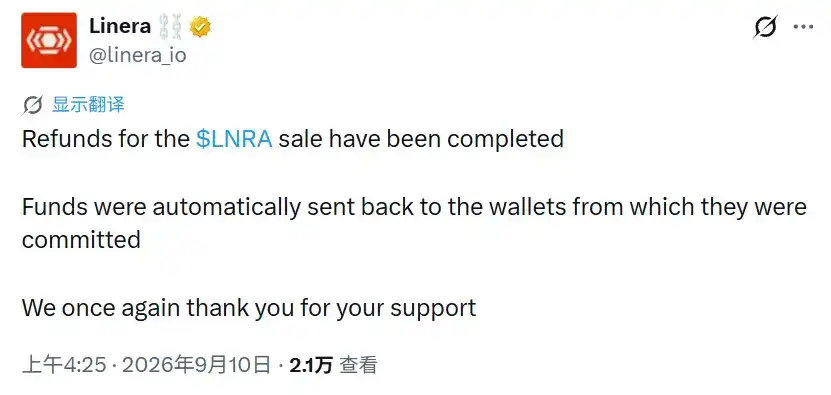
The outcome contrasted sharply with Linera’s earlier positioning in the market. Backed by firms including a16z, the project had raised about $12 million across two financing rounds. The community sale priced tokens at $0.16, while a Founder incentive structure pushed the effective cost as low as $0.02 under the terms presented by the project. Badge-based priority access was also used to bring users into the sale, but the $1.5 million threshold still was not reached.
From a Diem-era pedigree to a prediction-market pivot
According to official materials, Linera is a Layer 1 blockchain built around a microchain architecture, where each user and application runs on its own lightweight execution chain in parallel.
During 2022 and 2023, Linera was framed as part of a new wave of high-performance blockchains, with an emphasis on real-time applications and lower latency. Founder Mathieu Baudet previously worked on FastPay-related research at Meta. Linera has described the chain as a production-oriented implementation of that body of work.
Meta’s broader blockchain context at the time also included Diem, the successor to the Libra stablecoin initiative, which was later halted by regulators. After the Diem team broke up, some former members went on to launch Aptos and Sui using Move, while Linera took a different route with Rust.
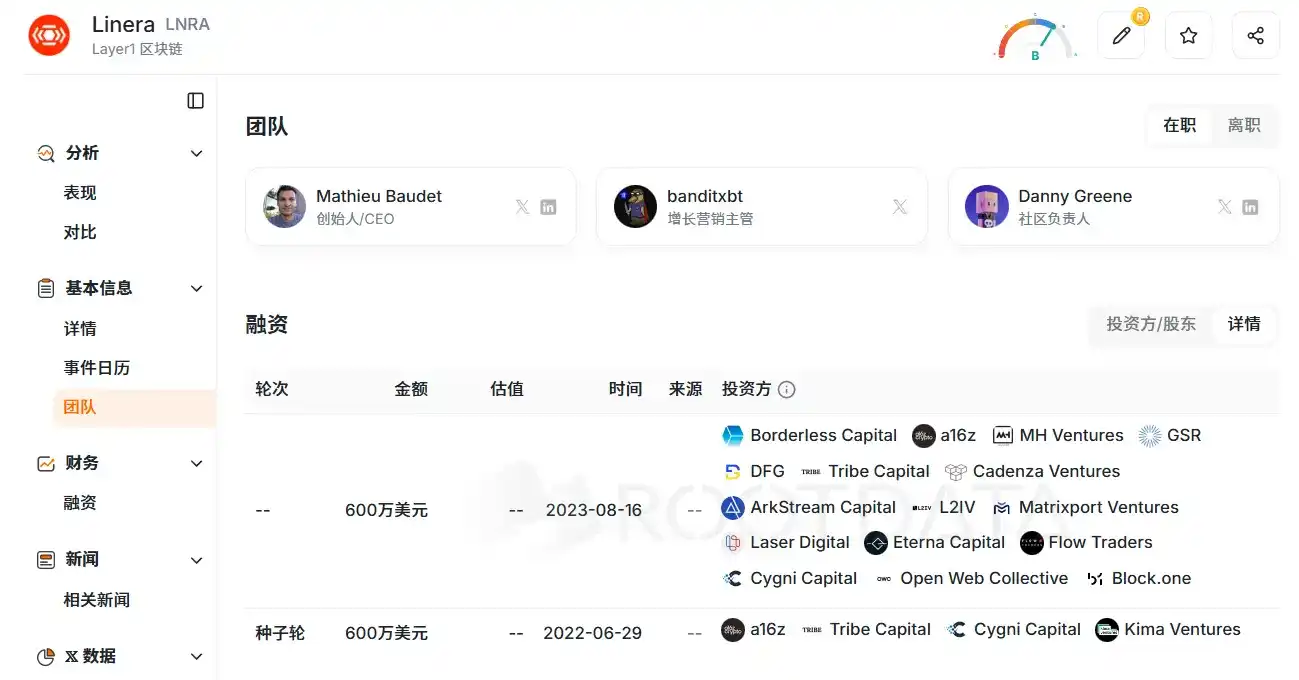
On financing, Linera completed a $6 million seed round in June 2022 with a16z, Tribe Capital, Cygni Capital, and Kima Ventures among the investors. In August 2023, it raised another $6 million. a16z participated again, alongside Borderless Capital, GSR, DFG, Matrixport Ventures, and Flow Traders. That brought total disclosed fundraising to about $12 million.
The mainnet, however, still has not launched more than three years later. On the product side, Linera later introduced Linera Markets, a short-cycle onchain prediction product that offers one-minute up-or-down markets across assets including BTC, ETH, and SOL.
In August, Baudet reset the project’s public framing. He wrote that fast-cycle prediction products, including markets on BTC moves every five minutes, had generally proven more popular than expected across the industry. Linera then elevated its one-minute market format from a product experiment to a central external narrative, tying the chain more closely to an application-led model designed to generate app revenue.
How the community sale was structured
Linera said Linera Markets had been running on testnet for more than 25 weeks, with about 85 million transactions and more than 50,000 users. A sales page also said daily participation exceeded 8,000 users.
The community raise opened soon after. Pre-registration began in late August. The sale window opened on Sept. 1 and was originally scheduled to close on Sept. 8, before being extended by 10 hours. The minimum target was set at $1.5 million and the hard cap at $8 million.
According to the official sales page, participants first had to complete identity verification through Sonar and then use USDC on Base to purchase tokens. The minimum ticket size was $100, while the open pool carried a per-wallet cap of about $100,000. U.S. investors had to meet accredited-investor requirements and accept a 12-month lockup. Some jurisdictions could not register.
Testnet badges were tied to a separate airdrop worth about 1% of total token supply. In the community sale itself, badge holders were placed into a reserved pool with priority access, while other users entered the open pool, where oversubscription would have triggered pro rata allocation.
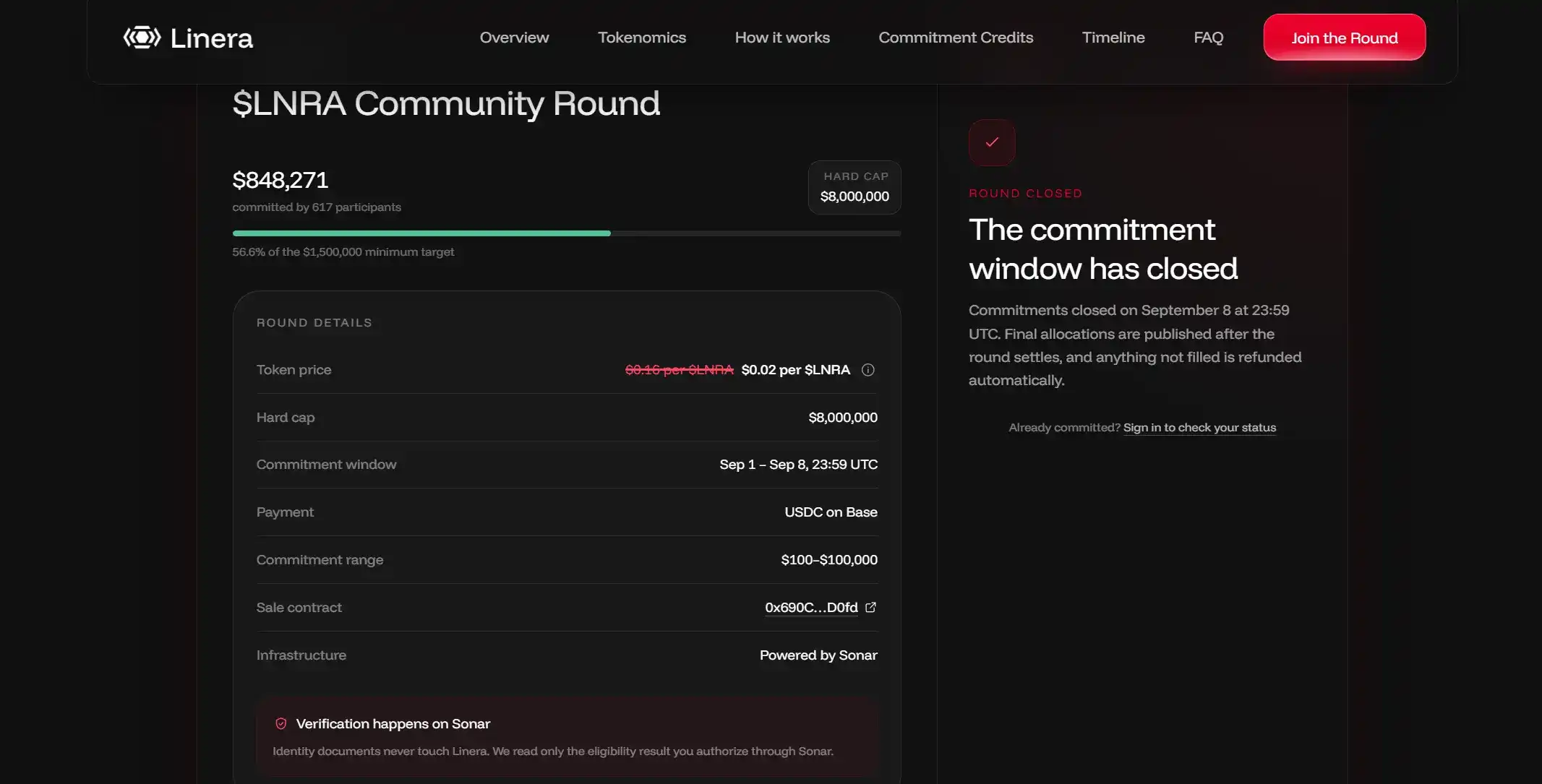
The sale price of $0.16 implied a fully diluted valuation of $160 million. The first $1.6 million of purchases came with Founder status. Under the stated rules, once the mainnet launches and a buyer completes one trade in the official app before token generation, each purchased token would qualify for seven additional tokens distributed from community reserves, bringing the effective acquisition cost to around $0.02 per token.
Even so, traction was weak. By the second day after launch, subscriptions amounted to about 1.1% of the hard cap. Some users questioned the project’s earlier claims about benchmarking itself against leading trading applications and pricing the community round in line with institutional valuations. Others said the sale rules were difficult to follow, especially around who qualified for extra tokens and when those tokens would unlock. Many addresses in Asia were also blocked during KYC.
An onchain KOL cited in the source said that if Linera had launched in the same cycle as Aptos and Sui, the token might have been viewed more as a high-upside airdrop candidate. In the current market, that person said, retail investors are less willing to pay for an institution-led narrative.
The final total came to $848,000, equal to about 56.6% of the minimum threshold and 10.6% of the hard cap. Linera confirmed in its announcement that the minimum had not been met. Chief Product Officer Ryan Trost said the team was about five people and had limited operating expenses. He said the round had aimed to distribute tokens more widely to core users willing to participate before the project was generating revenue. Average purchase size among testnet users came in above the team’s expectations, he added, but the final numbers still meant the round had to be refunded.
A colder primary market, not just a Linera problem
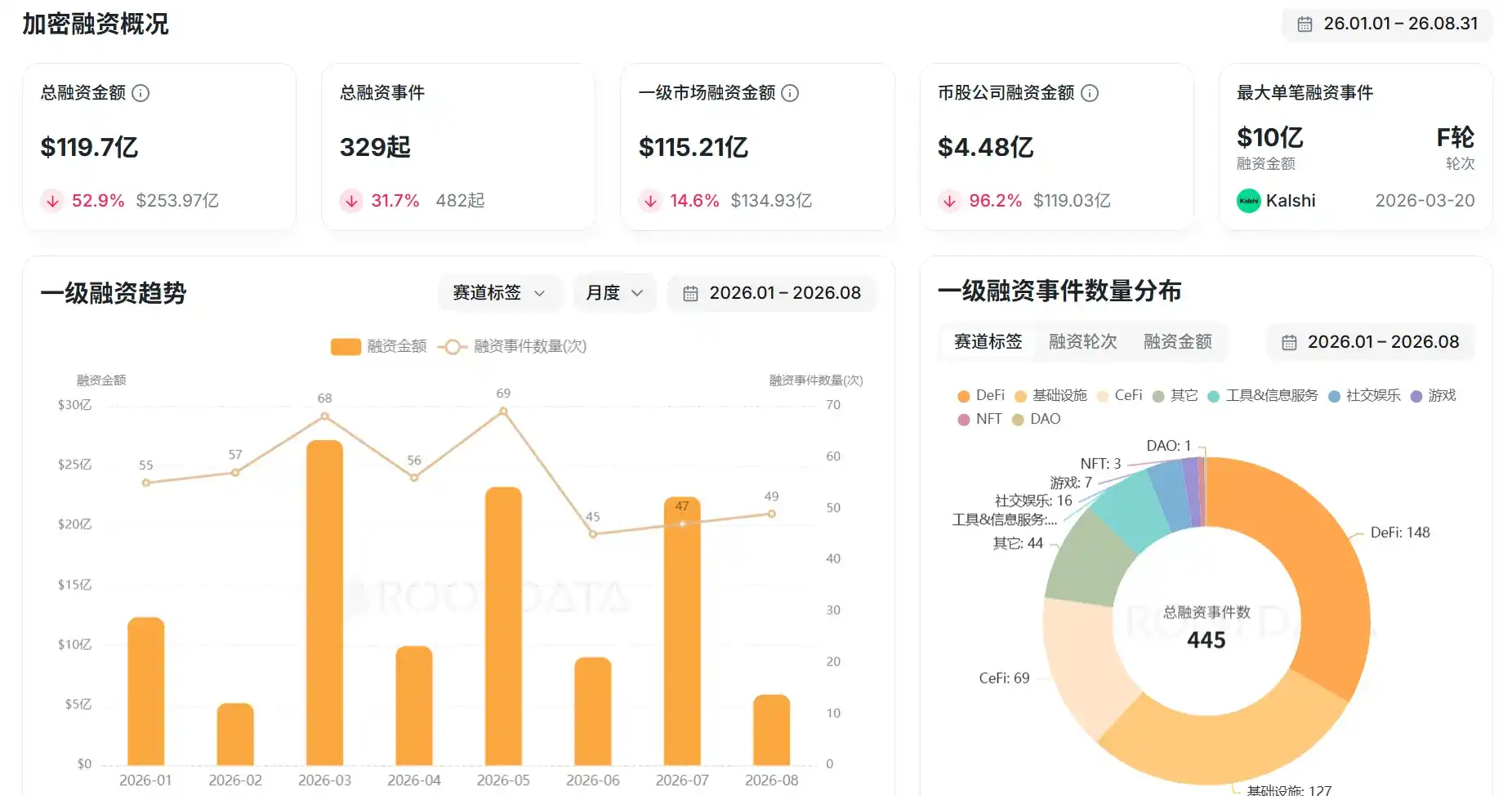
The report argues that Linera’s result is not an isolated case. RootData figures cited in the article show that disclosed crypto fundraising totaled about $11.97 billion from January through August 2026, down about 52.9% year over year. Of that, primary-market financing accounted for about $11.521 billion, down roughly 14.6%. There were 329 financing events, a decline of about 31.7%. The picture described in the source is one in which total capital is still being supported by a small number of large deals, while institutional deployment has become more concentrated.
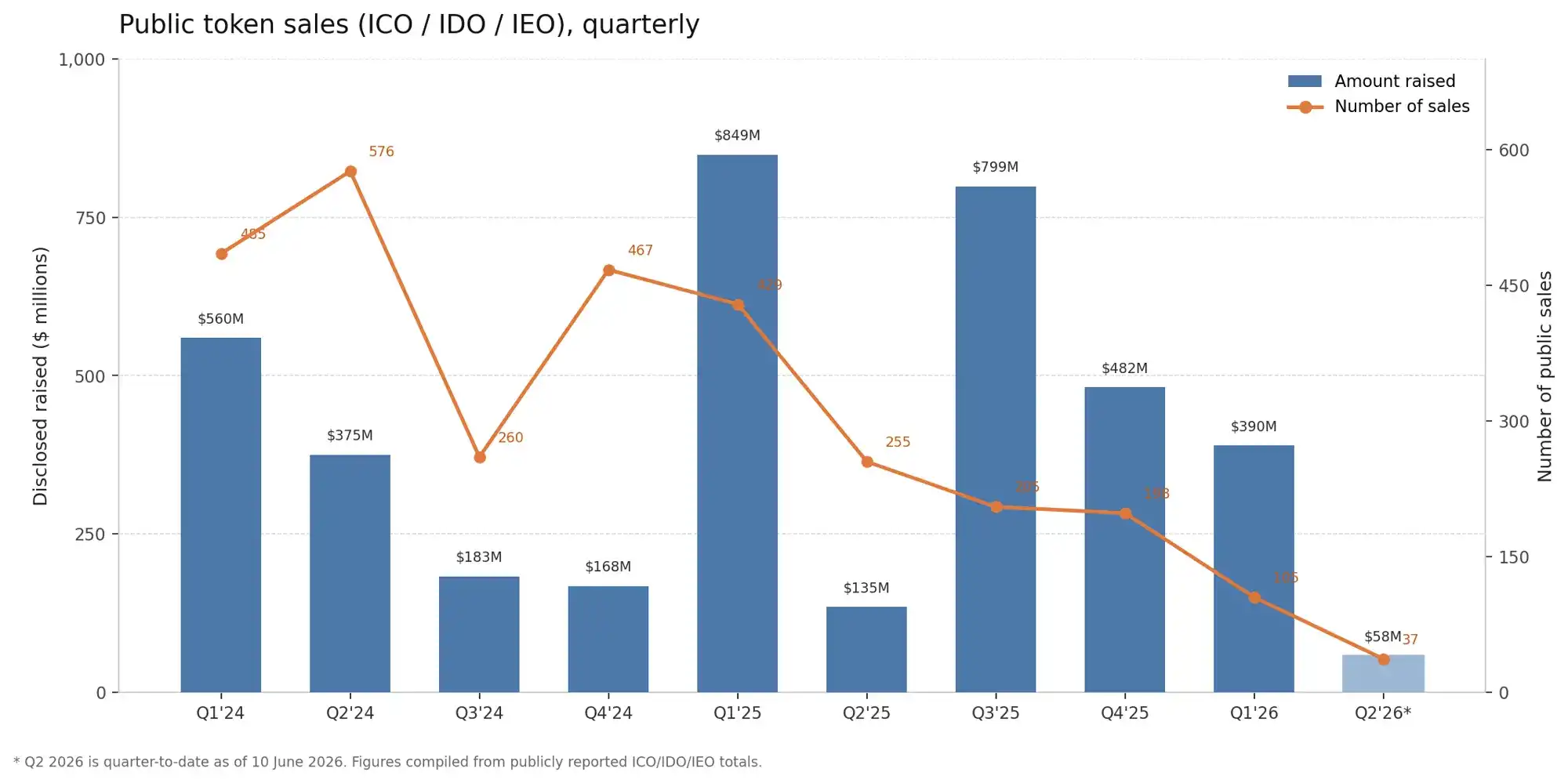
Retail-facing public sales have tightened more sharply. Public sale tracking data cited in the article shows ICO, IDO, and IEO fundraising totaled about $390 million across 105 deals in the first quarter of 2026. By early June, that figure had fallen to about $58 million across 37 deals. Both proceeds and deal count were well below the first quarter. For comparison, the first quarter of 2025 reached about $849 million across 429 deals.
The shift is straightforward: there is less money willing to absorb early-stage uncertainty in the primary market, and the money that remains has become more selective.
Weak post-listing performance has changed buyer behavior
The article also points to underwhelming secondary-market performance among several headline projects. MegaETH was once bid to a $6 billion FDV in the premarket. It officially listed on April 30 this year, opening with an FDV between $1.6 billion and $2 billion, and its high was reached on listing day. By press time, the token had fallen back to $0.037, leaving FDV at just $370 million, down 80% from the high.
Monad raised about $225 million in an institutional round led by Paradigm in 2024, then completed a public sale of about $269 million on Coinbase in November 2025. After listing, its FDV briefly approached $4.7 billion. It has since retreated to around $2.3 billion, a drop of 52% from the peak.
Plasma used the same Sonar public sale system as Linera. It had targeted $50 million but was oversubscribed to $373 million, priced at a $500 million FDV. On its first trading day, the token climbed to an all-time high of $1.68 before sliding steadily. By press time, it was trading at about $0.084, down 95% from that peak. Its fully diluted valuation stood at around $650 million, meaning most of the premium built after listing had been erased.
In earlier cycles, primary-market buyers were often willing to pay for narrative alone. If the story was large enough and liquidity was strong enough, public offerings could fill or even oversubscribe. This year, though, both the size and the number of public sales have fallen. Linera came to market with an institutional valuation shaped in an earlier cycle and a newer product story, but the broader market did not respond with the same pricing tolerance.
Blockchains are being pushed toward users, fees, and revenue
The same pressure is now showing up among live networks. As new chains with strong backers continue to enter the market, block space on older chains increasingly looks interchangeable. Users and fee generation are being pulled toward a smaller number of networks that already have applications. Throughput and zero-knowledge proofs alone are no longer enough to sustain fresh valuation arguments.
On Sept. 8, Ethereum Layer 2 project Scroll published an update on its governance forum saying it planned to shift gradually from a general-purpose zkEVM toward a dedicated network centered on its AI product Compass, with a transition period of about nine months. Scroll said this was not a formal proposal and that later items involving network transformation and DAO approval would be submitted separately.
The product lineup described by Scroll includes the consumer-facing Compass app, Compass API connected to more than 30 large models, the CENO privacy layer, and the USX payment and settlement product. The team said CENO had already engaged with more than 30 prospective clients, with 12 in proof-of-concept work, while Compass remained in early consumer validation.
Similar moves are appearing elsewhere. MegaETH has shut down the more speculative MegaMafia accelerator and turned toward building its own consumer applications, while using revenue from its stablecoin product USDm for buybacks and burns. Arbitrum, Sei, and Sophon are also discussing ways to bring applications and fees back into their own ecosystems.
Xiao Feng of Wanxiang Blockchain wrote this year that about 90% of crypto projects still lack clear users, recurring revenue, or regulatory compliance. In his view, the next phase will depend more on revenue, stability, and links to the real economy, while white papers and performance metrics are no longer enough on their own to support valuations.
Seen through that lens, Linera’s failed community round is more than a single fundraising miss. It shows a market that is pricing projects less by story size and more by whether users are already there and whether revenue can be shown.