
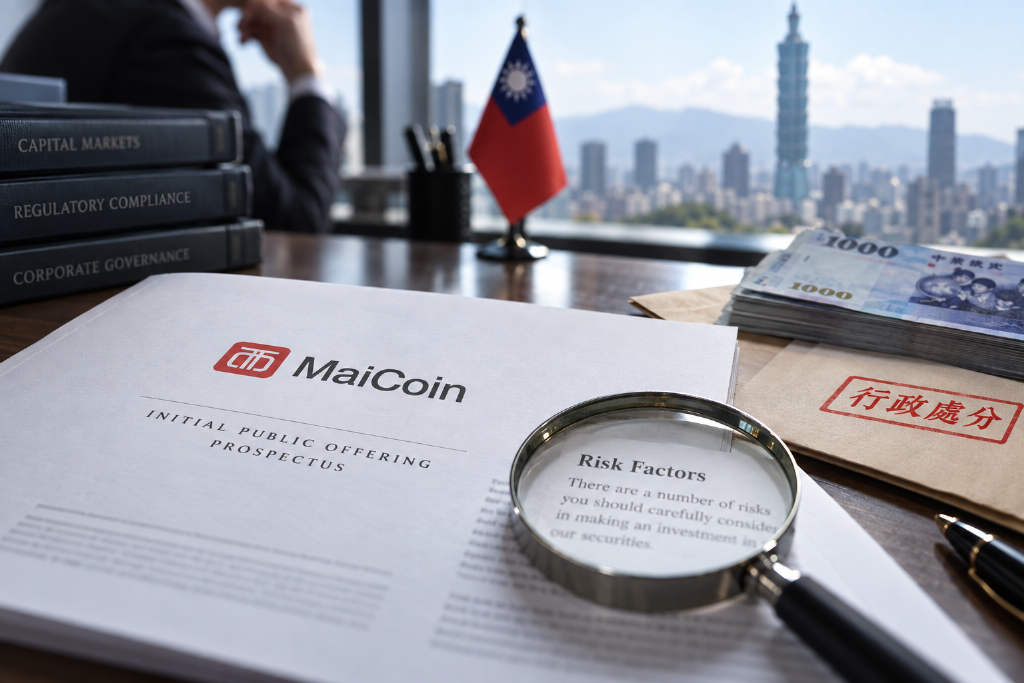
Modern Wealth Holdings, the parent company of MaiCoin Group and the entity listed under securities code 7903, used its draft prospectus for a Taiwan Innovation Board listing to disclose not only financial figures but also past penalties, subsidiary financial conditions, regulatory transition risks, shareholder data, and employee stock option terms.
NT$1.5 million FSC penalty in 2024
A legal opinion attached to the filing lists two violations. The first concerns Modern Wealth Technology, the group’s operating entity, which was fined NT$1.5 million by Taiwan’s Financial Supervisory Commission on Nov. 25, 2024.
The prospectus says the case involved violations of Article 5, Paragraph 2, Article 7, Paragraph 5, Article 8, Paragraph 4, and Article 10, Paragraph 5 of Taiwan’s Anti-Money Laundering Control Act. It lists the deficiencies as failures to conduct required customer due diligence and enhanced due diligence, failure to incorporate suspicious transaction patterns identified by the FSC into monitoring systems, ineffective transaction monitoring patterns, failure to set different monitoring thresholds based on customer AML risk levels, failure to investigate and assess whether suspicious transaction reports should be filed for customers flagged by banks for fraud-related account holds or unusual transactions, failure to report to the Ministry of Justice Investigation Bureau within the required period, and inability during inspection to provide balances for all customer holdings by token type as of the inspection reference date.
The legal opinion says the company has completed remediation measures and that the matter should not have a material adverse impact.
AMIS operating entity was insolvent and fined NT$20,000
The second issue involves Account Link Network Technology, a second-tier subsidiary established in 2016 and the operating entity behind the group’s blockchain technology brand AMIS. The legal opinion says that as of June 30, 2025, the company’s accumulated losses had exceeded paid-in capital and its liabilities were greater than total assets. Its board did not petition for bankruptcy under Article 211, Paragraph 2 of Taiwan’s Company Act, and it was fined NT$20,000.
The prospectus says the parent company has issued a financial support statement, submitted the matter to the board, and prepared an operating improvement plan for 2026. In other sections, the filing describes AMIS node operations and wallet management as part of the group’s technical services and says Union Bank of Taiwan and CTBC Bank use AMIS cold wallet solutions.
Licensing rules and the Travel Rule are listed as key industry risks
The prospectus places regulatory and compliance risk at the top of its industry risk section. It says the Virtual Asset Service Act was promulgated by the president on July 22, 2026. Once it takes effect, Taiwan’s virtual asset service providers will move from the current registration regime to a licensing regime, while the FSC is still drafting related subordinate rules.
The company estimates that more than six months will be needed between the law’s promulgation and the implementation of those rules. It says new requirements will cover capital or earmarked operating funds, operating bonds, qualifications for responsible persons and business personnel, internal control systems, and financial disclosure.
The filing also says the Travel Rule will be rolled out gradually starting in October this year. Violations could lead to orders for correction within a specified period and fines. As part of its response, the company says it has appointed a dedicated chief compliance officer, completed an internal capital adequacy assessment ahead of time, and strengthened Travel Rule compliance and on-chain monitoring with reference to FATF’s 2023 revised guidance on virtual assets.
Cayman structure raises possible economic substance questions
Another section of the legal opinion says the owner of the MAX exchange and the MaiCoin platform is Modern Wealth Holdings itself, a Cayman-registered company. Platform management is delegated to Taiwan-based Modern Wealth Technology, while part of operating revenue is recognized by the Cayman company. The group has also registered certain trademarks and patents in Taiwan.
The lawyers say these facts could amount to a “relevant activity” under Cayman economic substance rules. If so, the company would need to note that in its annual filing with Cayman authorities and complete an annual declaration. The prospectus says that in its most recent filing on Dec. 5, 2025, for the 2025 reporting year, the company concluded that no relevant activity existed and did not make any further declaration.
The group’s offshore subsidiaries also include Shenzhen Mailian Technology, a China-based entity wholly owned by the group. The prospectus groups it with Fishcoin Fintech and Modernity Technologies entities in Singapore and the United States as companies established “for the purpose of expanding global business or making investments.” Investment details show Shenzhen Mailian was funded in U.S. dollars, carried a book value of NT$3.61 million, and posted an investment loss of NT$1.78 million.
Hi-Life and Far EasTone together hold about 11%
As of Aug. 10, 2026, the company had issued 58.81 million shares, with the top 10 shareholders holding 69.98% in total. Chairman Liu Shih-Wei held 28.65%, while his son Liu Hong-Ji separately held 2.40%. CT Investment Limited owned 11.10%.
Two traditional Taiwanese companies also appear on the shareholder list. Hi-Life International held 6.26%, making it the third-largest shareholder, while Far EasTone Telecommunications held 4.73%, ranking fifth. Their combined stake was about 11%.
Among venture investors, Zhen Partners Fund II held 5.20%, Ceyuan Ventures III held 3.34%, Tianji Smart Energy held 2.04%, and Chief Technology Officer Lin You-De held 1.61%.
In a section on competitive strengths, the prospectus says the group has received backing from institutional investors including SBI Group, Union Bank Group, and Far EasTone Telecommunications, and that it signed a memorandum of understanding with Visa.
The filing also includes a table showing directors, supervisors, and shareholders with more than 10% ownership who waived participation in cash capital increases. It says Hi-Life was entitled to subscribe for 429,000 shares in 2024, 306,000 shares in 2025, and 453,000 shares in 2026, while the actual subscribed share fields were blank in each case.
5.11 million employee stock options, with some priced at $0.001
The company issued 5,112,428 employee stock option units in December 2025. Of those, 3,545,579 units were granted to current employees and 1,566,849 units to former employees and consultants. The shares underlying the options accounted for 8.69% of issued shares, while the underwriter’s assessment section described the potential dilution at about 11.06%.
As of June 30, 2026, 4,295,307 shares had been exercised for a subscription amount of NT$57.31 million. Exercise prices were set based on the company’s per-share price when each employee joined. Early tranches were mostly priced between $0.05 and $0.7321, the 2021 hiring tranche was priced at $2.66, and some tranches used a par value of $0.001 as compensation. The filing says those exercise prices were ratified by a board resolution on Dec. 9, 2025.
On vesting, some tranches vested in full on the grant date, while others vested monthly over four years and were subject to a one-year lock-up. During the same period, the Pre-IPO round subscription price was $5.41 per share.
MAX market share estimated at about 68%
The prospectus says there are no official statistics for Taiwan’s virtual asset market, so it calculates market share by comparing MAX exchange trading volume with BitoPro trading volume compiled from candlestick data obtained through BitoPro’s official API. From Jan. 1, 2024, to Aug. 27, 2026, the two exchanges posted total trading volumes of $21.3 billion and $10.04 billion, respectively, leading to an estimated MAX market share of about 68%.
The filing says that figure covers only the two platforms and excludes other registered operators and the trading volume of overseas exchanges in Taiwan.
It also says the market is seeing a near-term volume correction tied to crypto price cycles, and that competitors may intensify competition through pricing, products, or capital investment. The company says it will invest in products, brand building, and internal management, but it does not guarantee that it can maintain its market position.
The draft prospectus is dated Sept. 8. Any supplements or revisions made during the Taiwan Stock Exchange review process will be reflected in the final version.