
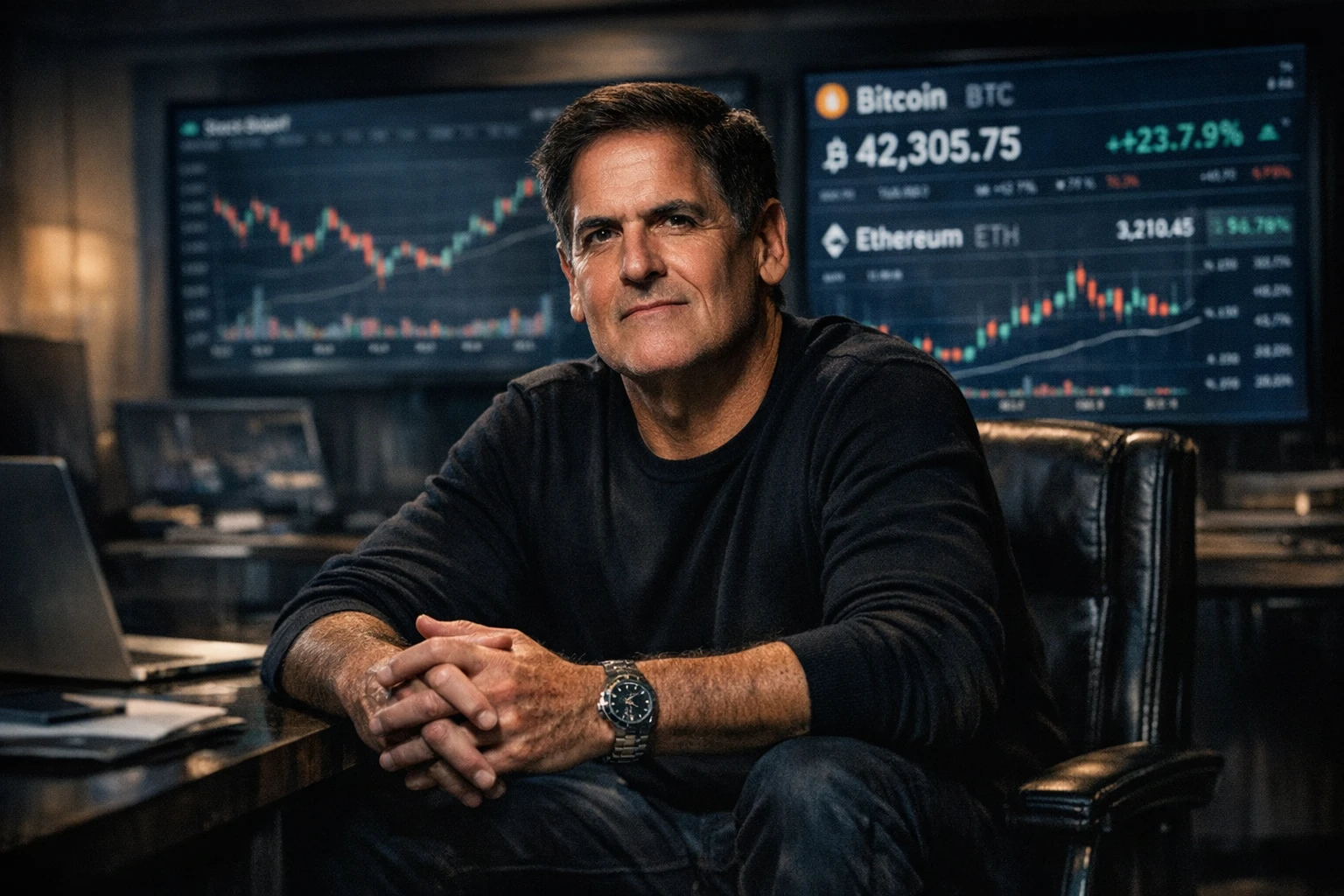
Mark Cuban said he has sold most of his Bitcoin holdings and openly challenged Bitcoin’s role as a hedge asset. In public remarks dated May 21, 2026, Cuban said Bitcoin had “lost direction.” He added that he had long believed BTC would become a better version of gold, yet gold rose while Bitcoin fell, which was not the safe-haven behavior he expected.
He also described meme coins as “garbage.” The comment marks a sharp break from his earlier stance during the crypto boom years.
From early criticism to crypto expansion and back out of BTC
Cuban’s relationship with crypto has shifted several times. In 2019, he famously said he would rather own bananas than Bitcoin, arguing that bananas at least had intrinsic value because “you can eat them.” At that stage, he saw Bitcoin as difficult to use, lacking basic utility, and driven mainly by speculation.
That view changed during the pandemic-era surge in DeFi and NFTs. Cuban moved into a range of crypto investments, including Polygon (MATIC), NFT marketplaces OpenSea and Mintable, as well as several DeFi protocols. He was especially positive on Ethereum, saying its ability to support decentralized applications made it the closest thing to “real money.”
By the peak of the 2021 meme-coin run, Cuban had also become one of Dogecoin’s best-known supporters. He announced that the NBA’s Dallas Mavericks would accept DOGE for tickets and merchandise, arguing at the time that meme coins, with low unit prices and high inflation, encouraged spending rather than hoarding. His latest comments point in the opposite direction.
Bitcoin’s hedge narrative weakens as gold and BTC diverge
The center of Cuban’s criticism is Bitcoin’s failure, in his view, to behave like a hedge. His argument is straightforward: when macro stress hits, gold tends to show the stability expected from a traditional safe-haven asset, while Bitcoin often trades more like a risk asset and falls alongside other volatile markets.
That position lines up with market conditions described in the source material. In May 2026, Bitcoin pulled back from higher levels and the market saw heavy liquidations. A CryptoQuant analyst said futures liquidity had become tight and that the market could move into consolidation. CoinDesk reported the same day that BTC faced ETF outflows and $584 million in long liquidations, with the price stalling near $78,000.
Gold, by contrast, was relatively steady during the same period and in some cases moved higher. That gap in performance helps explain why Cuban said he was disappointed with the “digital gold” case for Bitcoin.
Investors remain split on whether BTC works as a safe haven
The source also points to similar doubts in Asia. Many crypto investors in South Korea and mainland China are said to view BTC as a highly volatile speculative asset rather than a conventional hedge. Some communities even use the label “risk gold,” suggesting that Bitcoin can deliver upside but may still fall with U.S. equities when protection is needed most.
Institutional opinion is also divided. The material notes that some Wall Street funds continue to accumulate BTC, including BlackRock’s IBIT, while many Asia-based local funds treat Bitcoin as speculative portfolio exposure rather than a defensive allocation. Cuban’s exit does not settle that debate, but it brings the question back into focus: if Bitcoin does not hold up in periods of stress, the digital gold label becomes harder to defend.