
Marvell Technology posted results for fiscal 2027 second quarter in the early hours of Aug. 28 Beijing time, covering the period through July 2026. The quarter was basically in line. What people really cared about was management’s refreshed multi-year growth view, and whether the company’s recent Google deal would show up in a stronger custom ASIC forecast.
Revenue targets for fiscal 2027 and 2028 moved higher
Marvell lifted its fiscal 2027 revenue target to $12 billion from $11.5 billion before, implying 45% year-over-year growth. It also raised its fiscal 2028 revenue target to $18 billion from $16.5 billion, implying 50% growth. Inside that, management said data center revenue should grow by more than 60%, while custom ASIC revenue is still expected to more than double in fiscal 2028.
Even after the bump, the guidance was only a bit ahead of what the market had already penciled in. Before the report, major institutions were looking for about $11.8 billion in fiscal 2027 revenue and around $17 billion to $17.5 billion for fiscal 2028. Put next to Nvidia’s much harder-hitting growth guidance earlier, Marvell’s update felt less persuasive.
And that difference matters. Recent sentiment around Marvell had been shaped partly by its agreement with Google. Investors had connected that deal with hopes for stronger custom ASIC demand, including possible TPU-related upside. This quarter, though, Marvell did not lift its ASIC guidance. It also gave no growth target for the current fiscal year, while keeping the next fiscal year outlook at more than doubling. So the obvious question stayed alive: how much extra business is Google really going to add?
Quarterly revenue was near consensus, with data center doing the heavy lifting
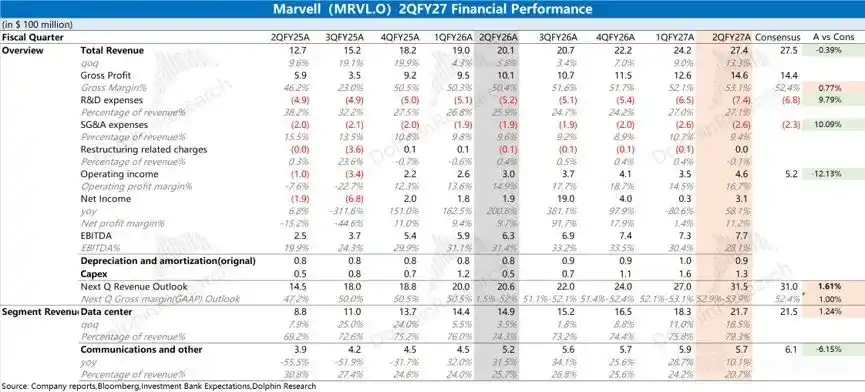
Marvell reported quarterly revenue of $2.74 billion, up 13% sequentially and very close to the market expectation of $2.75 billion. According to the article, the roughly $300 million quarter-over-quarter increase came entirely from data center growth.
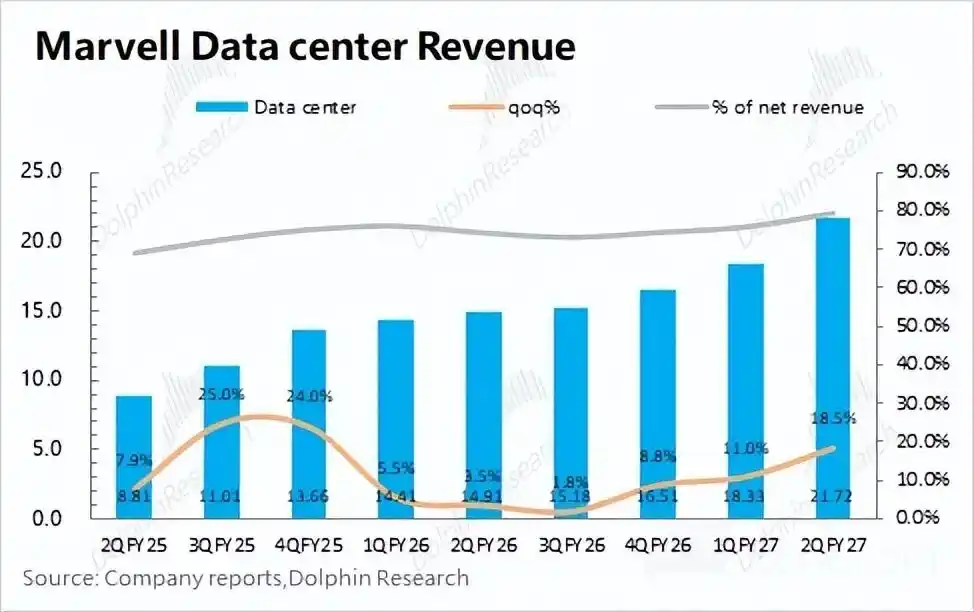
Data center revenue hit $2.17 billion, up 19% from the prior quarter, mostly because of growth in connectivity products. The segment made up 79% of total revenue in the quarter.
That strength itself was no shock. Connectivity has already been the main engine inside Marvell’s data center business. But the market’s attention has moved. The real focus now is custom ASIC execution, especially after the company signed its cooperation agreement with Google.
Right now, Marvell’s custom ASIC business is mainly tied to Amazon’s Trainium chip line. The article said that business has not done especially well against competition from Alchip, and it has trailed the pace of Amazon’s capital spending growth. When Marvell announced its Google arrangement, the stock at one point jumped more than 10%. A lot of that move was tied to hopes for custom ASIC gains and possible TPU order exposure.
Management’s follow-up comments did not do much to back that up. The company did not raise ASIC guidance, did not mention a growth target for the current fiscal year, and stuck only with the view that revenue in the next fiscal year would more than double. In the market’s view, Google’s contribution is still a question mark.
Margins improved on a GAAP basis, while adjusted gross margin stayed flat
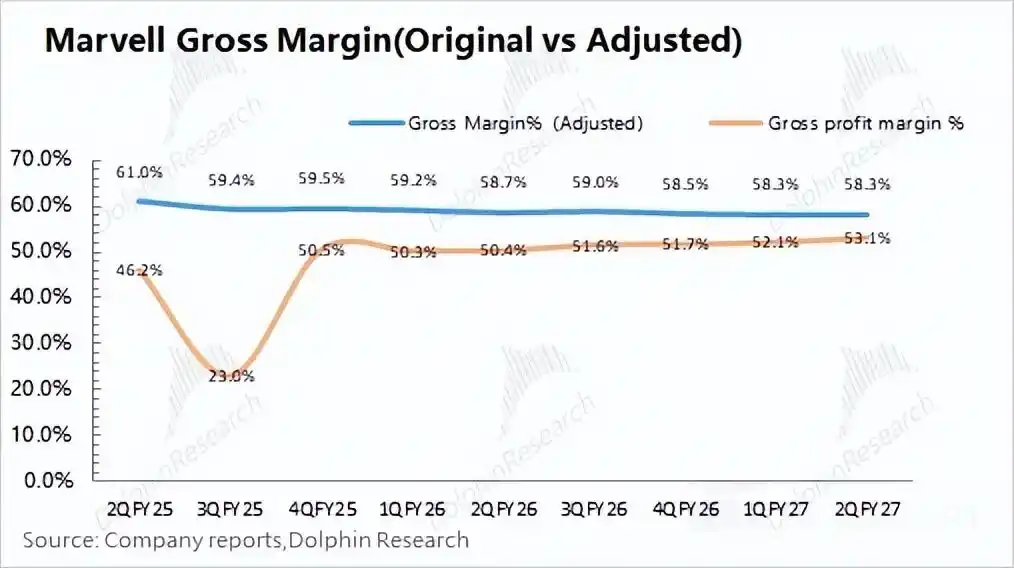
GAAP gross margin for the quarter was 53.1%, up 1 percentage point sequentially. The article said Marvell’s reported gross margin is affected by items like amortization tied to acquired assets, which makes the headline figure less useful as a clean read on operations.
On the adjusted basis used by the author, Marvell’s adjusted gross margin was 58.3%, unchanged from the prior quarter. The article also said that if lower-margin businesses such as custom ASIC start growing faster later, gross margin could still face pressure.
Next-quarter guidance was a little better than expected
For the next quarter, Marvell guided revenue to $3.15 billion, a touch above the $3.1 billion market expectation. GAAP gross margin guidance was set at 52.9% to 53.9%.
Taken together with the full-year outlook, the article inferred fourth-quarter revenue of about $3.7 billion. That would mean the next two quarters both grow around 15% to 20% sequentially, still driven mainly by demand for interconnect products. Since management has already laid out annual revenue targets for fiscal 2027 and 2028, one-quarter guidance matters less now than the longer-term setup.
Reporting structure changed, with data center becoming more central
Marvell also changed the way it reports its business lines starting this fiscal year. The company went from five reporting categories to two: data center, and communications and other. Under that setup, data center was plainly the growth engine this quarter, with 19% sequential growth powered by connectivity demand.
Google warrant package remains a major talking point
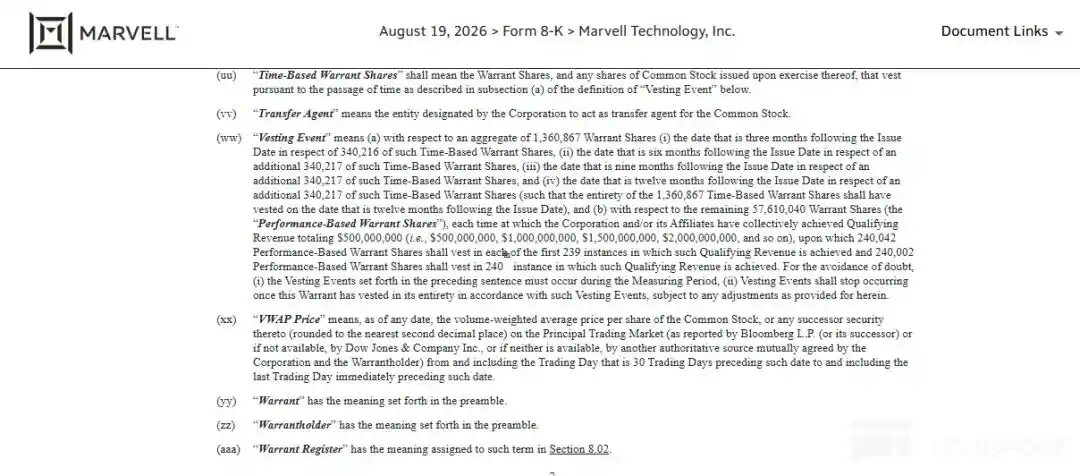
One of the biggest issues around Marvell’s ASIC strategy is the structure of its recent deal with Google. According to the article, Marvell plans to grant Google warrants covering a total of 58.97 million shares, with an issuance date of Aug. 18, 2026 and an exercise price of $206.58 per share.
The package comes in two pieces. First, 1.36 million shares are granted directly, vesting in four tranches of 340,000 shares each after 3, 6, 9 and 12 months. Second, 57.61 million shares are performance-linked and split into 240 portions. Starting Aug. 1, 2026, every $500 million of qualified revenue unlocks one portion, or about 240,000 shares.
Qualified revenue is defined as revenue tied to Google custom ASIC chips, including AI inference accelerators, storage controllers, network interface controllers, memory interface controllers and near-memory computing.
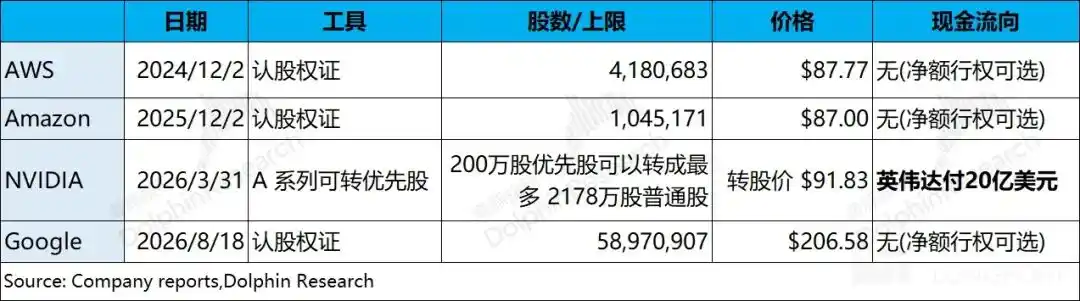
The article argued that this setup shows Marvell bargaining from a relatively weaker position. Simple idea. Win Google custom ASIC orders, and use part of the warrant package as a concession. It also said the overall design echoes Marvell’s earlier cooperation model with Amazon.
Interconnect assets span three AI networking layers
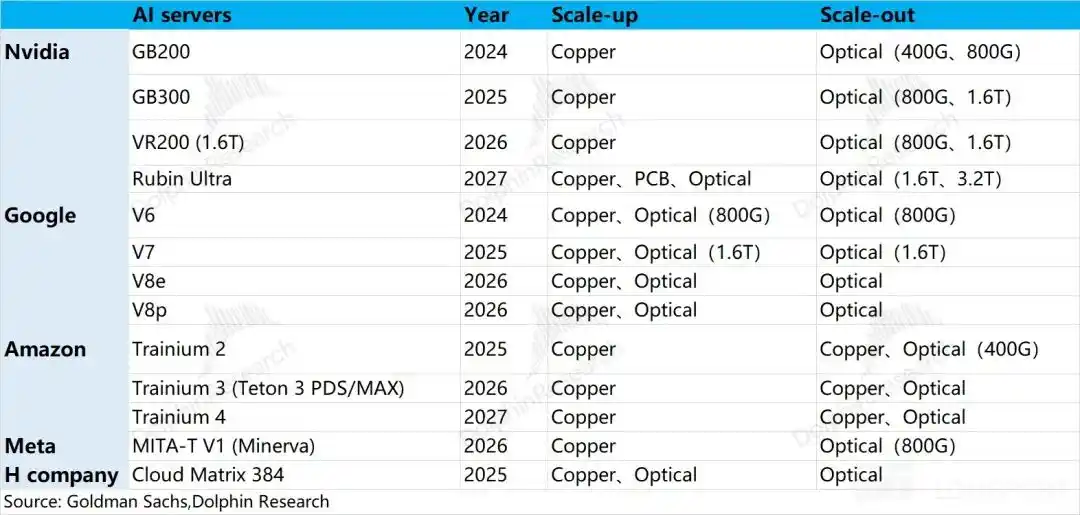
On networking and connectivity, the article said Marvell has built up capabilities through acquisitions of XConn, Celestial AI and Polariton, covering PCIe/CXL switching, photonic interconnect and electro-optic modulation. That gives the company assets across three AI networking layers: Scale-Out, Scale up and Scale-Across. In plain terms, Marvell can supply high-speed interconnect hardware from inside the rack to links across data centers.
In current Scale-out optical interconnect deployments, traditional pluggable optical modules are still the dominant option. Nvidia, Google and other large companies mostly use the pluggable path, and the article described Marvell’s PAM4 DSP as relatively strong in that market. Management had previously said that "the 1.6T solution has already entered mass production and will ramp quickly in fiscal 2027" (the 1.6T solution has already entered mass production and will ramp quickly in fiscal 2027), and that is identified as a main growth driver for the interconnect portfolio.
CXL memory expansion and pooling are also part of the story
The article also pointed to Marvell’s Structera family in CXL memory expansion and pooling. As AI inference workloads demand very large KV Cache capacity, HBM remains expensive and DRAM capacity can be a constraint, leaving NAND and storage-class memory expansion as possible alternatives.

Marvell’s products in this area include Structera A, Structera X and Structera S, serving as a near-storage accelerator, a memory expansion controller and a memory pooling and switching product, respectively.
Valuation still rests on future share gains and growth delivery
The article’s main argument is pretty direct: Marvell trades at a richer valuation than Nvidia and Broadcom because investors are pricing in two things, possible share gains in AI custom ASIC and sustained high growth in connectivity. The latest guidance did not fully make that case.
For fiscal 2028, Marvell’s projected data center growth of more than 60% is below the more than 70% growth figure the article cited for Nvidia’s outlook. That made Marvell’s data center growth profile look less explosive. At the same time, some of the recent stock strength came from the Google agreement. Read together with Marvell’s arrangements with Google and Amazon, the article said the company seems to be negotiating from a position of weakness. And Marvell’s decision not to raise ASIC guidance this time only added to the view that the deal may be more of a framework agreement than a clear revenue catalyst.
The article said the sharp after-hours drop was driven mainly by disappointment with the company’s full-year outlook. Because investors are focused on Marvell’s future growth path, recent developments such as open-source models and a slowdown in Anthropic ARR slope were described as factors that can amplify share-price volatility.
More ASIC detail is expected on Oct. 6
Management later added that it will discuss the ASIC outlook in more detail and provide scenario ranges at its analyst day on Oct. 6.
The article also said the AI chip field still has relatively few players, and Marvell is one of the few U.S. ASIC companies with ties to several large customers. Broadcom’s work with Google on TPU helped push its market value to $2 trillion at one point, while Marvell’s market capitalization is about $200 billion. If Marvell were to win 10% to 20% of TPU share, the article said, that could mean several billions of dollars in extra annual revenue. For reference, Marvell’s current annual custom ASIC revenue is only about $2 billion.
That is why expectations have not disappeared after this report. The article said that while the company’s full-year outlook did not satisfy the market, Marvell has already put partnership structures in place with Amazon and Google, keeping the spotlight on whether real orders show up. Near term, a high valuation could leave the stock open to pullback pressure. Longer term, the mix of more than 50% growth over the next two years and visible strategic optionality is still what supports the valuation argument.
The original article was published by the WeChat account Haitun Research, with authorship attributed to Haitunjun. It also said the adjusted operating figures include SBC and mainly remove depreciation and amortization effects to show underlying operations more clearly.