
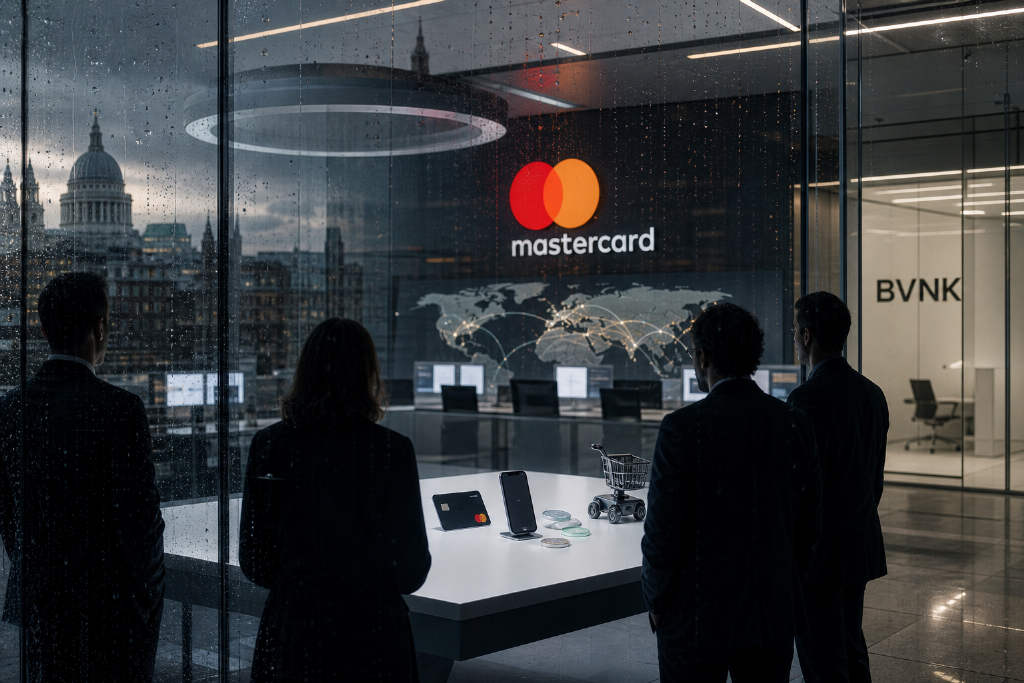
Mastercard’s latest messaging on stablecoins, agentic commerce and AI points to one core idea: money may move across different rails, but the company wants to stay in control of the trust, safety and interoperability layer.
CEO Michael Miebach made that case in two public settings on July 30, the day Mastercard reported second-quarter results for 2026. He first spoke with analysts on the earnings call, then spent 46 minutes with Tom Gardner on a Motley Fool podcast. The audience changed. The wording loosened and tightened depending on the format. The underlying thesis did not. Three days later, on August 3, Mastercard closed its acquisition of BVNK for $1.8 billion, five months ahead of the original year-end plan.
What Mastercard says it actually sells
At the start of the Motley Fool interview, Gardner asked Miebach to explain the basic relationship among banks, merchants and cardholders. Miebach first corrected a number, saying Mastercard has 3.7 billion cardholders, not 4 billion. Then he made the point that frames the rest of the discussion: cardholders are not Mastercard’s customers. Its customers are banks and, in some cases, merchants such as Walmart or JPMorgan.
That distinction matters because it shifts the company’s product away from payment in the narrow sense and toward the layer that makes payment acceptable to other parties. In Miebach’s description, a shopper can leave a website and wait for delivery, or walk out of a store with goods in hand, because Mastercard stands behind the transaction with a payment guarantee to the merchant. The actual transfer of funds in the four-party model happens afterward, when the cardholder’s bank sends money to the merchant’s bank.
That guarantee has to work across 220 countries and territories and across 3.7 billion cards, even though regulatory rules and infrastructure differ from one market to another.
The other side of trust is risk control. Miebach said consumers remain protected if they pay on a fake website because the fault does not lie with them. In the background, systems scan trillions of data points at nanosecond speed to detect fraud, including whether a person is likely to be in a given location and whether a purchase exceeds anything in that user’s prior spending record.
He described Mastercard as the operating system of the digital economy. The phrase could sound like branding, but he broke it into components: a security layer, a money movement layer, and a layer of data and insights on top. The wording around money movement is especially important in this context because it spans cards, account-to-account systems and stablecoins. In his framing, the security layer is singular. The movement layer is plural.
The revenue mix is also moving up the stack. In the second quarter, net revenue rose 12% on a currency-neutral basis. Value-added services and solutions increased 18%, outperforming the top line by 6 percentage points, with about 60% of that business tied to the network. Security, identity, fraud management and personalization are not payments by themselves. They are decisioning and support functions sold around payments.
On the security side, Miebach cited a large number. Fraud and cyber risk losses are projected to reach $15.6 trillion by 2030, and if cyber risk were a country, it would rank as the world’s third-largest economy. Using threat intelligence built on Recorded Future, Mastercard identified more than 7 million card testing transactions in 192 countries over the first three quarters and estimated that it prevented $172 million in losses.
Stablecoins: where Mastercard sees utility, and where it does not
Miebach’s clearest formal statement on stablecoins came in the opening remarks of the earnings call. He said stablecoins have strong potential, but to scale they need reliability, security and interoperability, which he said are the things Mastercard provides.
That is not a rejection of stablecoins as such. It is a claim that stablecoins do not yet arrive with those three conditions fully built in.
He then drew a sharp use-case boundary. On the call, Miebach said stablecoins have clear utility in some B2B and P2P flows, but that in P2M, pay-to-merchant transactions, there is "no problem to solve."
In the podcast, he put that into a more visual example. A person buying coffee from a neighborhood shop may have little reason to use a stablecoin. A small business paying an overseas supplier is different. In the correspondent banking system, fees can be high and visibility poor. A company may send $100 and have no idea that two intermediaries each took $5, leaving only $90 to arrive.
His principle was straightforward: this is not really about the technology by itself, but about whose problem gets solved. Miebach said Mastercard has invested in account-to-account systems since 2016 and is now one of the largest A2A solution providers. Cards are a big part of the answer, he said, but not the answer for every payment type. Mastercard’s network today can process U.S. dollars, other fiat currencies and stablecoins. The goal is not only to let stablecoins run through the system, but also to carry over the protections people expect from card payments.
In other words, he did not say stablecoins are unworkable. He said they have not yet developed an acceptance network with the scale Mastercard thinks the market needs. The company, in his telling, spent 60 years building the world’s largest acceptance network. What people want from a payment system is scale, predictability and protection, and he argued that stablecoins do not currently offer those attributes on their own.
On the earnings call, he described the future as a world of multiplicity: many coins, many chains, and a need for a trusted interoperability layer because people will transact across different assets.
Mastercard has been active on that front. The company partnered with SoFi in March, obtained a BitLicense from the New York Department of Financial Services in May, and expanded settlement in June to six regulated stablecoins across eight blockchains. Earlier initiatives included the Multi-Token Network, or MTN, Crypto Credential, and One Credential, which combines fiat and stablecoin balances within a single credential.
The harder question is traction. On the call, Miebach gave only one growth metric tied to digital assets: crypto co-branded card spending volume has more than tripled over the past two years, and Bitget and Kraken were added in the quarter. That is a real number, but it measures how often stablecoin holders spend through cards. It does not show how much stablecoin settlement is actually running natively on Mastercard’s network.
He did not disclose a volume figure that would directly show stablecoins settling on Mastercard rails. The article notes that some analysts have pointed out Mastercard has never published a stablecoin settlement number comparable to Visa’s, and that many of Mastercard’s initiatives may still be in pilot stages. By contrast, the comparison number cited for Visa was public: by April this year, Visa’s annualized stablecoin settlement run rate had reached $7 billion, up 50% quarter over quarter, spanning nine chains and more than 160 stablecoin card programs. In on-chain card settlement share, Visa was said to hold 97% against Mastercard’s 3%, even though the number of supported projects was nearly the same.
That leaves Mastercard with a broader framework than its rival in some respects, but less disclosed flow to prove it so far. The evidence it can point to publicly is still growth in card spending by stablecoin users.
Agentic commerce: who is buying decides which rail matters
One of the sharpest questions on the earnings call came from analyst Ramsey El-Assal, who asked whether there are agentic commerce cases that require stablecoins, or whether traditional Mastercard credentials can cover the field.
Miebach did not answer with a simple yes or no. He split the market into two categories.
When AI buys for people, Mastercard says cards can still win
The first category is AI buying on behalf of people. Miebach used a camping example. A user asks AI what to bring on a trip and receives a list of 15 items. The AI already knows the user owns a tent, so it does not recommend one. But after getting the list, the user still has to visit multiple websites and place orders manually. If checkout could happen in that moment and a shopping agent could complete the purchase using a Mastercard credential underneath, the process would be much smoother.
That introduces new questions. How do you know the agent is known and authentic rather than fake? How do you know it bought what the user intended to buy? If it orders two grills instead of one, what proof does the user have when the charge appears?
Miebach said Mastercard Agent Pay carries over existing card tools into that setting: tokenization, zero-liability protection and dispute handling. The centerpiece, which he named on the earnings call, is Verifiable Intent. That mechanism is meant to let a user challenge a transaction by saying, in effect, that this was never what they intended to buy, and then trigger the chargeback process again. He added one detail on the call that was not stated in the podcast version: the capability was built with Google.
His conclusion was plain. Merchants will always need reach and a predictable customer experience. Consumers do too. So, he said, Mastercard really believes cards will win in that world.
He applied the same logic to businesses. On the call, Miebach said there will be a class of B2B agent transactions where an agent procures goods or services on behalf of a company. In his view, those transactions can also run inside the card ecosystem because the ticket sizes, speed requirements and use cases fit, and because they still need protection and global reach.
Under that framework, AI buying for individuals and AI buying for enterprises do not amount to a direct challenge to card rails.
The business opportunity for Mastercard includes tokenization itself, which is already a product it sells. Token penetration in the second quarter rose to just above 40% of switched transactions, leaving the rest of the base as runway. At the same time, the article notes that agents do not automatically create new demand. People are not going to buy five more tents because an agent exists. Much of this is likely to be a replacement of existing transaction flow, not a net expansion in consumption.
When machines buy, Mastercard allows for non-card rails
The second category is machine-driven purchasing of digital goods and services such as APIs, compute, data and content.
Miebach argued that these flows do not fit neatly into invoice-driven payment logic. A company buying compute may prefer usage-based billing, turning capacity up by 10% when needed and scaling down later, paying only for actual consumption. That improves working capital efficiency and matches what procurement leaders and chief financial officers want.
What it requires, though, is a payment ecosystem that is always on, high frequency and able to price transactions in tiny fractions of a U.S. dollar. Miebach’s point was that such a payment ecosystem does not really exist today.
In the prepared remarks of the call, he summarized the architecture in one line: on-chain permissioning, off-chain settlement. He also said Mastercard is the only network that supports machine-to-machine payments.
The division of labor is clear in that formula. Authorization happens on-chain because machines need to identify and approve a transaction instantly. Settlement happens off-chain because the route the money takes is a separate question. In the Q&A portion of the call, Miebach said settlement could take place over different kinds of rails, possibly involving stablecoins or other methods, and Mastercard is open to that.
He put it even more directly in the podcast: the underlying rails and infrastructure will likely differ from card rails. They could be stablecoins or something else. That choice belongs to the enterprise. Mastercard, he said, is neutral on that point, while the trust and interoperability protocol above the rails is what matters.
The launch ecosystem includes more than 30 companies, among them Adyen, Ant International, BVNK, Checkout.com, Coinbase, OKX and Cloudflare. The article argues that Cloudflare’s presence on the list is revealing because it suggests the target is not just traditional procurement workflows, but also billing for compute and APIs.
This is where Mastercard’s concession becomes precise. As long as the buyer is still a person, whether an individual or someone acting for a company, Miebach says cards will win. Only when the buyer becomes a machine does he openly accept that the market may need more than one settlement rail. Even then, he wants Mastercard to own the trusted layer above those rails.
AI: the advantage, in Mastercard’s telling, comes from proprietary data
Gardner also pressed Miebach on a broader issue: if AI becomes capable of doing much of the work people do today at lower cost, and if large technology companies with strong cash flow and balance sheets are already reducing headcount, what does that imply for consumer spending?
Miebach first answered through the lens of the technology itself. AI needs to be explored, he said, and if deployed well it can support prosperity and growth. But it also has a downside. Generative AI is giving tools to fraudsters, scammers and hackers. The same technology can be used to attack or to defend, making it an arms race.
On the earnings call, he became more specific. Cybersecurity is what occupies CEOs and boards right now, and the debate around frontier models is whether they should be seen as threats or as tools for finding a company’s own vulnerabilities. His answer was both. Mastercard is already using frontier models to speed up internal vulnerability detection and is sharing that approach with clients as a best practice.
At the human level, he said this industry, and most industries, ultimately depend on attracting and keeping the best talent, which means people need to upgrade their skills. He defined the direction as human-centered AI applications: use tools to do work better and strip out repetitive tasks. He offered a personal example, saying he built an AI assistant to handle email. He still reviews the output, but the routine parts are no longer manual. He also said teams use AI to compile public information before conversations with clients who want to discuss agentic commerce and stablecoins, saving time for the parts of those discussions that matter most.
As for why Mastercard does not see itself as an AI trade, Miebach drew a distinction. Mastercard has always been about technology rather than headcount, he said, because it is fundamentally a network company operating across 220 countries and territories with a relatively light human footprint for its market value. In that sense, he said, this is not an industry that requires a complete rethink.
He made the distinction explicit: Mastercard is not an AI trade and not AI infrastructure. It is an applied AI company.
That view also sits behind capital allocation. Mastercard repurchased $4.9 billion of stock in the second quarter. The article notes that while AI shares were leading the market, Mastercard at one point became a source of funds for portfolio rotation, with the share price falling from 570 to 470. Miebach said buybacks are opportunistic and that Mastercard is not in the business of doing buybacks for their own sake.
His definition of an AI-era winner was concise. The companies that stand out, he said, will be those that can use different models and also have proprietary data to feed those models. Mastercard, in his view, owns one of the most distinctive datasets available: transaction data. That is what gives the company staying power and a seat at the table.
Why BVNK matters to Mastercard
The BVNK acquisition, which closed on August 3, puts operating detail behind that strategy.
In the traditional fiat model, banks perform the final movement of funds while Mastercard handles messaging and clearing logic. In the familiar retail scenario where a shopper leaves with goods, the actual money is sent by the issuing bank to the merchant’s bank. Mastercard supplies the guarantee and the routing. Member banks form the fiat rail, and Mastercard does not need to hold the licenses itself or touch the funds directly. It does not control settlement in the final sense.
The problem appears when settlement may happen over blockchain-based stablecoins. On that rail, there is no equivalent member-bank system automatically standing in for Mastercard to handle receiving, settling and converting funds.
That is the gap BVNK is meant to fill. On the earnings call, Miebach described BVNK’s role this way: with BVNK, Mastercard will act as the trusted interoperability layer that lets clients send, receive, store and convert assets.
What BVNK brings into the network
The transaction closed on August 3 with a structure of $1.5 billion in base consideration and $300 million in earnout, bringing the total to $1.8 billion. The closing came five months ahead of the original year-end target.
According to the article, BVNK brings about $30 billion in annualized stablecoin transaction volume, more than 25 licenses across 130 markets, authorization under MiCA obtained in February, and direct connectivity into the SEPA euro rail through Lithuania. Its client list includes Worldpay, Deel, Rapyd, Flywire and Visa Direct.
Once inside Mastercard, BVNK is expected to do three concrete things:
- provide 24/7 stablecoin settlement for processors and acquirers,
- add stablecoin checkout capability to Mastercard’s payment gateway,
- enable conversion between fiat and stablecoins.
The article’s framing is that BVNK will perform on the stablecoin side the same functions that member banks perform on the fiat side, including collections, settlement and foreign exchange conversion.
Miebach’s own rationale for the deal included a line the article singles out: BVNK’s payment orchestration, licensing footprint and connectivity are highly differentiated, and they are already live in the market today. In that reading, what Mastercard bought for $1.8 billion was not abstract technology. It bought time.
Chief Product Officer Jorn Lambert put the official label on the deal in the closing announcement, saying that in a multi-currency world where fiat, stablecoins and tokenized deposits coexist, the next payment paradigm will be defined by how efficiently different rails connect to one another.
Details from the bidding process
The article also cites comments from Kjartan Rist, founding partner of Concentric and an early institutional investor in BVNK, for details on the sale process.
First, the pressure point was Stripe. Rist said Stripe’s $1.1 billion acquisition of Bridge at the end of 2024 forced Mastercard to look back over its shoulder. He broke the competitive threat into three elements: execution, product simplicity and a lack of legacy baggage.
Second, Coinbase reportedly bid higher. The article says Coinbase at one stage offered $2.5 billion, but BVNK’s founders prioritized cultural fit in choosing a buyer. In Rist’s description, Coinbase is an exchange, while Mastercard is a financial services company.
Third, Visa, despite being both a shareholder and holder of a board observer seat, did not pursue the asset. Rist’s interpretation was that Visa is following a different strategy, choosing to partner with several operators rather than owning one.
The article reduces that contrast to a simple distinction: one company rents pipes, the other buys a pipe.
On valuation, the piece argues that $1.8 billion is not especially expensive in Mastercard’s context. The company spent $4.9 billion on stock buybacks in the same quarter, so the acquisition cost was a little more than one-third of that amount. The article also notes a basic difference between the two uses of capital: repurchased stock can later be reissued, while an acquired company cannot be returned in the same way.
Another signal came in May with Mastercard’s BitLicense approval from NYDFS. Card networks traditionally did not need to hold these licenses themselves because member banks held them. By applying directly for the ability to clear tokenized deposits and payment stablecoins, then adding BVNK’s more than 25 licenses and SEPA access, Mastercard appears to be building a new rail of its own.
On stablecoin rails, the article’s conclusion is blunt: if there are no member banks to do the job, Mastercard has to step into something like that role itself.
The common thread across stablecoins, agents and AI
Across both the podcast and the earnings call, Miebach returned in different ways to one practical point: what consumers want from payments has not changed much over decades. They want simplicity, safety and clarity about what happens when something goes wrong.
That is why the article argues that card networks have not really been selling clearing or switching for the past 60 years. They have been selling a system of accountability.
By that logic, stablecoins do not yet come with chargebacks. Agentic commerce does not solve that issue either, which is why Mastercard says it needs things like Verifiable Intent with Google. AI can recommend and execute, but it does not automatically supply accountability.
Miebach’s three answers therefore collapse into one. The market can choose whichever rails it wants, but when disputes, risk and responsibility appear, Mastercard wants to be the party that gets paid for standing behind the system. Buying BVNK gives that trust layer something new to connect to: a rail Mastercard once did not need to own, but now appears to want in hand.
The article ends by leaving one question open. Mastercard’s bet assumes that responsibility itself will remain as valuable in the next payment environment as it has been in the last one. That is the part the market has not fully tested yet.