
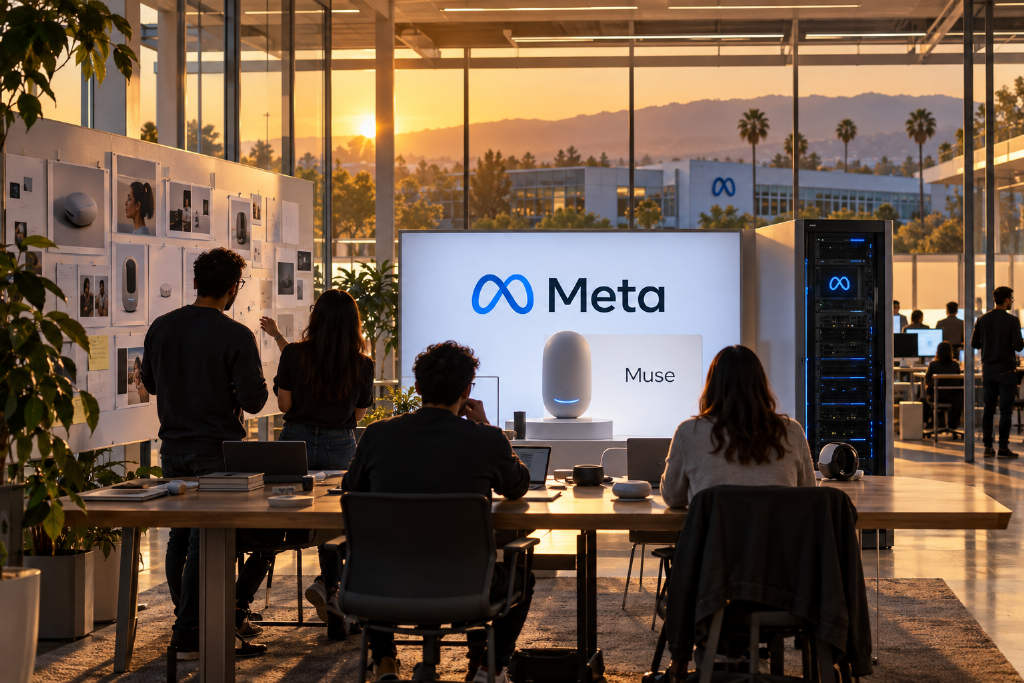
Meta Chief AI Officer Alexandr Wang said in a recent interview that Muse, the company’s personal AI agent built to carry out tasks for users, took seven months to move from prototype to release. The core team handling the model and product had fewer than 200 people.
Meta backed personal agents over coding agents
Wang said that earlier this year, Anthropic was well ahead in coding agents, and many in the industry saw programming as the most important application for advanced AI. He and former GitHub CEO Nat Friedman, now Meta’s head of AI products, took a different view and placed more weight on personal agents.
Wang said Meta’s apps are used by about 3.5 billion people every day, and argued that building AI products for ordinary users fits the company’s strengths better. He added that Meta had already laid out its "personal superintelligence" direction in 2025, while OpenClaw gave that idea a more concrete product form.
OpenClaw led to the first Muse prototype
In February, after spending time with OpenClaw, Wang and Friedman each sent memos to Meta’s board. Friedman wrote two. One was titled Trust Is a Must and argued that a personal agent had to win user trust.
The team then built a Muse prototype in one to two weeks. Early versions already included the mascot Jolly and a first concept for the dedicated hardware device Muse Charm. Even so, the product was unstable at that stage. It could occasionally impress, but most of the time it still struggled with basic tasks.
Release came only after more than 100 tests were cleared
Over the next few months, the team kept tuning the model. Meta drew up a list of more than 100 required capabilities, designed tests for each one, and used those results as its launch threshold.
Wang said some model versions were able to pass about 80 of the tests, but still failed roughly 20, which meant more training was needed. Muse was not released until the specially trained Muse Spark 1.3 passed the full evaluation set.
A top product for the year, without a big hiring push
Meta leadership viewed Muse as one of the company’s most important products of the year, but did not aggressively expand the development team. Wang said products inside large companies can easily turn into a mix of too many people’s ideas, with each product manager trying to add something, until the result becomes a patchwork.
He said Muse was designed from the start to preserve a unified product experience, with Friedman leading that effort. Wang added that his AI research organization follows a similarly lean structure.
Wang described a flat research management model
Wang said he currently has more than 200 direct reports. Researchers on the TBD team report to him directly, without multiple layers of people-management roles in between. Individual groups still have technical leads, who decide the technical direction.
He also said he is not necessarily the best manager for all 200-plus people, but argued that the researchers have already proven what they can do and do not need close supervision on every matter. In his view, giving them enough resources and freedom matters more.