
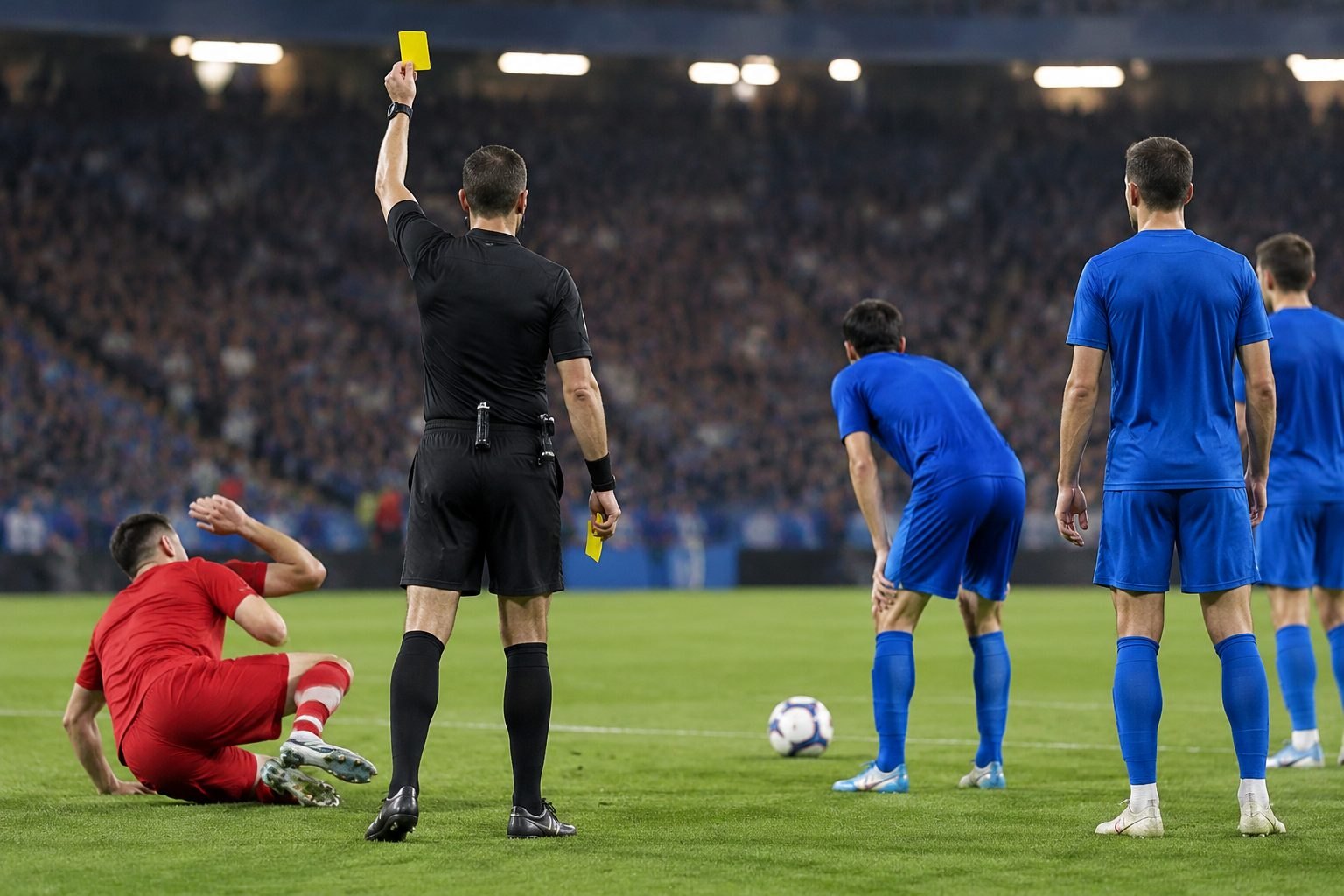
Yes. Under the IFAB Laws of the Game, a player who attempts to deceive the referee, for example by feigning injury or pretending to have been fouled, must be cautioned for unsporting behaviour. That is simulation, and a player already on a caution is sent off after a second caution.
What simulation means in the Laws
Simulation is an action that creates a false impression that something has happened when it has not, committed by a player to gain an unfair advantage.
To deceive means misleading the referee into an incorrect decision or disciplinary sanction that benefits the player and/or the player’s team. Feigning injury and pretending to have been fouled are named examples, but the category is wider than those two acts.
What the decision and restart can be
These are the direct outcomes attached to simulation.
| Situation | Decision |
|---|---|
| A player attempts to deceive the referee, e.g. by feigning injury or pretending to have been fouled | Caution for unsporting behaviour |
| The player has already been cautioned | Second yellow card, then a red card |
| The referee stopped play for the simulation | Indirect free kick to the opposing team where the offence occurred |
| A penalty kick, but the review clearly shows the attacker pretended to have been fouled and was not touched | Penalty kick cancelled; indirect free kick to the defending team; the attacker cautioned |
| A caution for simulation in the opponents' penalty area, but the review clearly shows a foul | If the referee decides it was not simulation: caution cancelled and penalty kick awarded |
If the player had already been cautioned, the next step is a second yellow card and then a red card. If play was stopped for the simulation, the opponents restart with an indirect free kick from the place of the offence.
How VAR can change the outcome
VAR can help the referee correct a decision tied to simulation when the case falls within the review process. That can affect a penalty kick, a caution, or even a second caution followed by a red card.
One IFAB example starts with a penalty kick. After an on-field review clearly shows that the attacker pretended to have been fouled and the defender did not touch the attacker, the penalty kick is cancelled, the defending team gets an indirect free kick, and the attacker is cautioned for simulation.
Another example runs the other way. A player is cautioned for simulation in the opponents’ penalty area, but the VAR review clearly shows a foul. If the referee decides it was not simulation, the caution is cancelled and the penalty kick is awarded; the defender who committed the foul is then shown a yellow or red card if appropriate.
A further example covers a clearly incorrect second yellow card. A defender falls and pretends to have been fouled although there was no contact, and the attacker is shown a second yellow card and a red card. After the review, the second yellow and the red card are cancelled, the defender is cautioned for simulation, and play restarts with an indirect free kick to the attacker’s team.
How the Premier League frames it
For the Premier League in 2026/27, one refereeing point of emphasis is to continue to deal firmly with clear actions intended to deceive the referee (simulation and embellishment).
FAQ
What is simulation in football?
It is creating a false impression that something happened when it did not, done to gain an unfair advantage. Under the Laws, it is an attempt to deceive the referee, for example by feigning injury or pretending to have been fouled.
Can VAR punish diving?
VAR can help correct decisions connected to simulation in reviewable situations. That includes cancelling a penalty kick, removing a wrong second yellow and red card, or cancelling a caution that should not have been given.
The referee still makes the final decision after the review.
What happens if a player dives in the penalty area?
If the review clearly shows that the attacker pretended to have been fouled and was not touched, a penalty kick that had been awarded is cancelled. The restart becomes an indirect free kick to the defending team, and the attacker is cautioned.
If the player was instead cautioned for simulation, but the review clearly shows a foul and the referee decides it was not simulation, the caution is cancelled and the penalty kick is awarded.
Is diving a booking in the Premier League?
Yes. The Premier League’s 2026/27 refereeing emphasis includes dealing firmly with clear actions intended to deceive the referee (simulation and embellishment).
The booking itself comes from the Laws as a caution for unsporting behaviour, and an earlier caution turns it into a second caution and a red card.