
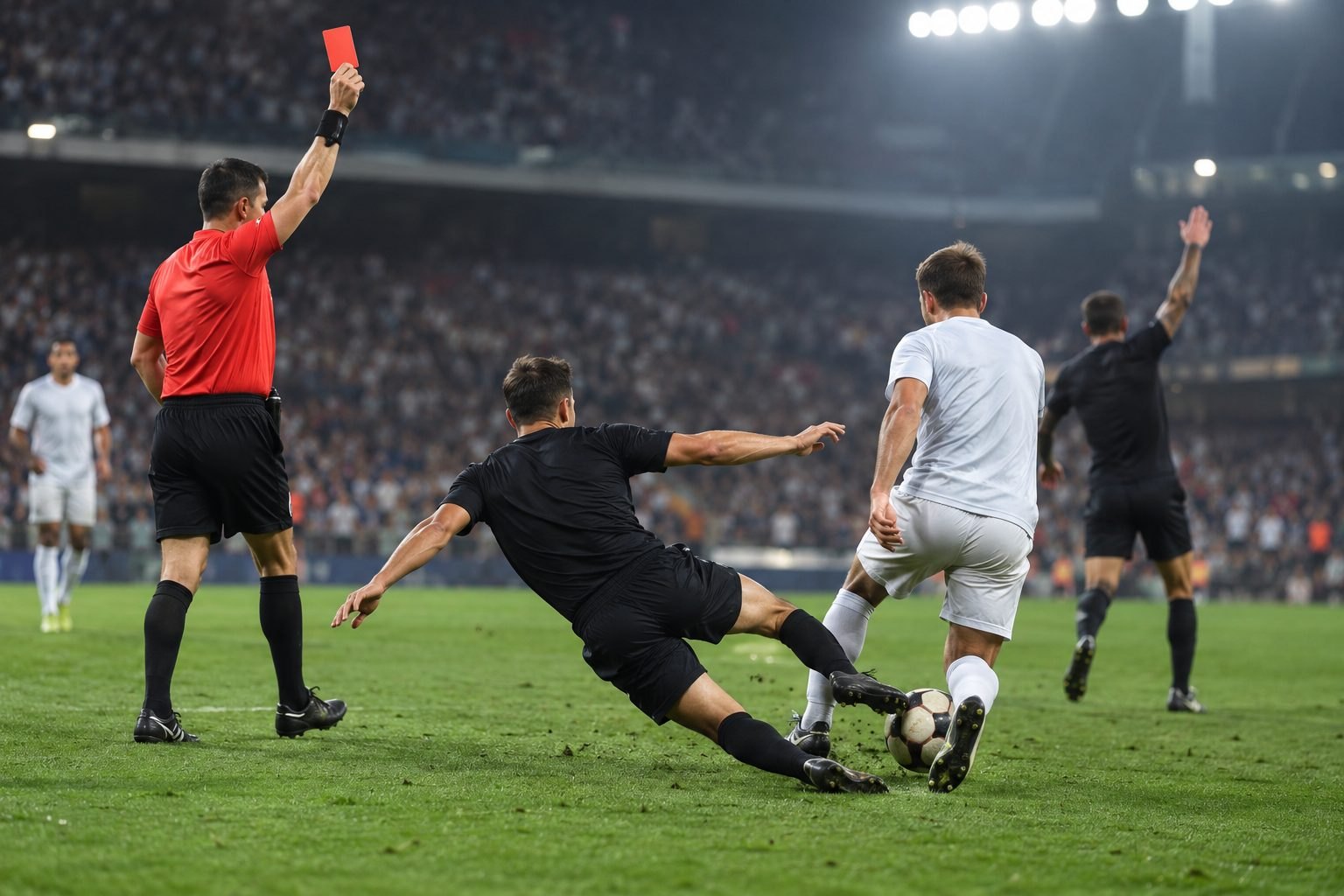
Both are sending-off offences. The difference is whether the player was challenging for the ball: serious foul play is a tackle or challenge that endangers an opponent's safety or uses excessive force or brutality, while violent conduct is using or attempting to use excessive force or brutality when not challenging for the ball.
How the definitions separate the two
Here is the side-by-side split.
| Point | Serious foul play | Violent conduct |
|---|---|---|
| Challenging for the ball? | Yes: a tackle or challenge for the ball | No: not challenging for the ball |
| What makes it the offence | Endangers the safety of an opponent, or uses excessive force or brutality | Uses or attempts to use excessive force or brutality, whether or not contact is made |
| Against whom | An opponent | An opponent, a team-mate, a team official, a match official, a spectator or any other person |
| Sanction | Sending-off | Sending-off |
| VAR review after play has stopped and restarted | Not possible for a potential sending-off | Possible for a potential sending-off |
The definitions in the IFAB Laws of the Game
Serious foul play: a tackle or challenge that endangers the safety of an opponent or uses excessive force or brutality must be sanctioned as serious foul play. Any player who lunges at an opponent in challenging for the ball from the front, from the side or from behind, using one or both legs, with excessive force or endangering the safety of an opponent is guilty of serious foul play.
Violent conduct: using or attempting to use excessive force or brutality against an opponent when not challenging for the ball, or against a team-mate, team official, match official, spectator or any other person, regardless of whether contact is made. A player who, when not challenging for the ball, deliberately strikes an opponent or any other person on the head or face with the hand or arm is guilty of violent conduct unless the force used was negligible.
Excessive force means more force or energy than is necessary. Brutality means an act that is savage, ruthless or deliberately violent.
What the decision looks like on the field
These examples show how the distinction works in practice.
| Situation | Decision |
|---|---|
| An attacker deliberately stamps on an opponent's back while the ball is in play | Violent conduct, sent off; direct free kick to the opponents |
| Two team-mates fight inside the field of play while the ball is in play | Both sent off for violent conduct; direct free kick, or penalty kick if it happens inside the offenders' own penalty area |
| A player attempts brutality against an opponent when not challenging for the ball and does not touch the opponent | Still violent conduct |
Contact is not required for violent conduct. The target also does not have to be an opponent; violent conduct against a team-mate is still a sending-off offence.
Advantage and VAR
These are the process rules that change how the offence is handled.
| Rule situation | What happens |
|---|---|
| Whether advantage applies for serious foul play, violent conduct or a second cautionable offence | It should not be applied, unless there is a clear opportunity to score a goal |
| When the referee sends the player off after advantage is played | When the ball is next out of play, the referee must send off the player |
| If that player then plays the ball, challenges or interferes with an opponent | The referee will stop play, send off the player and restart with an indirect free kick, unless the player committed a more serious offence |
| Red-card categories VAR can assist with | These include serious foul play (or a reckless challenge) and violent conduct |
| After play has stopped and restarted, whether the referee may still review | A potential sending-off for serious foul play: no; for violent conduct: yes. Mistaken identity can also be reviewed, as can potential sending-off offences for spitting, biting, or extremely offensive, insulting and/or abusive action(s) |
A possible red card for serious foul play cannot be reviewed after play has stopped and restarted, but a possible red card for violent conduct still can be reviewed at that stage.
FAQ
What counts as violent conduct in football?
It is the use, or attempted use, of excessive force or brutality when not challenging for the ball. The act can be against an opponent, a team-mate, a team official, a match official, a spectator or any other person, and contact does not have to happen.
What counts as serious foul play in football?
It is a tackle or challenge for the ball that endangers an opponent's safety or uses excessive force or brutality. A player who lunges at an opponent in challenging for the ball from the front, side or behind, using one or both legs, with excessive force or endangering the opponent's safety is also guilty of serious foul play.
Is hitting a team-mate a red card?
Yes, if the act is violent conduct. When a player is not challenging for the ball and uses or attempts to use excessive force or brutality against a team-mate, the punishment is a sending-off. For a physical offence against a team-mate on the field of play while the ball is in play, the restart is a direct free kick, or a penalty kick if it is inside the offenders' own penalty area.
Is a punch always a red card in football?
Not always. When a player is not challenging for the ball and deliberately strikes an opponent or any other person on the head or face with the hand or arm, that is violent conduct, unless the force used was negligible.