
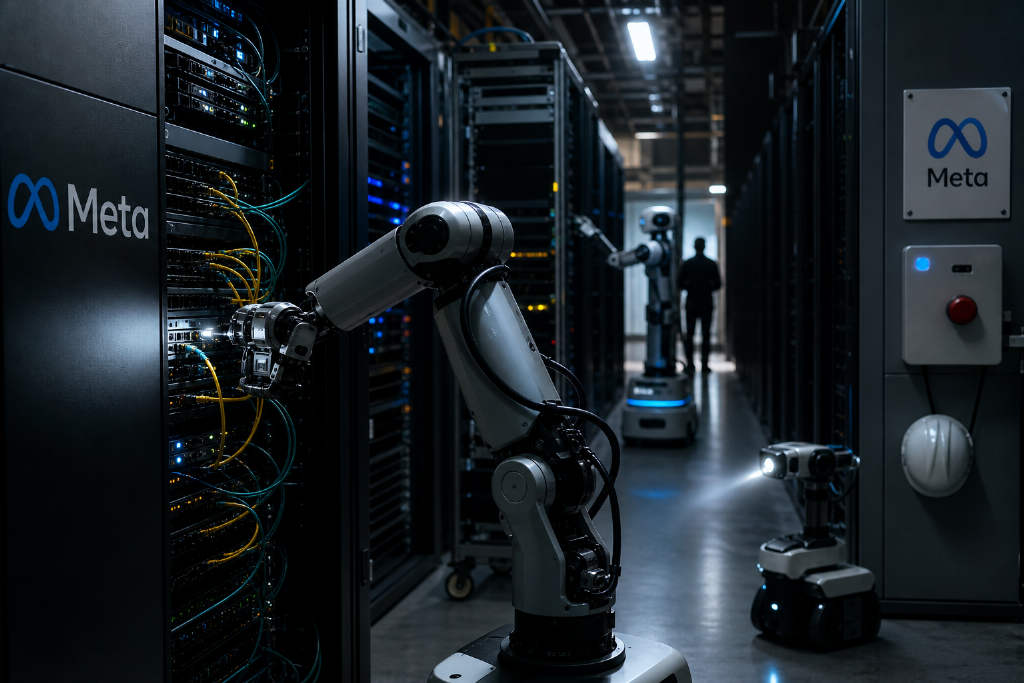
Meta is testing robots to maintain the data centers that power its artificial intelligence systems, including machines that can replace networking cables, restart servers, inspect equipment, and move server racks.
According to a Friday report by WIRED, Meta is evaluating robots from San Francisco-based Watney Robotics, Quebec-based Kinova, and Zurich-based ABB. The report said the systems could reduce labor costs as Meta expands its AI infrastructure, and could also affect staffing levels.
One unnamed employee estimated that a cable-swapping robot, if successful, could replace as much as 80% of the work performed in certain roles. The report made clear that this was the worker’s estimate, not a projection from Meta, and that the machine still cannot match a human’s speed.
Robots are being tested inside server rooms
Meta is using the robots in trials for several data center tasks, including moving server racks, inspecting equipment, replacing cables, and restarting servers. Even so, the machines still need human supervision. They also struggle with obstacles, battery life, visual inspections, and dense cabling.
Nvidia and Alibaba are also building systems intended to improve robot training. In June, Alibaba introduced its Qwen-Robot Suite, with models for navigation, object handling, and physical simulation. Nvidia researchers, meanwhile, introduced AI agents that train robot fleets.
Limited real-world data remains a barrier to bringing robots into warehouse and industrial settings at scale. Wang Xiaogang, chairman of ACE Robotics, said embodied AI—the type of AI that allows machines to perceive and act in physical environments—could have a 「ChatGPT moment」 by the end of 2027.
Robot testing is also spreading beyond data centers. Bedrock Robotics has deployed autonomous construction equipment, while Mercedes-Benz has tested humanoid robots for repetitive factory work. Their developers point to labor shortages and worker safety, while critics warn that automation could eliminate jobs.
AI expansion raises questions about future jobs
Meta’s robotics effort is adding to concern that the data centers built for AI could end up employing fewer people. Workers told WIRED that automation may reduce demand for experienced technicians and shift some remaining tasks to lower-paid employees following AI-generated instructions.
A Meta spokesperson said the company continues to hire and train workers during a shortage of skilled labor.
According to the report, the spokesperson said: 「America is in the middle of its biggest infrastructure boom since World War II, and there’s a major shortage of skilled workers to fill the roles; we need more workers, not fewer.」
That concern clashes with the industry’s case for automation. Nvidia CEO Jensen Huang has described data centers as 「AI factories」 run by people, software agents, and robots. Huang and robotics developers argue that machines can help fill labor shortages and take on repetitive or dangerous work.
On Wednesday, Microsoft co-founder Bill Gates proposed taxing robots and AI tokens, arguing that current tax rules can make machines cheaper than employees. Meta’s robots still require human oversight and people for difficult repairs, but their development could help decide whether the company’s growing data center footprint creates jobs or replaces them.
Meta did not immediately respond to Decrypt’s request for comment.