
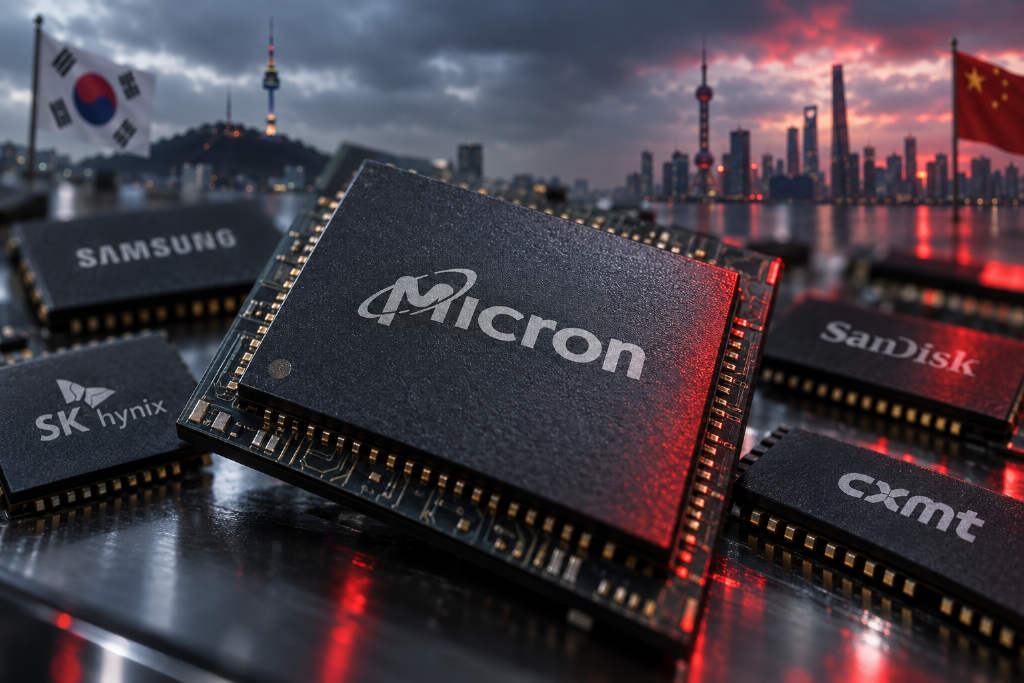
Storage stocks were hit by a concentrated selloff, with Micron closing down 3.88% on Monday and Sandisk falling 5.97%. According to the source article, both bellwether names have declined in six of the past seven trading sessions. Micron is now down nearly 20% from its June high, leaving the stock close to technical bear-market territory.
The article ties the move to three overlapping pressures: a catch-up decline in South Korea after a holiday, the early end of what it describes as the largest buyback programs in Korean market history at Samsung Electronics and SK Hynix, and a weekend announcement from ChangXin Memory Technologies, or CXMT, in Shanghai on progress in its 4F² next-generation DRAM architecture and a plan to launch a server memory product by year-end. Goldman Sachs EMEA trading head Rich Privorotsky summed up the setup by saying storage remains "the epicenter," while pointing to the market’s main concern: even with very strong recent fundamentals, worries about peak earnings are capping valuations.
The article frames the current setup as a paradox. Storage fundamentals have rarely looked stronger, yet investors are already focused on 2027 and 2028, when expanding Chinese memory capacity and new Korean wafer fabs could alter the supply-demand balance. Jon Withaar of Pictet said storage stocks "have become value stocks, cheap on current earnings," but added that "retail and fast-money hedge funds are chasing growth, not value."
South Korea’s delayed drop and the loss of buyback support
South Korean equities sold off sharply on Monday. The KOSPI fell 3.65% to 6384.2, ending the session close to its 200-day moving-average support at 6376. The more tech-heavy KOSDAQ dropped 4.8%, while the KRXSEMI semiconductor index lost 5.2%. SK Hynix and Samsung each fell about 4.5%. Goldman’s Seoul trading desk described the session as a one-way decline from the open.
The immediate reason, according to the article, was that South Korea had to absorb losses already seen in U.S. chip stocks over the previous two trading days while the local market was closed for Hangeul Day. Foreign investors were net sellers for a fifth straight session. Net selling in the technology sector reached $1.3 billion in a single day, including $782 million of selling in SK Hynix and $415 million in Samsung. Retail investors stepped in on the other side, buying a net $710 million of Samsung shares, though Goldman said the scale of retail net buying has been trending lower.
A deeper issue was the disappearance of buyback support. The article says previously announced repurchase programs totaling about KRW 55 trillion, or roughly $40 billion, at Samsung and SK Hynix had ended several weeks early. It adds that Samsung’s buyback effectively stopped on Oct. 6. In the three trading days after the buybacks ended, the KOSPI fell about 8% in total. The index is now down about 30% from its June 22 record high, while SK Hynix has fallen 45%.
The article says some analysts view South Korea as an early signal for the memory cycle: the market led on the way up and may again be leading on the way down.
CXMT’s 4F² progress raises longer-term supply concerns
Weekend news from Shanghai became another key catalyst for the selloff. Citing Shanghai Securities News, the article says that at the fourth Integrated Chip and Chiplet Conference held on Oct. 9 and 10, CXMT President Cao Kanyu said the company had made key progress in 4F² architecture development. He also said CXMT expects to launch a next-generation DDR5 RDIMM product by year-end, combining 4F² architecture with advanced technologies including hybrid bonding, and targeting the server memory market directly.
The significance of 4F² lies in density. The article explains that the mainstream DRAM structure today is 6F², meaning each memory cell occupies an area equal to six times the square of the minimum feature size. Moving to 4F² cuts cell area by about one-third and, in theory, can lift memory density by about 50% on the same wafer area and process node. CXMT’s core innovation is a self-developed VSG, or Vertical Surrounded Gate, transistor. The structure is designed to strengthen gate control through a vertically surrounded channel, address leakage and short-channel effects, and reduce area through a vertical transistor layout.
In the article’s description, the shift from 6F² to 4F² is not a routine shrink. It is a fundamental change in transistor channel orientation, from horizontal to vertical, and requires a new process flow rather than the design and manufacturing system used in the 6F² era. CXMT has also decoupled DRAM and CMOS processes and uses wafer-level hybrid bonding for high-speed interconnects, which the article describes as a key turning point from two-dimensional scaling toward three-dimensional DRAM integration.
The article says CXMT began 4F² research and patent planning from the time it was founded, with more than 300 disclosed patent families, a figure it says leads peers in China and overseas. The company published a paper related to 4F² architecture in 2021 and continued to disclose research progress in 2023 and 2025. In 2025, it also presented a paper at IEDM describing experimental validation of DRAM and CMOS wafer-level bonding on a 12-inch wafer platform.
That timeline creates direct pressure for Samsung and SK Hynix. The article says SK Hynix did not publish its 4F² roadmap until 2025. Samsung, according to Korean media outlet The Elec as cited in the article, is targeting mass production of sub-10nm DRAM based on the architecture in 2028. If CXMT delivers its 4F² DDR5 RDIMM product on schedule by year-end, the article says it would put the company roughly two years ahead of the two Korean giants at the cell-architecture level.
Strong fundamentals remain, but the market is pricing the peak
The article argues that memory fundamentals are still strong, and that is exactly the problem for investors: the strong numbers are already in the price, so the market has started discounting longer-dated risks.
It points to third-quarter results from Nanya Technology in Taiwan, which Goldman’s Taipei trading desk called "another astonishing quarter." Revenue reached TWD 133.6 billion, up 62% quarter on quarter and 612% year on year. Gross margin was 85.7%, up 6.2 percentage points from the prior quarter. Operating margin reached 80%. Blended average selling prices rose more than 60% from the previous quarter, with more than half of that increase coming from contract resets tied to long-term agreements expiring in 2025. Management said double-digit contract price increases in 2027 remain possible and that gross margin above 80% is achievable.
Even so, Goldman’s Taipei desk said bluntly that there is not enough near-term catalyst to drive another leg of re-rating. The article notes that Samsung’s third-quarter operating profit rose by nearly nine times. Instead of restarting the memory rally, that result was followed by selling, which it says shows how far expectations had already moved.
Goldman Prime Book data cited in the article shows that the U.S. information technology sector swung from being the most net-bought sector in four of the previous five weeks to the most net-sold sector last week, with the fastest pace of selling in seven weeks. Technology hardware, storage and peripherals, and semiconductors were the areas with the heaviest selling.
In that reading, the pressure on storage stocks is not coming from a deterioration in fundamentals. It is coming from the market pricing the top of the cycle ahead of time.
Attention shifts to the 2028 supply-demand picture
The market narrative has shifted from how strong near-term fundamentals are to what supply and demand will look like in 2028. Goldman’s Korea research team listed six key questions for Samsung’s Oct. 29 earnings call, and the first one was whether the company would, like Micron, explicitly say memory supply will tighten in 2028.
The article also cites Acer CEO Jason Chen, who previously said that "the supply shortage issue has completely disappeared" and expected memory prices to peak around the middle of 2027. Acer, HP and ASUS have already adopted CXMT chips in their PC products, according to the article. It also says ASML is reportedly raising spare-parts prices for Korean customers by about 10%, a move Samsung and SK Hynix have accepted and that will take effect in January 2027.
Several events this week could shape the next move in chip stocks. TSMC is due to report on Thursday, ASML will release earnings on Wednesday, and SEMICON West is also set to take place. The article says those events may offer fresh directional signals for the semiconductor sector.