


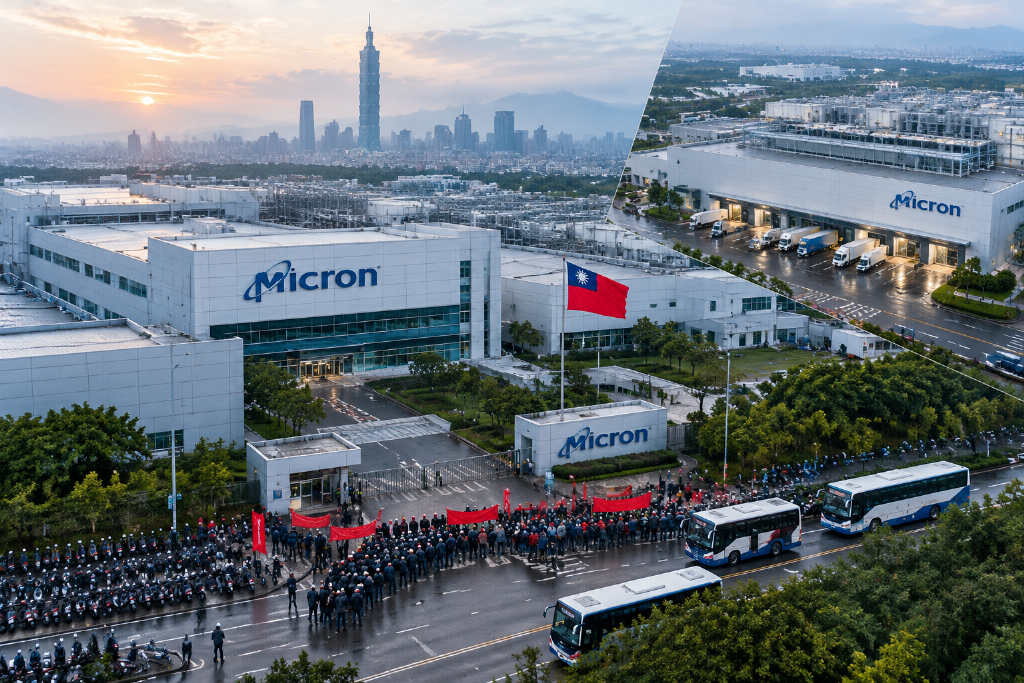
Micron’s labor negotiations in Taiwan have produced sharply different outcomes at its two local plants. On Oct. 21, Micron Taiwan’s Taoyuan union said union officials would begin a 24-hour strike at 9 a.m. on Oct. 22 after talks with the company failed to reach consensus. At the Taichung plant, by contrast, labor and management said they had reached agreement on multiple issues and signed a deal, prompting the withdrawal of mediation that had been scheduled for Oct. 22.
Taoyuan union says four demands still lack concrete response
According to Economic Daily News, Micron Taiwan’s Taoyuan union said late on Oct. 21 that it had negotiated with the company over four key demands, but management had not provided concrete numerical responses. The union highlighted two points in particular: the ratio and amount of this year’s one-time bonus, and a future profit-sharing system.
The union said it had not, so far, received any specific proposal from management addressing its demands.
Union says strike is meant to pressure management, not end talks
On the planned action for Oct. 22, the Taoyuan union said the main goal was to push management to present a profit-sharing system and proposal that employees across Micron Taiwan could accept.
The union also said the strike was a last-resort pressure tactic rather than an attempt to terminate negotiations. If members find the company’s proposal acceptable, it said, the union is willing to sign an agreement with management so the labor dispute can be resolved as soon as possible.
The report said earlier talks between the Taoyuan union and the company had already broken down in September, and members approved taking action in early October.
Taichung plant signs agreement and withdraws mediation
At the Taichung plant, Micron Taichung’s union and the company said in a joint statement that they had reached consensus after multiple rounds of in-depth discussion. They said the talks were conducted in good faith, rationally, and with mutual respect, with labor and management continuing to communicate throughout the process.
The specific terms of the agreement were not disclosed. Both sides said they would explain the details separately in the coming days.
The Taichung union thanked management for listening to employee views and taking an active role in negotiations, while Micron acknowledged the efforts of union officials. Both sides said the agreement would help build a stable and trusting labor relationship and support Micron’s long-term development in Taiwan. They also thanked Taiwan’s Ministry of Labor and the Central Taiwan Science Park Bureau for their assistance.
Micron added that it hopes other labor issues still under discussion can also be resolved through rational dialogue and the greatest possible sincerity, with both sides seeking solutions they can accept.
Impact of Taoyuan strike remains uncertain as Taichung deal lowers HBM risk
The report said Taiwan is an important production base for Micron’s DRAM and high-bandwidth memory, or HBM, with about 15,000 employees across facilities in Taoyuan and Taichung. The company continues to invest in advanced packaging and testing there. Taichung Fab 4 supports HBM3E capacity expansion and integrates wafer manufacturing with backend packaging and testing to meet memory demand from AI servers.
As for the possible effect of the strike, the report said semiconductor plants do require round-the-clock operation, but a one-day warning strike would not necessarily lead to a full production halt if management has enough time and staffing to prepare. Whether wafers or equipment could be damaged remains unknown. The actual impact will depend on how many workers join the strike, which processes are affected, and Micron’s contingency plans.
Market research institutions cited in the report said the Taoyuan plant mainly produces DRAM. If equipment maintenance and process monitoring are affected, yield and operational stability could come under pressure. The Taichung plant, where core HBM capacity is located, has already reached an agreement with the company, leaving related risk relatively lower.