
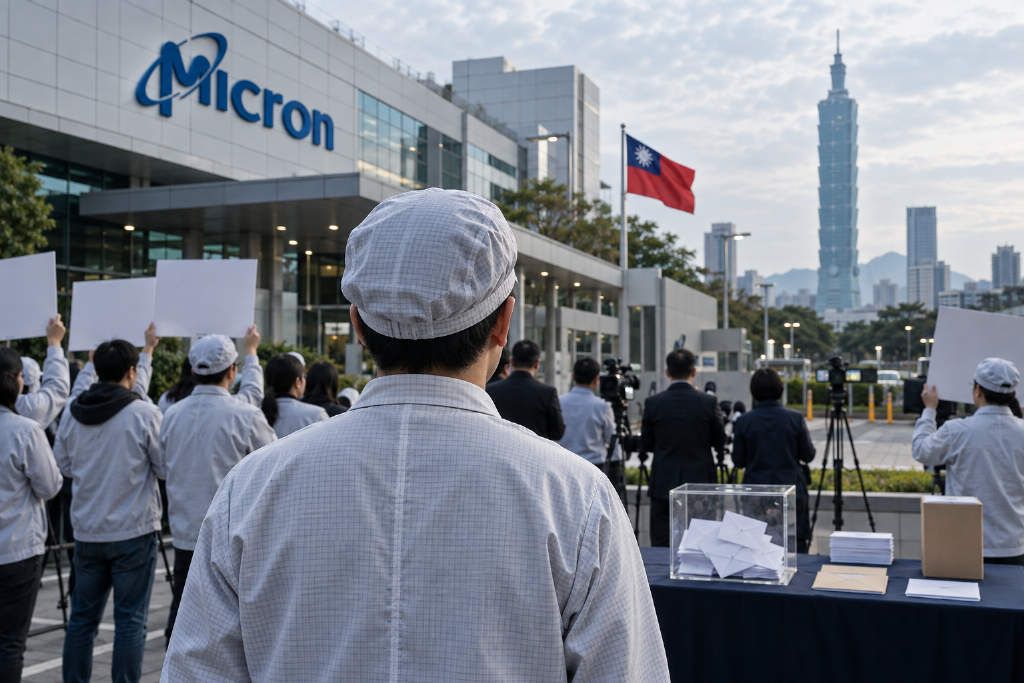
Micron’s labor fight in Taiwan got sharper on Sept. 15. That day, the Micron Taiwan Union and the Taoyuan Confederation of Trade Unions said they would start strike-vote procedures if management fails to bring a formal plan to allocate 15% of operating profit at the mediation meetings on Sept. 18 and Sept. 21.
Union challenges Micron’s “up to 68 months” bonus claim
Speaking at a press conference at the American Chamber of Commerce, the union argued that Micron’s public pitch around a bonus package worth up to 68 months of pay was misleading. The union said that figure came from using a base monthly salary of roughly NT$30,000 for entry-level workers, then stacking annual salary, a NT$1 million cash payment, and stock awards that might not be realized until the next several years.
Here is how the union put it at the press conference: “The news says employees can receive as much as 68 months of pay, but that wording could make the public or workers think every employee can get 68 months.”
Sept. 18 and Sept. 21 mediation sessions are the immediate deadline
The union’s demand is simple. Micron has to present an institutionalized 15% operating-profit sharing plan at the two mediation meetings set for Sept. 18 and Sept. 21. If that does not happen, the union said it will take the next step and begin strike-vote procedures.
Micron unveiled its FY26 compensation plan on Sept. 11. According to the report, the package includes:
- a NT$1 million cash “thank-you” payment for employees who joined on or before Aug. 29, 2025;
- estimated total compensation for Taiwan production-line employees equal to about 35 to 68 months of salary;
- a higher starting threshold for cash compensation of NT$1.7 million;
- average cash compensation of NT$2.9 million for entry-level engineers;
- average total compensation of up to NT$3.4 million after stock awards are added;
- 100% coverage for stock awards in annual performance-based pay adjustments.
The union is not mainly arguing about whether the package is big enough. That is not the heart of it. The union says the real issue is the way the compensation is built and whether it holds up over time. In its view, a one-time cash payment and stock awards tied to multiyear vesting are no substitute for the long-term profit-sharing protection workers want.
Earlier support for strike intent does not mean an immediate strike
The report said procedure is still holding the dispute in place. Votes on strike intent were finished in late August at Micron’s Taoyuan and Taichung sites, and about 80% of more than 10,000 employees backed the move. But that result is only an opening step.
If the upcoming mediation meetings go nowhere, an actual strike would still need a direct secret-ballot vote by all union members, and more than half would have to approve it before a strike could be officially declared. So, yes, the roughly 80% support level shows rank-and-file frustration has climbed to a breaking point. But no, it does not mean a strike would begin right away.
Union says internal communication deepened employee frustration
The union also took aim at the company’s communication style. After Micron rolled out the high-value bonus package, management allegedly tried to ease tensions through internal group messages. The union said those messages were mostly one-way, though, and rarely answered employees’ questions head-on.
According to the report, a new messaging group covering all Taiwan employees was set up over the past two days, then shut down soon after launch because challenges and questions poured in. When the group came back, employee speaking permissions had been restricted.
Micron responded by saying: “We will continue listening to team members’ views and will participate in the mediation process in line with our principle of integrity.”
The report also said the first round of mediation had already fallen apart. And that, too, was cited as the reason the union decided to argue its case publicly at the American Chamber of Commerce.
Taiwan plants hold a key place in Micron’s output structure
The union’s willingness to push harder is tied to Taiwan’s place in Micron’s manufacturing network. The report said the company’s two Taiwan sites, in Taoyuan and Taichung, make up as much as 60% to 70% of Micron’s critical memory output worldwide.
That matters. A lot. The dispute is happening at a time when AI server demand is driving HBM and DRAM shortages. According to the report, any amount of work stoppage could directly hit Micron’s shipment schedules and customer delivery timelines, and that could then show up in the company’s share price and in broader supply-chain confidence.
For that reason, people are watching this labor-management negotiation in Taiwan not just for what it does to employee compensation, but for what it could mean for the broader AI memory supply chain. The report flagged three near-term points to watch: an employee gathering on the evening of Sept. 17, then the two mediation sessions on Sept. 18 and Sept. 21.